

What Is Bookwiz and How Does It Work?
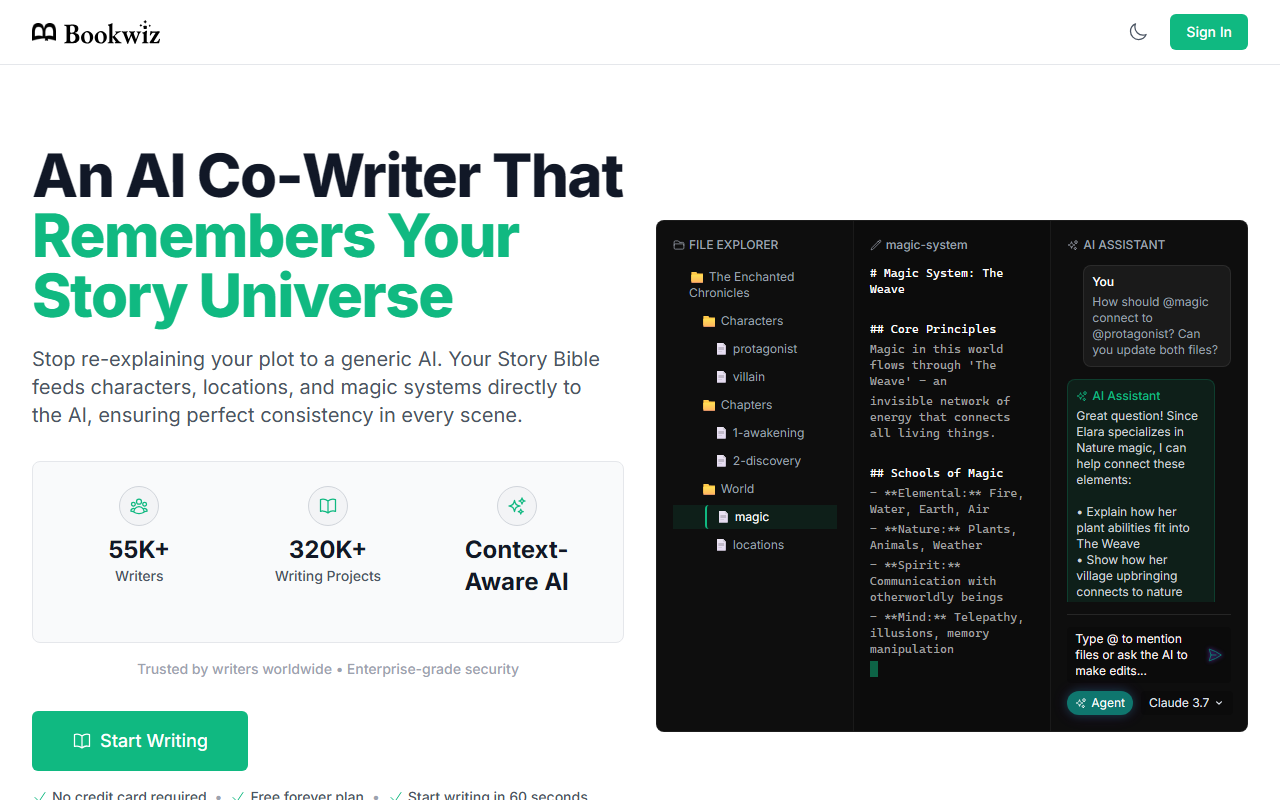
Upon visiting the Bookwiz homepage, I found a clear value proposition: an AI co-writer that remembers your story universe. The platform solves a pain point I've experienced with generic AI writers like ChatGPT or Sudowrite—having to re-explain plot details, character traits, and world rules every time I start a new session. Bookwiz addresses this with a Story Bible feature that stores characters, locations, magic systems, and plot threads. The AI, powered by Claude 3.7 (as indicated in the interface), references this bible automatically in every response. The dashboard displays a file explorer sidebar where you can organize your project into folders like Characters, Chapters, and World. I observed a sample project titled The Enchanted Chronicles with a protagonist file named Elara Nightwhisper, complete with age, background, and abilities. When I asked the AI assistant to help expand her backstory, it correctly referenced the file and offered to edit it directly—demonstrating genuine context awareness.
Hands-On Experience: Story Bible and Context Awareness
I tested the free tier by signing up with no credit card required. After about 60 seconds, I was inside a project workspace. The tool provides a split interface: on the left, the file explorer; on the right, a chat window with the AI co-writer. You can mention a file using the @ symbol, and the AI reads its content before responding. For instance, I typed @protagonist and asked for suggestions on Elara's backstory; the AI remembered she was a nature mage from Moonhaven and offered focused expansions. This is a huge improvement over generic AI that treats each chat as a blank slate. The platform also includes version control and history, allowing authors to track changes and revert if needed. I noticed the AI assistant can make edits directly to files, not just suggest text. For world-building, you can create separate files for magic systems, locations, and timelines. Bookwiz claims to help authors finish novels three times faster, and based on my short trial, the reduced friction from re-explaining context is genuinely time-saving.
Pricing, Limitations, and Who Should Use It
Bookwiz offers a free forever plan that includes up to three books, 3 Pro AI prompts, 15 Base AI prompts, and 100MB cloud storage. Pricing for paid tiers is not publicly listed on the website, which is a limitation for budget-conscious authors. I dislike hidden pricing, and you’ll need to sign up or check elsewhere for upgrades. Another limitation is the reliance on a single AI model (Claude 3.7 at the time of testing); while it works well for narrative tasks, you don’t get a choice of model. The tool is best suited for fantasy, sci-fi, and series authors who manage complex story universes. Mystery and thriller writers will appreciate the clue-tracking features, but the Story Bible approach may feel over-engineered for simple short stories or non-fiction. Alternatives like Sudowrite offer more flexible prose generation but lack persistent context. Bookwiz’s strength is its laser focus on consistency and world-building coherence. If you’re a serious novelist tired of AI forgetting your plot, this tool is worth trying. Visit Bookwiz at https://bookwiz.io/ to explore it yourself.













Comments