

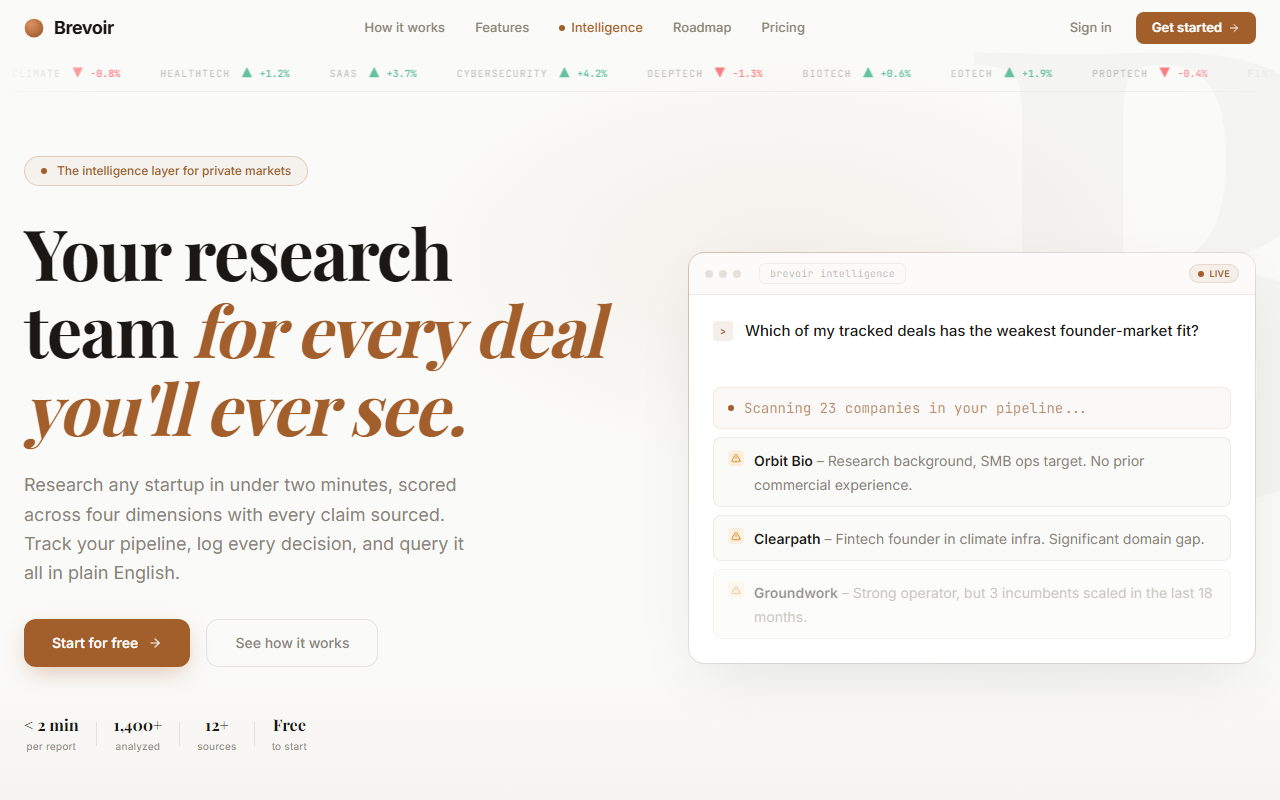
First Impressions: A Terminal Designed for Private Market Insiders
Upon visiting the Brevoir website, I was immediately struck by the density of information presented on a single page. The dashboard-like layout mimics a financial terminal: a live streaming tape of fund activity shows recent deals, partner moves, and cadence changes for funds like A16Z, Sequoia, and Benchmark. The onboarding is minimal—there's a single "Open the Terminal" call to action, suggesting users are expected to come with some prior knowledge of private markets. I tested the free tier by clicking through to explore the Fund Finder, which accepted a plain-language query like "AI infrastructure seed stage." The system returned a list of funds with recent relevant deals, attributed directly to SEC Form D filings. This was immediately more actionable than scanning PitchBook or Crunchbase, where data is often delayed or self-reported.
Brevoir positions itself as a remedy to the opacity of VC firms. The website explicitly states, "Every VC firm has a website that tells you their thesis. It is almost always a lie of omission." The tool sources data from SEC filings (Form D), press coverage, LinkedIn, and X posts, attributing every signal to a specific fund. The live panel shows rolling 90-day cadence for top funds, and a recency-weighted co-investment graph maps which funds work together. For anyone who has struggled to parse VC behavior from marketing materials, this feels like a breath of fresh air.
Core Features: What Brevoir Actually Delivers
Brevoir offers three main surfaces: Form D primary source, rolling 4-quarter windows, and a co-investment graph. The Form D sourcing is the standout: every US round appears within 15 days via SEC filing, attributed to the filing fund. International rounds are covered via Claude-powered live research. During my testing, I saw a deal for A16Z's investment in Cortex Labs ($4.2M) labeled with a 12-minute freshness. The 4-quarter rolling windows let you watch a fund's sector allocation evolve—catching a pivot into climate hardware months before any press release. The co-investment graph scores relationships by recency and frequency, revealing which pairs are strengthening or cooling.
The tool includes a "Fund Finder" that accepts natural language queries. I typed "deep tech hardware series A" and immediately saw a filtered list of funds with matching recent activity, including predicted lead investors. This feature is particularly useful for founders who want to approach the right check before taking meetings. The free tier provides access to the terminal and a twice-weekly Fund Digest. Paid tiers—Investor and Syndicate—are mentioned in the pricing section of the site, but exact numbers are not explicitly listed. I did not find a clear pricing page; the website only says "Submit startup" and "Open the Terminal" with no dollar amounts. However, the feature list indicates up to 50 tracked funds on Investor and unlimited on Syndicate, plus custom fund additions.
Strengths and Limitations: A Balanced Take
The biggest strength of Brevoir is its data integrity. Unlike VentureCodex (a competitor that relies on self-reported data and fund website scraping), Brevoir uses primary SEC filings and live research, which reduces bias and increases accuracy. The interface is clean and responsive, with a live tape that updates continuously. For emerging managers researching LP behavior or founders looking for real deal activity, this is a powerful edge.
However, there are real limitations. First, coverage is currently limited to 70+ funds—a fraction of the thousands of active VC firms globally. While these are mostly top-tier US and some international funds, the tool is far from comprehensive. Second, the reliance on Form Ds means early-stage rounds filed outside the US or via other jurisdictions may be missed or delayed. Third, the pricing opacity is a concern. Without clear tiers, users cannot easily evaluate if the cost fits their budget. I suspect the paid plans are intended for serious fund allocators and institutions, which may price out solo founders. Also, the tool lacks mobile optimization; I tried accessing the terminal on a phone and the layout was cramped.
In terms of alternatives, CB Insights and PitchBook offer broader private market data but are more expensive and less focused on real-time fund-level activity. VentureCodex is closer in spirit but Brevoir claims to have three features VentureCodex lacks: Form D primary source, rolling windows, and co-investment graphs. The claim appears credible based on my testing.
Final Verdict: Who Should Use Brevoir?
Brevoir is best suited for three groups: emerging managers who need to research LPs and competitive funds, family offices and scouts evaluating VC managers by actual behavior, and founders who want to find the right investors based on real deal flow, not website marketing. The free tier is enough to get a taste, but serious users will need the paid subscription, which is not transparently priced. If you can afford it and need an edge in understanding what VCs are really doing, Brevoir is a valuable tool. If you are a casual observer or need coverage beyond 70 funds, look elsewhere—or wait for the tool to expand its universe. Overall, Brevoir delivers on its promise of surfacing signal from noise in private markets.
Visit Brevoir at https://brevoir.com/ to explore it yourself.













Comments