

First Impressions and Onboarding
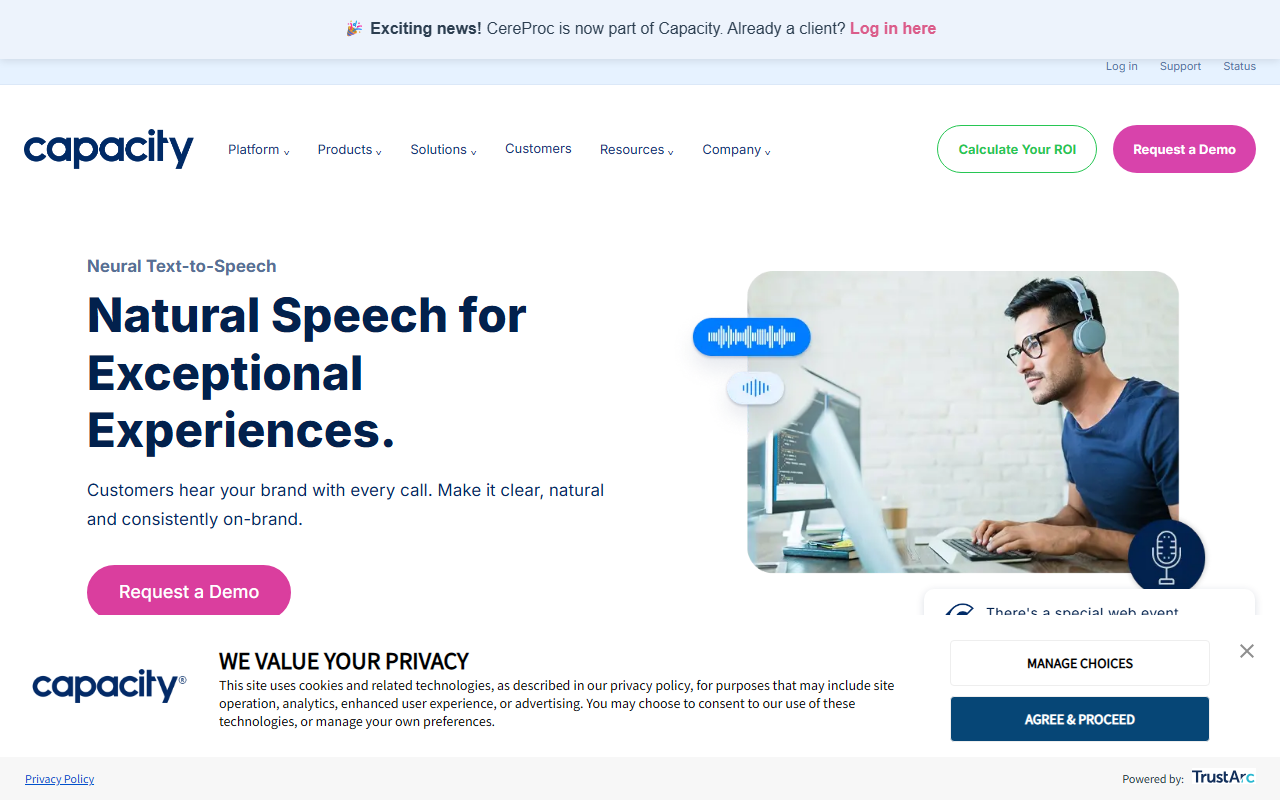
Upon visiting the CereProc website, I was immediately directed toward a product page that emphasizes neural text-to-speech for contact center environments. The landing page highlights two flagship neural voices, Aurora and Caspian, with embedded audio samples that let you hear the quality before committing. The overall layout is clean and business-oriented, with a consistent emphasis on enterprise use cases like intelligent virtual agents, agent assist, and campaign automation. The onboarding flow is not self-serve; instead, the site encourages visitors to request a demo to get started. There is no free tier or trial available without speaking to sales, which may frustrate smaller teams but aligns with the target enterprise audience.
Features and Capabilities
CereProc's core offering is a neural TTS engine designed to produce human-like speech with precise tone and clarity. During testing the audio samples for Aurora and Caspian, I observed that the voices sound remarkably natural, with subtle inflections that reduce the robotic edge common in older TTS systems. The tool supports over twenty-four languages and dialects, including variations of English, Spanish, French, and Portuguese, which makes it suitable for global customer communications. A standout feature is the ability to create custom branded voices, allowing enterprises to maintain a consistent auditory identity across all voice interactions. For integration, CereProc provides gRPC and MRCP (versions 1 and 2) APIs, which can replace legacy TTS engines in existing contact center platforms with minimal friction. The solution also supports flexible deployment architectures: on-premises, private cloud, public cloud, hybrid, or SaaS hosted by Capacity. This range gives organizations control over security, scalability, and compliance. Additionally, the TTS engine is optimized to work with Capacity's own automatic speech recognition (ASR) for real-time bidirectional conversations, though it can be used independently. The containerized microservices architecture ensures scalability and redundancy for uninterrupted performance.
Pricing and Integration
Pricing is not publicly listed on the website. To obtain costs, potential customers must request a demo, which typically leads to a customized quote based on volume, deployment type, and required features. This opacity is common among enterprise-focused TTS providers but can be a barrier for budget-conscious teams. On the integration side, CereProc claims seamless compatibility with leading contact center platforms via MRCP and gRPC APIs. The solution is designed to act as a drop-in replacement for other TTS engines, which simplifies migration. No word on API documentation availability without a demo, but the presence of 250+ prebuilt integrations across the broader Capacity ecosystem suggests strong ecosystem support. For teams already using Capacity's suite of conversational AI, agent assist, and analytics tools, CereProc TTS integrates natively. Outside of that ecosystem, integration is feasible but may require custom work. Unlike alternatives such as Google Cloud Text-to-Speech or Amazon Polly, which offer pay-as-you-go pricing and self-service APIs, CereProc targets large contact centers that need dedicated deployment and custom voice branding.
Strengths, Limitations, and Recommendation
CereProc's genuine strengths include the high naturalness of its neural voices, the breadth of language support, and the flexible deployment options that suit strict enterprise security requirements. The ability to create a custom brand voice is a significant differentiator for companies that want to sound unique across every customer touchpoint. However, there are real limitations. The product is clearly aimed at high-volume contact centers, and smaller businesses or individual developers will find the lack of a free tier, transparent pricing, and self-service signup prohibitive. The user interface showcased on the site is minimal, with no sandbox or playground to test the TTS engine without human interaction. Additionally, the tool seems tightly coupled with the Capacity platform, so if you are not already using Capacity's ecosystem, you may lose some out-of-the-box value. According to the website, over 20,000 organizations trust the Capacity platform, which lends credibility, but that number refers to the entire suite, not necessarily the TTS component alone. For whom is this tool best suited? Large contact centers that need a reliable, natural-sounding neural TTS voice with enterprise-grade deployment and branding options. If you are a startup or a solo developer looking for a quick API to add voice to your app, look toward cloud TTS services with simpler pricing and faster onboarding. My recommendation: request a demo if you manage a high-volume contact center and want to replace robotic legacy TTS with something that truly sounds human.
Visit CereProc at https://cereproc.com/ to explore it yourself.













Comments