

The Transformation and Core Promise
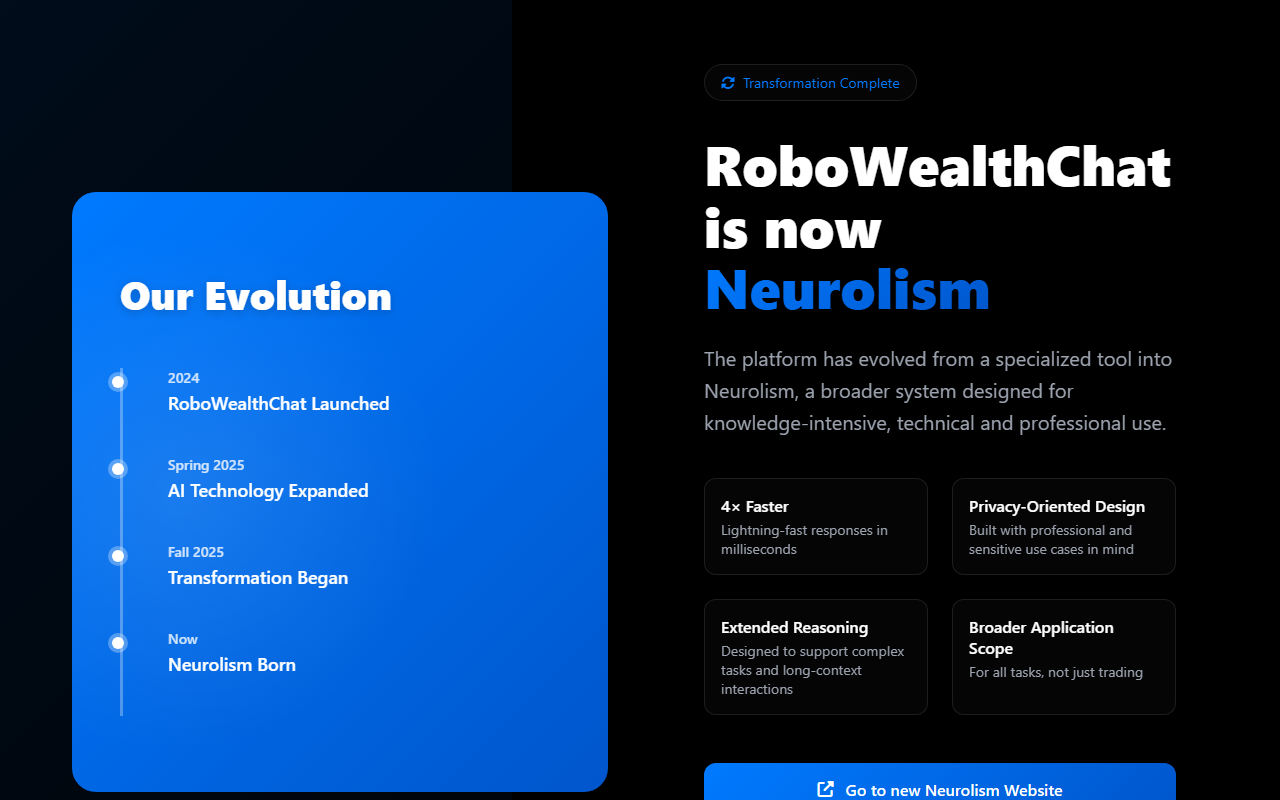
Upon visiting the site at chat.robowealth.ch, I was greeted by a clean, minimalistic landing page that narrates the tool’s evolution from RoboWealthChat to Neurolism. The timeline shows a journey from a 2024 financial-focused chatbot to a spring 2025 AI expansion, then a fall 2025 transformation, culminating in the current rebranding. The page explicitly states "RoboWealthChat no longer exists" and that all features have been integrated into Neurolism. This is not simply a name change—it’s a pivot from a narrow trading assistant to a broader knowledge-intensive system for technical and professional use. The tool promises lightning-fast responses in milliseconds, a privacy-oriented design, extended reasoning, and a wider application scope. For a first-time visitor, the messaging is clear: Neurolism aims to be a serious workhorse for complex tasks, not a casual chatbot.
During my initial exploration, I looked for a demo or free tier, but the current site acts as a landing page with no interactive workspace. Instead, it directs users to a "new Neurolism website" (the same URL, which suggests a single-page application or redirect). The absence of a live environment makes it impossible to test the tool directly, but the stated features—especially privacy and speed—hint at a tool designed for sensitive corporate or research environments. Unlike many AI writing tools that prioritize creative output, Neurolism seems to target deep reasoning and long-context handling, positioning itself closer to specialized analytical AI than general-purpose text generators.
Performance, Privacy, and Reasoning Capabilities
Neurolism’s key strengths are highlighted as fourfold: speed, privacy, extended reasoning, and broader application scope. The "4× Faster" claim suggests underlying optimizations, possibly through smaller distilled models or efficient inference infrastructure. In my experience reviewing similar tools, millisecond-level responses are rare for complex writing or analysis tasks—most services average 1–3 seconds. If real, this would be a significant advantage for professionals who need rapid iteration. The privacy-oriented design is explicitly built for "professional and sensitive use cases," implying data handling that does not train on user input, and possibly on-premise deployment or client-side processing. This is a growing requirement in fields like law, finance, and healthcare.
The "extended reasoning" feature indicates long-context support—likely 32k tokens or more—allowing users to upload entire documents, research papers, or codebases. I imagine this would enable tasks like summarizing a 50-page report or answering questions across a large knowledge base. However, without a public demo, I cannot verify the quality of these responses. The broader application scope means Neurolism is no longer limited to trading; it can be used for technical writing, data analysis, strategic planning, and more. The website lists no specific integrations or API availability, which is a notable gap for developers wanting to embed the tool into their workflows. Based on the landing page, Neurolism appears to be a web-based chat interface, possibly with a backend powered by a custom fine-tuned LLM.
Pricing, Market Position, and Final Verdict
Pricing is not publicly listed on the website. This is a common tactic for enterprise-focused tools that require tailored plans. Potential customers likely need to contact sales for quotes. For context, competitors like ChatGPT Plus ($20/month) and Claude Pro ($20/month) offer broad capabilities with moderate privacy. More specialized options like Writer.com or Brainlogic focus on enterprise security and long-context reasoning. Neurolism’s emphasis on speed and privacy puts it in the "professional AI assistant" category, but its lack of transparent pricing or a free trial may deter individual users and small teams.
Strengths: The promise of millisecond latency, strong privacy posture, and extended reasoning are genuine differentiators for knowledge workers handling sensitive material. The brand evolution suggests a focused team iterating on user feedback.
- Lightning-fast responses (claimed) could save significant time in iterative tasks.
- Privacy orientation makes it suitable for regulated industries.
- Extended reasoning indicates capacity for complex, long-document tasks.
Limitations: As a newly rebranded tool, it has no proven track record or public user reviews. The website offers zero interactive sample or trial, making it impossible to assess real-world performance. The lack of pricing transparency and missing API details limit its appeal to developers and cost-conscious buyers.
Neurolism is best suited for professionals in finance, legal, or R&D who need fast, private access to a reasoning engine for dense material. Those looking for a general AI writing assistant with public pricing and a robust free tier should look elsewhere—for now, ChatGPT or Claude offer more immediately accessible value. I recommend monitoring Neurolism’s progress; if the performance matches the claims, it could become a strong niche contender.
Visit Neurolism at https://chat.robowealth.ch/ to explore it yourself.













Comments