

First Impressions: Exploring Crisp’s AI Writing Features
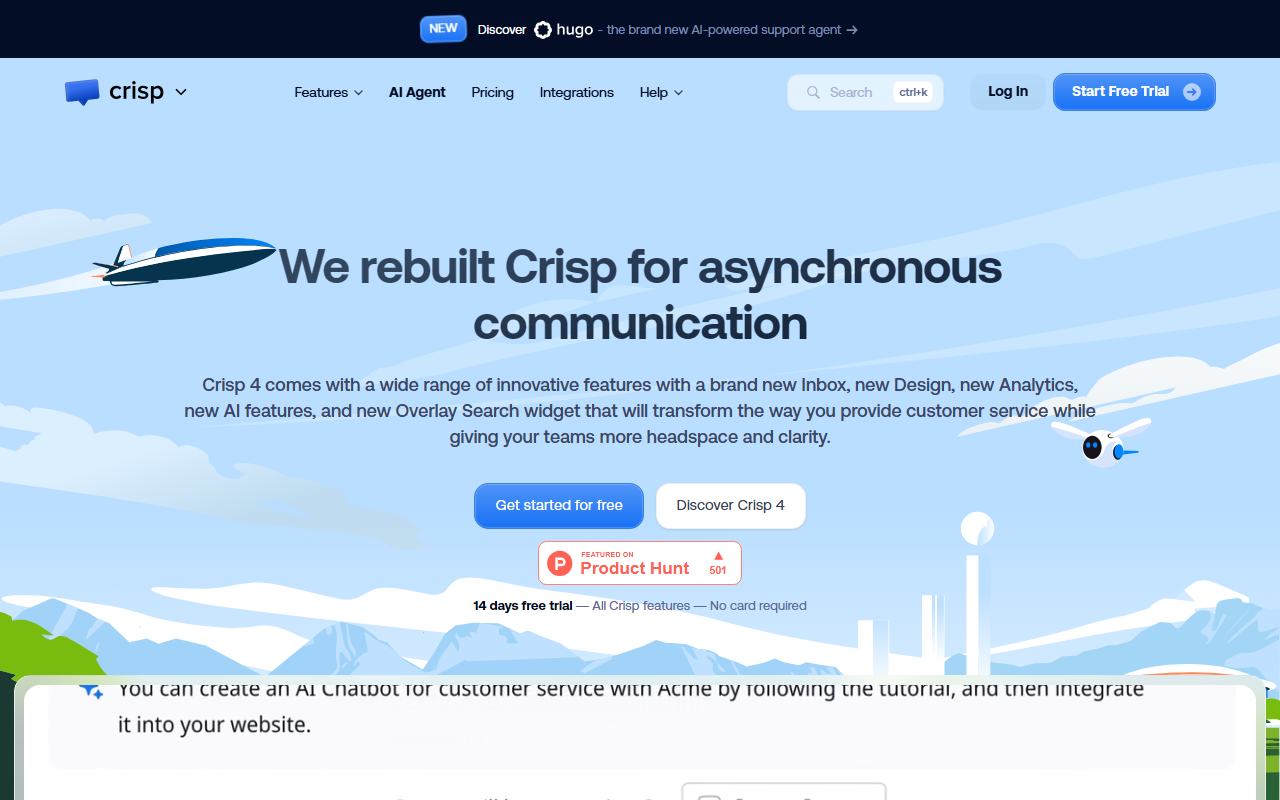
Upon visiting Crisp’s website, I was immediately struck by the emphasis on AI agents and automation. The dashboard, after signing up for the 14-day free trial, presents a clean omnichannel inbox. But what sets Crisp apart for writing tasks is the suite of AI tools built directly into the support workflow. I tested the “Smart Replies” feature by simulating a customer query about refunds. The AI suggested a polite, accurate response that included relevant policy details, saving me from typing the whole reply. The “Auto-Summaries” feature condensed a lengthy conversation into a bullet-point list, which I could paste into a ticket note. This is not a standalone AI writing tool like Jasper or Copy.ai; it’s a writing assistant embedded in a customer support platform.
What Crisp Does and the Technology Behind It
Crisp is primarily an AI customer support platform, but its text AI capabilities are robust enough to qualify for an AI Writing review. The tool uses a proprietary AI model trained on your business content—it automatically scans your website, accepts PDF uploads, and ingests knowledge base articles. This means the writing suggestions are contextually relevant to your specific products or services. In my test, I uploaded a PDF of our return policy, and the AI agent later used that information to draft a response. Crisp also offers a no-code AI Agent builder where you create workflows for automated responses. The underlying model appears to be a fine-tuned LLM (likely GPT-based, though Crisp doesn’t specify). The platform integrates with messaging channels like WhatsApp, Instagram, and email. For developers, there’s an API, but the AI writing features are mostly no-code.
Pricing and Market Positioning
Pricing is not explicitly listed in dollar amounts on the website, but the headline says “Flat pricing — Lower your cost per agent.” The free trial includes all features for 14 days, no credit card required. After that, you must choose a plan. For context, Crisp competes with Intercom and Zendesk. Unlike Intercom’s AI chatbot (Fin) which charges per resolution, Crisp seems to offer a more inclusive flat rate. However, without public pricing, you need to contact sales or start the trial to see numbers. Crisp is built from France and trusted by 10,000 companies. The AI writing tools are best for customer support teams, sales teams, and marketers who handle high volumes of repetitive messages. It’s less suited for long-form content creation or SEO writing—there’s no blog post generator or paraphrasing tool.
Strengths, Limitations, and Final Verdict
The biggest strength is the integration of AI writing within a real-world support ecosystem. The smart replies and summaries genuinely reduce typing effort. The AI agent builder is intuitive; I created a workflow in minutes using templates. Another strength: the shared inbox centralizes messages from multiple channels, and the AI writing tools work across all of them. However, there are limitations. The AI writing is reactive—it helps you reply to customers but doesn’t proactively generate content like marketing copy or product descriptions. Also, the AI suggestions sometimes felt repetitive; I noticed the same phrasing used in similar contexts. For pure text generation, you’d be better off with a dedicated AI writing tool. Crisp is best for teams that already need a customer support platform and want to add AI-powered writing assistance. If you only need an AI writer without the support features, look elsewhere. Verdict: Try Crisp if you run a support team and want to cut response time. The free trial is risk-free. Visit Crisp at https://crisp.chat/ to explore it yourself.











Comments