
First Impressions and Onboarding
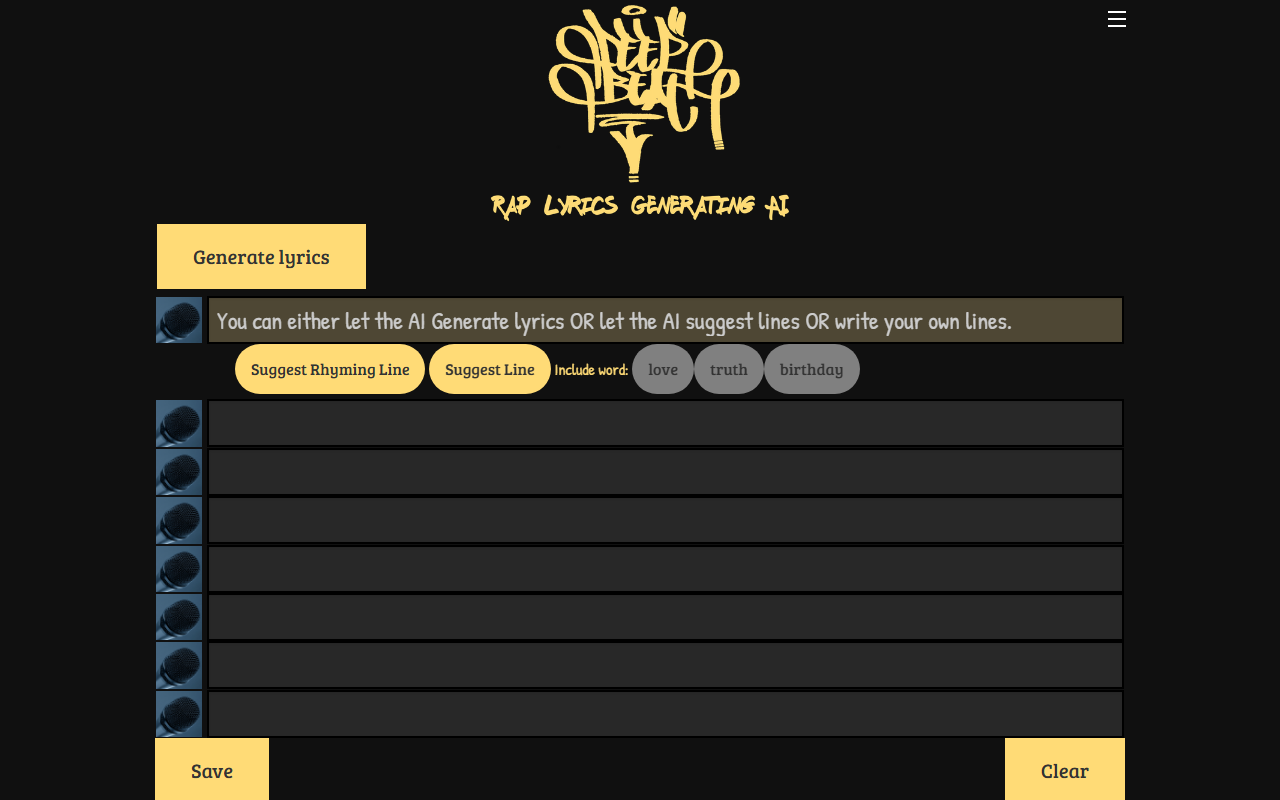
Upon visiting DeepBeat, I was greeted with a clean, minimalist interface. The home screen shows a text area where lyrics are generated, accompanied by configuration options for language (English or Finnish) and keywords. A prominent "Generate lyrics" button sits at the bottom. The layout feels like a stripped-down editor, which is appropriate for its single purpose: rap lyric generation. There is no onboarding tour, but a brief Instructions section is tucked away under the About tab. For a first-time user, the workflow is intuitive—type keywords, hit generate, and see results. However, the tool warns that generating lyrics might take up to 30 seconds, especially on the first request. I experienced this delay firsthand when testing the free tier: after clicking "Generate lyrics" with the keywords "money" and "flow," a loading spinner appeared, and after about 20 seconds, a set of lines popped up.
Features and Workflow: How DeepBeat Works
DeepBeat is built on machine learning techniques described in the research paper "DopeLearning: A Computational Approach to Rap Lyrics Generation." It combines lines from existing rap songs to create new verses, ensuring rhyming and thematic coherence. The core workflow lets you generate entire lyrics at once or build line by line. You can suggest a rhyming line for the current line, or request a fresh line with or without a specific word. Keywords are essential—they must appear in existing rap lyrics, and you can add multiple keywords via the settings menu. I found this both creative and limiting: it ensures relevance to real rap vocabulary, but users cannot invent new phrases. The deep learning feature (disabled by default for speed) promises more sophisticated line selection, though enabling it increased generation time noticeably. The tool also displays the source artist and track for each generated line in the "Song Details" section, adding transparency. Unfortunately, during my testing, I encountered the "No line candidates found" error when I used an unusual keyword like "quantum." The error message kindly asked me to change keywords and try again. This highlights a key dependency: DeepBeat's database is finite, pulling only from its library of rap lyrics.
Performance, Limitations, and Market Context
DeepBeat's performance is inconsistent. Generation speed varies widely; after the first slow request, subsequent ones were faster, but I still experienced occasional timeouts. The tool has a known history of server issues—their news section mentions outages in 2022 due to Python 2 deprecation. While these problems appear resolved, the site still sometimes hit server limits, showing the "curse of success" message. On the technical side, the tool's reliance on a pre-existing corpus of rap lyrics means it cannot generate truly original phrasing. Unlike general AI writing assistants such as ChatGPT or Jasper, DeepBeat is hyper-specialized. For context, competitors like OpenAI's GPT models can write rap lyrics too, but they lack the curated rhyme-pairing system that makes DeepBeat's output feel authentic. Pricing is not publicly listed; the tool appears to be free, with no subscription tiers or API access visible. This makes it ideal for hobbyists, aspiring rappers, and educators exploring AI creativity, but not suitable for professional content creation or commercial use. The tool also lacks export or save features beyond copying the text manually.
DeepBeat's strength is its focused purpose and research-backed approach. It genuinely helps users craft rhyming, rhythmically plausible rap verses by leveraging real song data. Its weaknesses include occasional unavailability, a limited keyword pool, and a narrow scope—it will not help with general writing tasks. For those looking to experiment with AI-generated rap or find inspiration for lyrics, DeepBeat is a fun and functional tool. However, writers expecting a polished, always-available service should look elsewhere. Ultimately, DeepBeat serves its niche well, especially for users willing to tinker with keywords and tolerate occasional hiccups.
Visit DeepBeat at https://deepbeat.org/ to explore it yourself.













Comments