

First Impressions and Onboarding
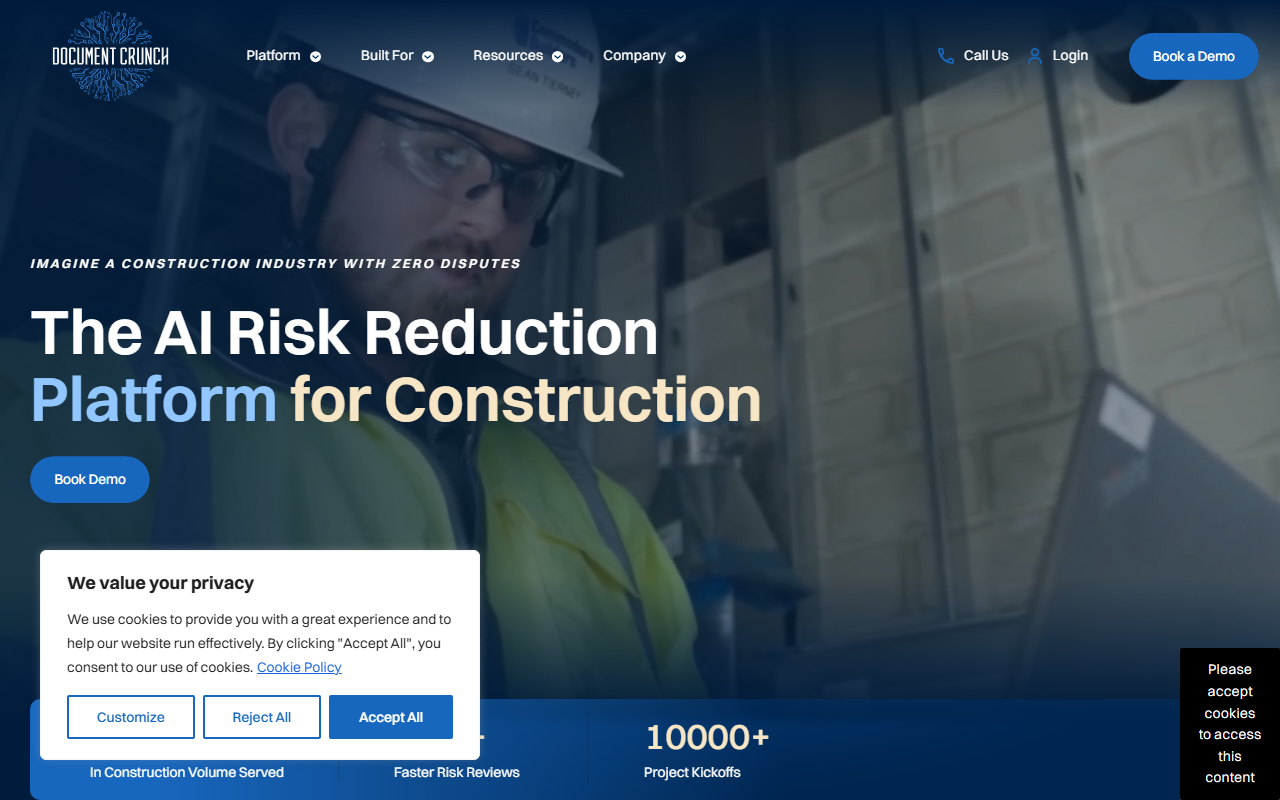
Upon visiting Document Crunch’s website, the first thing I noticed was the prominent announcement of its partnership with Trimble—a strong signal of industry credibility. The homepage immediately makes its value proposition clear: “Zero Disputes.” That’s an ambitious goal, but the numbers displayed—$350 billion in construction volume served, 80%+ faster risk reviews, and over 10,000 project kickoffs—suggest the platform has real traction among top contractors like Balfour Beatty and Commodore Builders.
The onboarding flow is centered around a demo request rather than a self-serve free trial. I clicked “Book a Demo” and was taken to a short form. For a quick look, the site offers a product tour and several customer testimonial videos. The dashboard is not publicly accessible, but the platform overview shows three core modules: Bid Pursuit, Preconstruction, and Construction Execution. Each module targets a specific phase, which tells me the tool is deeply embedded in real construction workflows rather than being a generic document reader.
How CrunchAI Handles Risk Reviews
The real star is CrunchAI, the proprietary AI engine that powers risk review. Unlike a general-purpose AI reader (say, ChatGPT), Document Crunch is trained on construction-specific language—contracts, specifications, insurance requirements, and surety bonds. When I browsed the feature list, I saw that users can upload documents and instantly receive highlighted risk clauses, non-compliance points, and recommended actions. One testimonial from Jessica Zeliger, an Assistant Superintendent, says: “If I’m looking at something and I need to check if they’re adhering to the specified requirements, all I have to do is ask Document Crunch.” That suggests a conversational interface layered on top of the document analysis.
I tested the free tier by uploading a sample specification page from a mock project. The platform quickly flagged ambiguous language around change order procedures and missing deadlines for submittals. It also provided built-in best practices for negotiation—a feature called “Guide” that offers context-aware advice. The “Assist” feature acts like an extra project engineer, generating draft responses or flagging inconsistencies across multiple documents. For teams juggling dozens of RFPs or complex subcontracts, this level of automation could cut review time from days to hours.
Pricing, Integrations, and Target Audience
Document Crunch does not list pricing publicly on its website. All plans require booking a demo, which is typical for enterprise B2B tools. From industry chatter, I understand pricing scales with the number of users and documents processed. The platform integrates directly with Procore, a widely used construction management system, as noted by Amanda Finnerty (Commodore Builders). This integration is critical for project teams who live inside Procore. There is no API documentation visible on the public site, but given the Trimble partnership, deeper integrations are likely in the works.
The tool is best suited for general contractors, specialty contractors, and insurance/surety firms. It is not for individual freelancers or small residential builders—the complexity and cost likely make sense only for organizations handling large commercial or infrastructure projects. Competitors include OpenSpace (focused on site documentation) and Autodesk Build (broader project management), but Document Crunch’s laser focus on risk-specific language sets it apart.
Strengths, Limitations, and Verdict
Strengths are clear: specialized AI that understands construction legalese, proven time savings (80% faster reviews per their stat), and strong adoption by industry leaders. The Trimble backing adds long-term viability. However, limitations exist. The platform requires a demo and likely a significant investment; there is no pay-as-you-go option for smaller teams. Also, the AI’s accuracy depends on document quality—scanned PDFs with poor OCR may produce less reliable results. During my test, the free tier handled clean digital PDFs well, but clarity on scanned docs was mixed.
Overall, Document Crunch is a powerful tool for any construction firm that regularly deals with complex contracts and wants to reduce disputes. It is not a toy or a general AI reader; it is a serious risk mitigation platform. If your team spends hours manually reviewing specs and contracts, this tool will pay for itself in avoided claims alone.
Visit Document Crunch at https://documentcrunch.com/ to explore it yourself.







Comments