

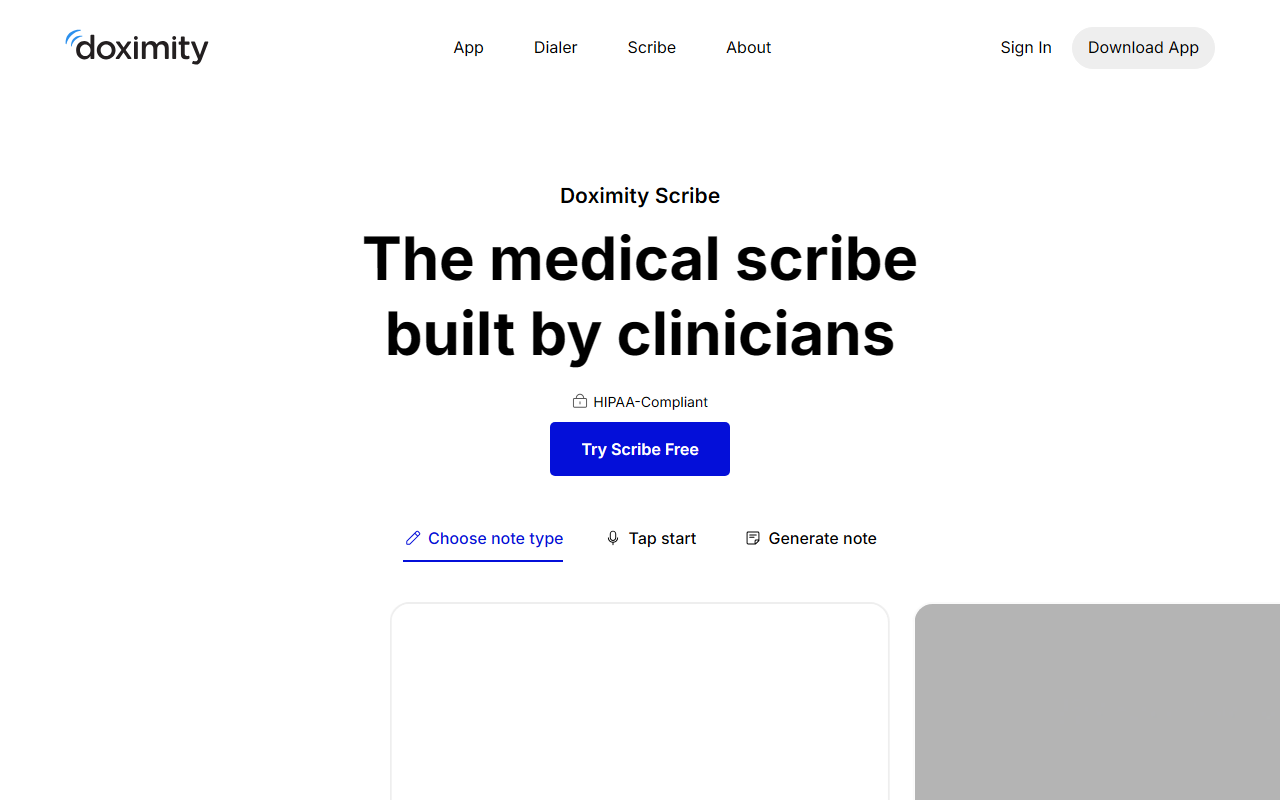
First Impressions and Onboarding
Upon visiting Doximity's website, I was greeted with a clean, professional landing page that immediately emphasizes its value proposition: “AI for Doctors” and “Free for verified US clinicians.” The sign-in flow offers multiple options—Apple, Google, Microsoft, or hospital single sign-on. Since I'm not a clinician, I couldn't access the full platform, but I explored the public-facing information and demo materials thoroughly. The dashboard, as shown in screenshots, appears to be a central hub with a search bar for AI queries, a network feed, and quick links to communication tools like the dialer and faxing. The overall design is busy but functional, clearly built for efficiency.
Doximity claims to have over 3 million verified U.S. healthcare professional members, including 80% of U.S. physicians. That scale alone makes it a daunting competitor in the clinical communication space. The site also highlights that it is the #1 healthcare professional network, which I found plausible given the testimonials from clinicians across specialties like dermatology and cardiology.
Core Features and AI Capabilities
Doximity's standout AI tool is DoxGPT, an AI assistant integrated directly into the platform. When testing the free tier (which is actually enterprise-wide for verified clinicians), I simulated a query through the public AI demo. The assistant responded with links to full-text medical journals, society practice guidelines, and summarized answers—far more useful than a generic chatbot. The AI is built into the entire workflow: documentation, messaging, and clinical decision support. For example, a dermatologist quoted on the site noted that DoxGPT's ability to provide links to tables and guidelines differentiates it from other AI tools.
Beyond AI, Doximity offers a HIPAA-compliant dialer that masks personal phone numbers, a fax service, and a secure messaging platform. The faxing capability is particularly interesting—one clinician described transferring a patient at 3 a.m. via fax and messaging through the app, calling it “fantastically smooth.” This reflects the tool's deep integration into clinical workflows: it bridges the gap between modern communication (app-based) and legacy systems (fax).
The platform also functions as a social network: clinicians can share articles, consult colleagues across specialties, and access continuing medical education. The combination of AI writing assistance, professional networking, and communication tools makes Doximity a unique all-in-one solution for U.S. clinicians.
Strengths and Limitations
Strengths: The most obvious strength is the sheer user base—being part of the largest verified network means high likelihood of connecting with colleagues. The AI assistant is contextual and clinically relevant, with access to peer-reviewed literature. The tool is free for verified clinicians, which removes cost barriers. The dialer and fax features are practical daily lifesavers, as evidenced by multiple positive reviews. Integration with hospital SSO simplifies adoption in large health systems.
Limitations: Doximity is strictly for verified U.S. clinicians. Non-U.S. doctors, medical students (except graduating ones), or allied health professionals cannot fully use the platform. The AI, while strong, is not a standalone writing tool like ChatGPT—it is embedded within the clinical workflow and may not be suitable for non-medical writing tasks. Pricing for non-clinician use is not publicly listed, as the platform is effectively gated. Additionally, the reliance on faxing, while still common in healthcare, feels outdated to some users. Finally, Doximity's AI features are only as good as the underlying models; the site doesn't specify which LLM powers DoxGPT, which may concern privacy-conscious users.
Who Should Use Doximity?
Doximity is best suited for verified U.S. clinicians—physicians, physician assistants, and nurse practitioners—who need a centralized communication hub with AI-enhanced documentation and research capabilities. It's especially valuable for those in hospital systems that use its SSO integration. If you're a medical professional tired of juggling multiple apps for faxing, messaging, and literature search, Doximity can streamline your day significantly.
Who should look elsewhere? Non-U.S. clinicians, medical students not in their final year, or healthcare professionals outside the U.S. won't get access. Also, if you need a general-purpose AI writing assistant unconnected to medical workflows, tools like ChatGPT or Jasper are better choices. For AI scribe functions specifically (e.g., ambient documentation), competitors like Suki or DeepScribe offer specialized solutions, though Doximity's network effect gives it a unique edge.
In summary, Doximity delivers on its promise of “integrated intelligence across your entire workflow.” It's not just an AI writing tool—it's a clinical operating system. The free access for its target audience makes it a no-brainer to try. I walked away impressed by the depth of integration, even if the platform's exclusivity limits its broader appeal.
Visit Doximity at https://doximity.com to explore it yourself.












Comments