

What Was EnhanceDocs?
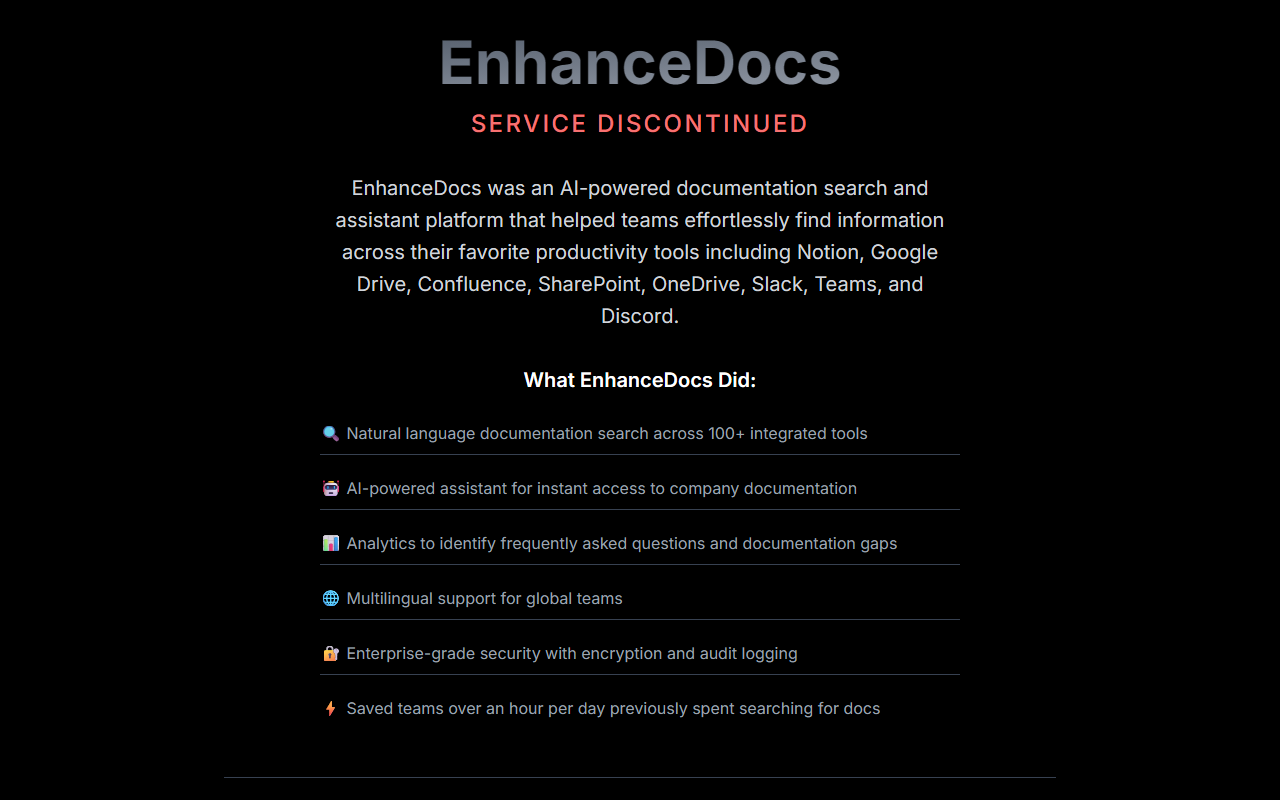
Upon visiting the EnhanceDocs website, I was greeted with a stark message: "Service Discontinued." The tool, founded in 2023 by Alvaro Molina, aimed to solve a common enterprise pain point—finding information scattered across multiple productivity tools. It offered natural language search across 100+ integrations, including Notion, Google Drive, Confluence, SharePoint, OneDrive, Slack, Teams, and Discord. The platform used an AI-powered assistant to answer questions directly from company documentation, along with analytics to identify repeated queries and documentation gaps. It promised to save teams over an hour per day previously wasted searching for docs. Unfortunately, the service was discontinued in 2024, making this review more of a postmortem than a recommendation.
Key Features and Capabilities
EnhanceDocs provided a unified search layer that understood natural language queries. For example, a user could type "What's the Q3 sales onboarding process?" and the assistant would pull the relevant document from whichever connected tool contained it. The dashboard likely showed analytics on top-asked questions, allowing teams to fill knowledge gaps. It also offered multilingual support for global teams and enterprise-grade security with encryption and audit logging. These features positioned it as a direct competitor to other knowledge management tools like Guru and Slite, but with a stronger focus on cross-platform retrieval rather than content creation. Unlike those competitors, EnhanceDocs did not build its own knowledge base; it relied entirely on existing connected sources.
Why It Mattered and Why It Ended
EnhanceDocs addressed a real problem: information silos in organizations. The promise of saving an hour per user per day is significant. However, the discontinuation after just one year suggests several limitations. First, the tool depended on reliable API access from integrated platforms, which may have introduced stability issues. Second, building accurate AI retrieval at scale across diverse document formats is technically challenging. Third, the market for enterprise search is crowded with well-funded players (e.g., Elastic, Algolia, and even built-in search in Notion and Confluence). Without a clear differentiator or strong go-to-market strategy, EnhanceDocs likely struggled to gain traction. The founder's transparent acknowledgment—"We believed in the power of easily accessible and accurate information"—is a humble farewell, but it also hints at the difficulty of sustaining a niche AI tool in a competitive landscape.
Conclusion and Lessons
EnhanceDocs was a well-conceived tool that ultimately failed due to market and execution challenges. It is best suited for teams that remember it fondly but cannot use it today. For current needs, consider alternatives like Dashworks, which offers similar cross-platform search with active development, or use built-in search features in your existing tools. A genuine strength of EnhanceDocs was its simplicity and broad integration scope; a real limitation was its lack of proprietary content storage and short lifespan. This review serves as a cautionary tale: even promising AI tools can vanish quickly. If you are evaluating similar solutions, ensure the vendor has financial stability and a clear roadmap. Visit EnhanceDocs at https://enhancedocs.com/ to see the service-discontinued notice and learn from its brief journey.













Comments