

What Is InterpretML and What Problem Does It Solve?
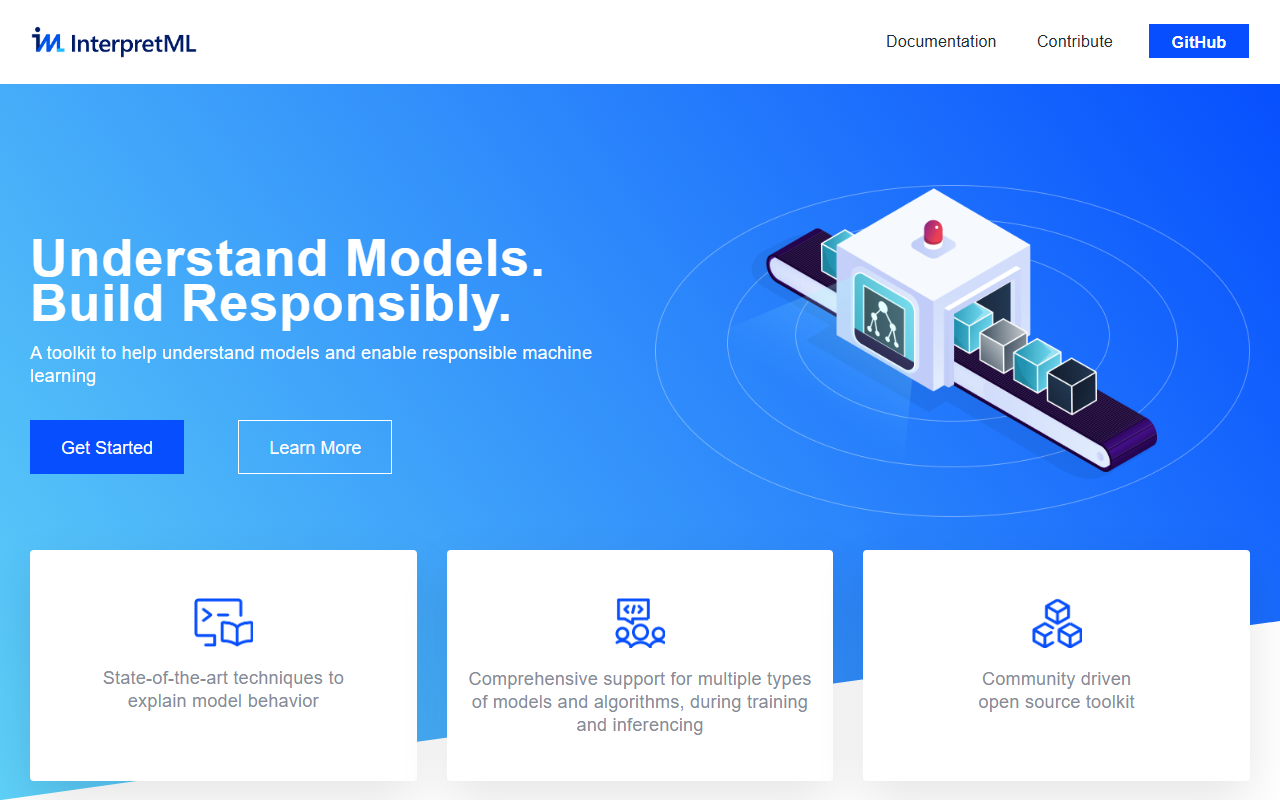
Upon visiting interpret.ml, you're greeted with a clean, minimal landing page that immediately positions the tool as a toolkit for responsible machine learning. The hero section reads "Understand Models. Build Responsibly." and offers two primary buttons: Get Started and Learn More. InterpretML is not a standalone application but a Python library — specifically a development framework under the Text AI category. It addresses the critical challenge of model interpretability: understanding why a model makes certain predictions, debugging errors, and ensuring compliance with regulations like GDPR or HIPAA. The toolkit provides two broad categories of techniques: glass-box models (inherently interpretable, such as Explainable Boosting Machines, linear models, decision trees) and black-box explainers (post-hoc methods like LIME and SHAP) that analyze opaque models like deep neural networks.
First-Hand Impressions: Onboarding and Workflow
Clicking "Get Started" takes you to a documentation page with pip installation commands — pip install interpret. I tested the free tier (which, since it's open source, is the entire library). The dashboard, so to speak, is your Python environment. The library's API is unified: you can load a dataset using interpret.Dataset, train a glass-box model like ExplainableBoostingClassifier, and then call .explain_global() or .explain_local() to generate visualizations. The visualizations appear in Jupyter notebooks as interactive charts — feature importance bar plots, what-if sliders, and individual prediction breakdowns. This workflow is intuitive for anyone familiar with scikit-learn. One particularly impressive interaction was using the global feature importance plot: I trained an EBM on the UCI Adult Income dataset, and the dashboard immediately showed that education and marital status were the top drivers, with confidence intervals around each feature's contribution. The ability to compare multiple models side-by-side in the same view is a standout feature.
Technical Details and Market Positioning
InterpretML is built primarily on Python and integrates seamlessly with scikit-learn and XGBoost. The toolkit leverages Microsoft's Research and includes their proprietary Explainable Boosting Machine (EBM), which is a glass-box model that often performs comparably to gradient boosting. The library supports global, local, subset, and feature-impact explanations. Pricing is not publicly listed on the website because InterpretML is fully open source under the MIT license — there is no paid tier. For context, competing frameworks include IBM's AI Explainability 360 and the standalone LIME/SHAP libraries. Unlike IBM's offering, which can feel more academic and complex, InterpretML focuses on ease of use with a unified API and richer, interactive visualizations out of the box. The community is active on GitHub (over 6,500 stars) and contributions are encouraged.
Strengths, Limitations, and Final Verdict
The genuine strengths of InterpretML are its comprehensive support for both glass-box and black-box methods, the high-quality visualizations, and the active community backing from Microsoft. The EBM model alone is worth trying for interpretable high-performance tasks. However, a real limitation is that InterpretML is strictly a coding library — there is no GUI or no-code interface. If you're a business analyst without Python skills, you'll need to look elsewhere. Also, the documentation, while good, could have more end-to-end tutorials for real-world datasets. This tool is best suited for data scientists and machine learning engineers who want to debug models, explain predictions to stakeholders, or meet audit requirements. Auditors and compliance officers may also benefit if they have technical support. If you need a drag-and-drop interpretability dashboard, consider tools like H2O Driverless AI's Explainable ML module. For everyone else, InterpretML is a must-try. Visit InterpretML at https://interpret.ml/ to explore it yourself.













Comments