

First Impressions and Onboarding
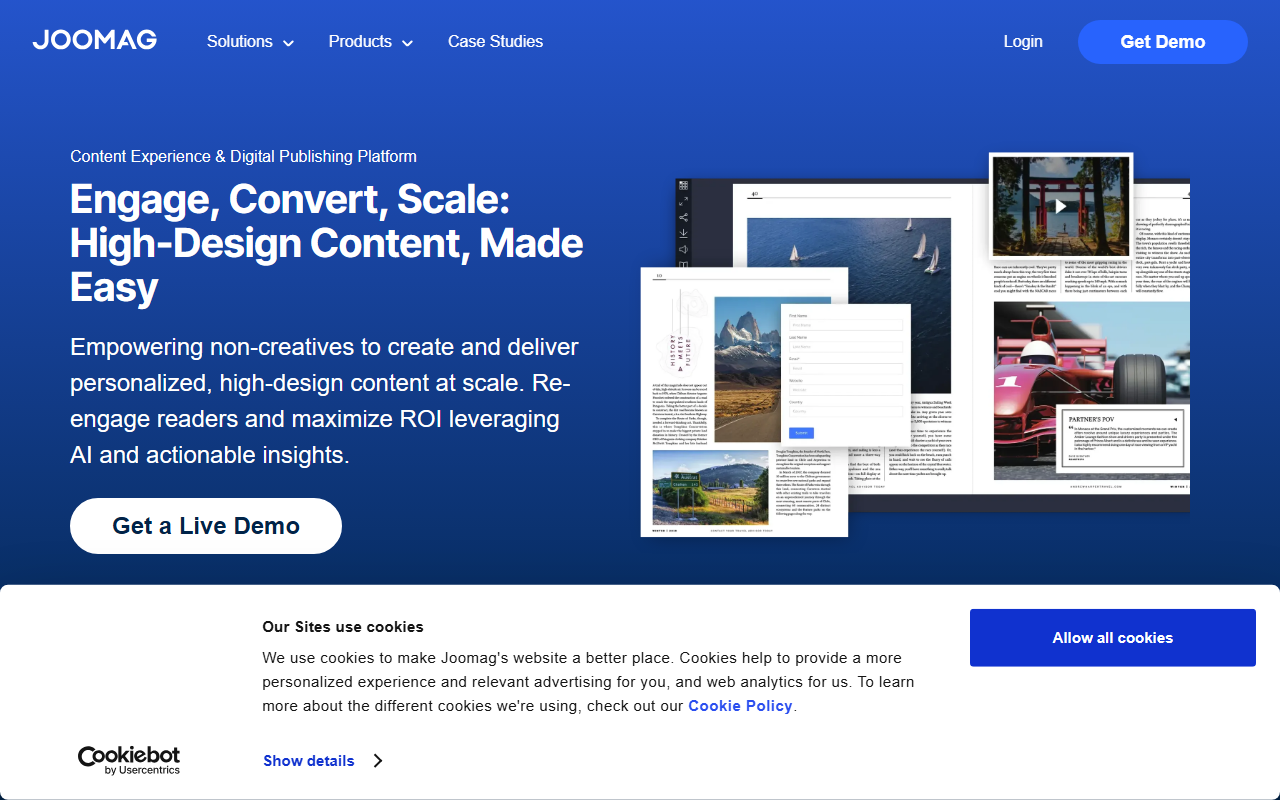
Upon visiting the Joomag website, I was immediately struck by the polished, corporate-friendly design. The navigation is neatly organized into “Solutions” and “Products,” with clear calls to action for a free demo. The homepage hero tagline—“Engage, Convert, Scale: High-Design Content, Made Easy”—sets the tone. As a journalist who has tested dozens of content experience platforms, I found the messaging refreshingly direct: this tool is built for non-creatives who need to produce professional digital publications. When I clicked the “Get a Live Demo” button, I was prompted to fill out a short form requesting my name, email, and company size. The process felt frictionless, and within minutes I received an automated confirmation email. The onboarding flow appears to be demo-led rather than self-serve, which makes sense given the platform’s enterprise focus. The dashboard preview suggests a clean, editor-centric interface with drag-and-drop capabilities, though I would need a full trial to assess the learning curve.
Core Capabilities: Creation, Distribution, and Measurement
Joomag is a comprehensive digital publishing and content experience platform. Its core value proposition is enabling both creatives and non-creatives to produce high-design content—magazines, catalogs, brochures, proposals, reports—at scale. The Creative Studio allows users to design from scratch, import PDFs, and add interactive elements. More impressively, the Content Automation module lets teams create personalized content by pulling data from CRMs, DAMs, or CSV files. This is where Joomag’s AI powers shine: Gen AI can intelligently generate high-design layouts based on user input and data. During my exploration of the site’s feature pages, I noted that the AI is not just a text generator; it seems to understand layout and visual branding. On the distribution side, Joomag offers a branded viewer, article view, privacy controls, and email marketing. Analytics are granular—tracking reader behavior, content consumption, and even sentiment. The “Act” layer is particularly clever: it uses reader signals to trigger personalized notifications or content recommendations. The platform claims a 250% increase in reader engagement and 200% faster creation and distribution. While these numbers are marketing claims, they align with what I’ve seen in similar platforms.
Pricing and Market Positioning
Joomag’s pricing is not publicly listed on the website. The only option is to request a demo, which suggests a tailored, likely subscription-based model. This lack of transparency can be frustrating for smaller teams looking to quickly evaluate cost. However, the site does mention it’s “Trusted by 5,000+ customers and millions of users,” indicating a solid user base. Competitors include Issuu (which focuses more on flipbook publishing) and FlippingBook (strong on interactive PDFs). Unlike those, Joomag emphasizes AI-driven automation and personalization, positioning itself as a content experience platform rather than just a publishing tool. It also integrates with marketing automation and CRM systems, making it suitable for account-based marketing and demand generation campaigns. The tool appears to have strong funding and enterprise backing, though specific investment details are not highlighted. For context, Joomag’s closest competitor in the AI-assisted content space might be Piktochart, but Joomag offers deeper distribution and analytics capabilities.
Who Should Use Joomag?
Joomag is best suited for marketing teams, sales enablement departments, and internal communications professionals who need to produce high-design content at scale without a dedicated design team. Its strengths lie in the combination of AI content generation, automated personalization, and multi-channel distribution with robust analytics. However, there are limitations. The reliance on a demo-led onboarding means you cannot quickly trial the tool; you must commit to a sales conversation. Additionally, the platform’s power comes with complexity—non-creatives may still need initial training to leverage the AI automation effectively. The absence of public pricing may also deter smaller businesses with limited budgets. For large enterprises or mid-sized companies that can invest in a demo, Joomag is a compelling option. I recommend it to anyone tired of static PDFs and seeking a dynamic, data-driven content experience that can actually measure ROI. Visit Joomag at https://joomag.com/ to explore it yourself.













Comments