

First Impressions and Onboarding
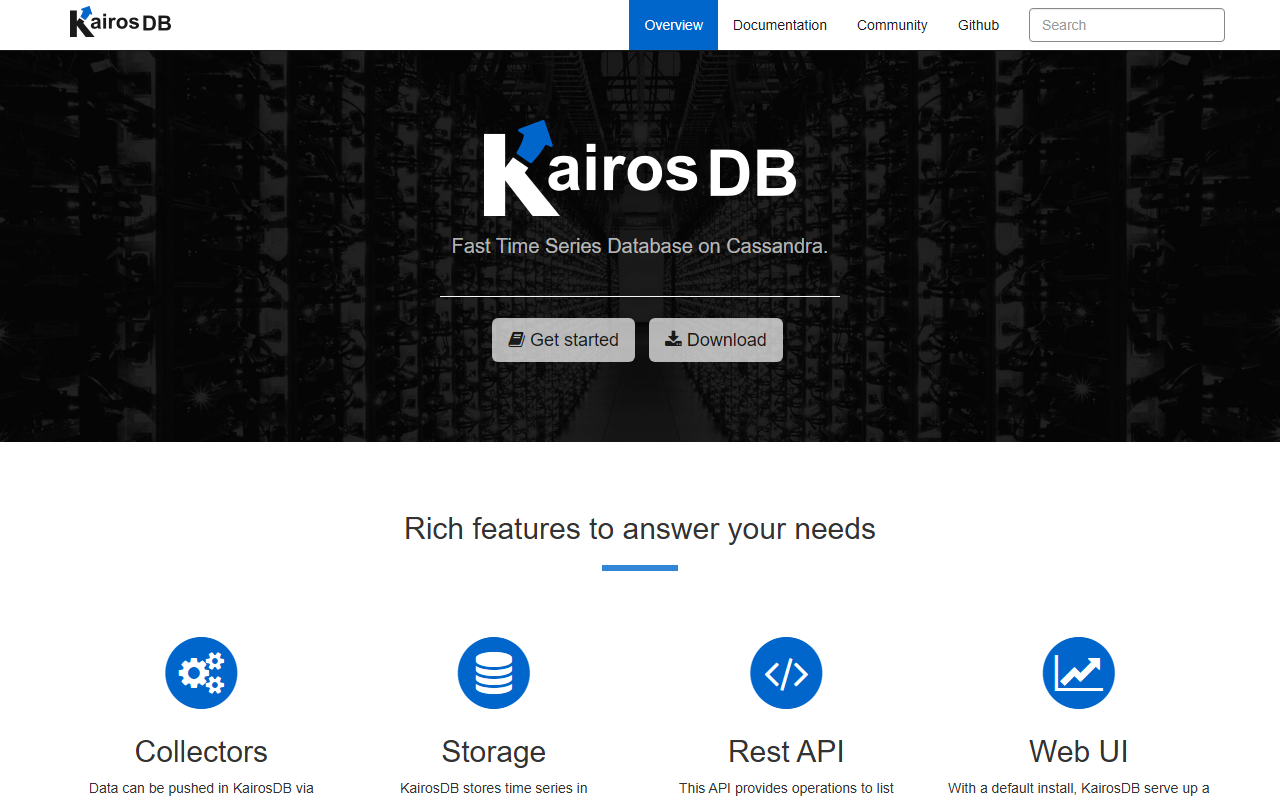
Upon visiting the KairosDB website at kairosdb.github.io, I immediately noticed its dated design and the copyright year 2015. The landing page is straightforward: a brief tagline, "Fast Time Series Database on Cassandra," and a set of feature cards. I clicked the "Get Started" link and was taken to a GitHub-based documentation page. The onboarding involves downloading the binary from GitHub, configuring a Cassandra instance, and launching the server. There is no hosted trial or SaaS layer; you must set it up yourself. The Web UI described as a development tool is basic—a simple query page for browsing data points. I tested the free tier by running a local instance and pushing data via the REST API using curl. The response times were acceptable for small datasets, but the lack of built-in authentication or modern query languages (like SQL or PromQL) stood out immediately.
Features and Integration Depth
KairosDB’s core value is storing time series data in Cassandra’s column-family model, which provides horizontal scalability and fast writes. The schema uses three column families: data points, metric names, and tag indexes. The REST API lists metric names, tags, and allows inserting and querying data points. I wrote a Python script to push 10,000 temperature readings; the REST endpoint responded within milliseconds. Aggregators include min, max, sum, count, mean, and downsampling—essential for summarising long-term trends. The client library is Java-only, though the REST API makes it usable from any language. Plugins based on Guice allow custom data stores, protocol handlers, and data point listeners. However, compared to modern competitors like InfluxDB (which offers Flux and SQL support) or TimescaleDB (PostgreSQL-based with continuous aggregates), KairosDB’s feature set feels limited. Notably, there is no built-in retention policy, downsampling is manual, and the last commit on its GitHub repository was over six years ago.
Use Cases and Market Position
KairosDB is best suited for teams already invested in Cassandra who need a lightweight time series layer without moving to a specialized database. It works well for IoT telemetry, application monitoring, and DevOps metrics where data volume is moderate. However, developers looking for modern query languages, automatic retention, or cloud-native deployment should look elsewhere. Unlike InfluxDB, KairosDB does not support SQL or Flux, and its plugin ecosystem is static. The project appears to be in maintenance mode, with no active development or community updates since 2015. There are no indicators of commercial backing or a large user base. For a production environment, I would hesitate to rely on an unmaintained tool unless the use case is extremely simple and static.
Strengths, Limitations, and Final Verdict
KairosDB’s strength is its tight integration with Cassandra—if you already have a Cassandra cluster, adding KairosDB requires minimal overhead. The REST API is clean and well-documented, and the aggregator functions are reliable. However, the tool has significant limitations: no authentication, no built-in data compression, no horizontal auto-sharding (Cassandra handles that, but KairosDB does not add much value on top), and a complete lack of modern features like alerts, dashboard integration, or SQL support. The Web UI is barely usable for debugging. Considering the age and inactivity, I would only recommend KairosDB for educational purposes or legacy systems that cannot migrate. For new projects, choose InfluxDB or TimescaleDB. Visit KairosDB at https://kairosdb.github.io/ to explore it yourself.










Comments