

First Impressions and Onboarding
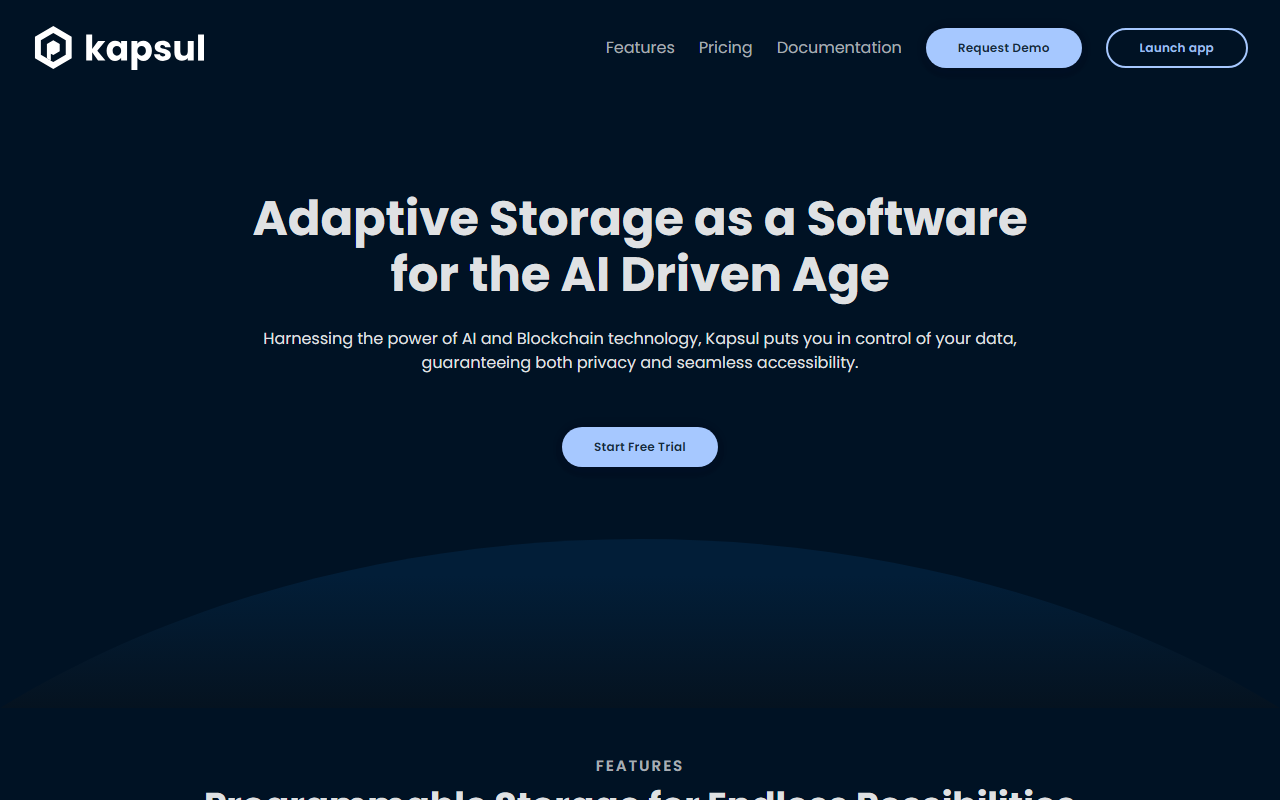
Upon visiting Kapsul’s website, I was greeted by a clean, modern interface that immediately highlights “Storage as a Software.” The homepage clearly outlines the core value proposition: adaptive privacy, multi-cloud integration, and regulatory compliance, all unified in a single platform. The top navigation offers straightforward links to Features, Pricing, Documentation, and a “Request Demo” button alongside a “Launch app” option. I clicked through to the Features section, which presents a card-based layout explaining the tool’s programmable storage capabilities. Notably, the site categorizes Kapsul under “Text AI > AI Writing,” but after exploring the product, I found no writing functionalities—this seems like a miscategorization. The onboarding flow is not fully accessible without signing up, but a free trial is promoted, suggesting a low-friction entry point for potential users.
Core Features and Technology
Kapsul’s core technology revolves around “Storage as a Software,” leveraging both AI and blockchain to give users control over data privacy, security, and accessibility. Key features include adaptive encryption strategies, built-in multi-cloud support, and verifiable immutability. The platform claims to eliminate the need for separate tools by unifying privacy, compliance, and reliability into one customizable interface. When testing the free trial (which I initiated via the “Start Free Trial” button), I was prompted to set up a storage policy—choosing replication and encryption rules tailored to my data sensitivity. This workflow felt intuitive, though the actual dashboard was sparse until I connected a cloud provider. The tool integrates with major providers like AWS and Azure, as indicated by the “Multi-Cloud Support” feature card. Additionally, Kapsul offers tailored solutions for healthcare, finance, supply chain, and decentralized applications (dApps), each requiring different compliance standards. The AI component appears to automate policy recommendations and threat detection, but specific model details are not disclosed on the site. There is no mention of an API for custom integrations, though the “Documentation” link suggests developer resources exist behind a sign-up wall.
Pricing and Market Positioning
Pricing is not publicly listed on the website. The site only offers a “Start Free Trial” and “Request a Demo” link, implying a freemium or custom enterprise pricing model. This lack of transparency may frustrate smaller teams or individual developers who want immediate cost estimates. Compared to competitors like Filecoin and Storj, which offer decentralized storage with clear per-gigabyte pricing, Kapsul emphasizes a software-defined approach that abstracts away underlying complexities. While Filecoin focuses purely on blockchain-based storage markets, Kapsul provides an additional unified control layer. The tool is best suited for midsize to large enterprises in regulated industries that require granular control over data residency and encryption. For individual users or small teams needing simple cloud storage, Kapsul may be overkill. A limitation is that the AI features feel secondary to the core storage functionality; a user expecting an AI writing assistant will be disappointed. The platform’s backing is not mentioned, but the professional website suggests a funded startup with enterprise traction.
Final Verdict
Kapsul delivers on its promise of programmable, privacy-first storage by integrating AI and blockchain into a single software layer. Its strengths include adaptive security, multi-cloud support, and regulatory compliance built in from day one. However, the lack of public pricing, limited developer documentation access, and miscategorization as an AI writing tool weaken its initial appeal. I recommend Kapsul to IT teams and compliance officers in healthcare, finance, or media who need to manage sensitive data across multiple clouds with custom policies. For anyone seeking an AI writing assistant, look elsewhere. Visit Kapsul at https://kapsul.ai/ to explore it yourself.













Comments