

First Impressions and Interface
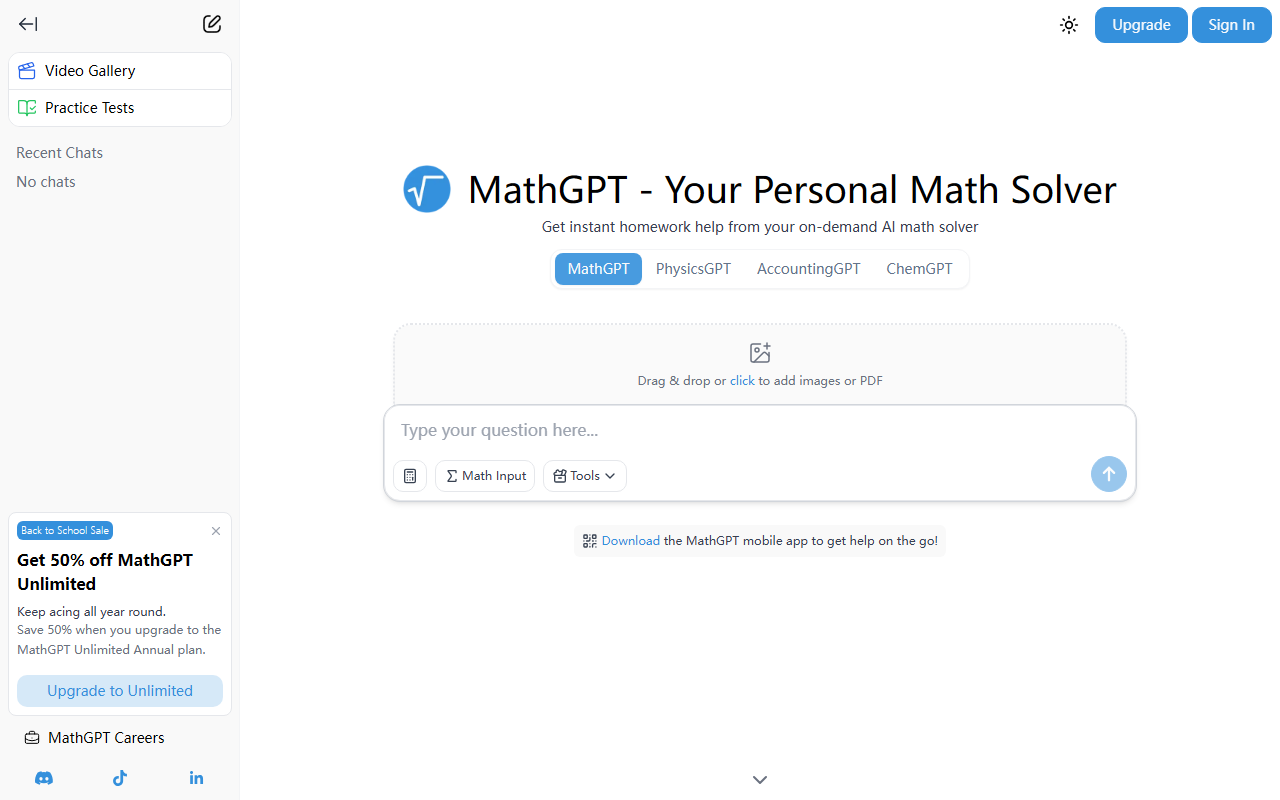
Upon visiting the MathGPT website, I was greeted by a clean, modern dashboard with a prominent chat input area. The homepage showcases a video gallery and options like Practice Tests and AP Exam Hub. The main solver interface allows you to type a question or upload images and PDFs. I tested the drag-and-drop feature with a photo of a calculus problem, and the AI processed it within seconds. The layout is intuitive, though the recent chats panel was empty during my test, which felt a bit unfinished. The mobile app is also available, providing on-the-go access.
Core Features and Performance
MathGPT positions itself as a personal math tutor, offering step-by-step solutions, AI video explanations, custom interactive quizzes, and graphing tools. When I entered an algebra word problem, the solver broke it down into clear steps with explanations. The video explanation feature is unique: it generates a short animated tutorial with voiceover that walks through each step, making it easier to grasp complex concepts. I also created a custom quiz on calculus derivatives; the questions were relevant and adaptive. The AI handles algebra, calculus, chemistry, physics, and even accounting, which broadens its utility beyond typical math solvers. However, I noticed occasional delays in video generation, and some step explanations felt too verbose for quick review.
Expertise and Market Context
MathGPT uses advanced AI (likely based on large language models fine-tuned for STEM) to understand text, images, and PDFs. Unlike competitors like Photomath or Wolfram Alpha, MathGPT focuses on interactive video explanations and quiz creation. Wolfram Alpha excels at symbolic computation, while Photomath is stronger for pure math. MathGPT fills a niche for students who want visual, narrative-driven learning. The tool was created by two Cornell Engineering students, which adds credibility but also means it lacks the resources of larger companies. No pricing is listed on the website, suggesting a freemium model with paid tiers for advanced features. Over 2 million users from 150+ countries indicate strong adoption, especially in high school and college demographics.
Strengths, Limitations, and Verdict
MathGPT’s greatest strengths are its video explanations and interactive quizzes, which foster deeper understanding. The ability to upload images and PDFs works reliably, and the multi-subject support (including physics and chemistry) makes it a versatile homework helper. However, the lack of transparent pricing is a major drawback—users cannot evaluate the cost before committing. Additionally, the accuracy can be inconsistent with highly specialized or ambiguous problems, and the interface lacks a robust history or bookmarking feature. For students who need visual, step-by-step guidance and are willing to explore a freemium model, MathGPT is a powerful ally. For those seeking simple answer generation or advanced symbolic math, alternatives like Wolfram Alpha may be more suitable. I recommend MathGPT for high school and early college students who want to learn concepts, not just get answers.
Visit MathGPT at https://math-gpt.org/ to explore it yourself.













Comments