

First Impressions of Metal Networks
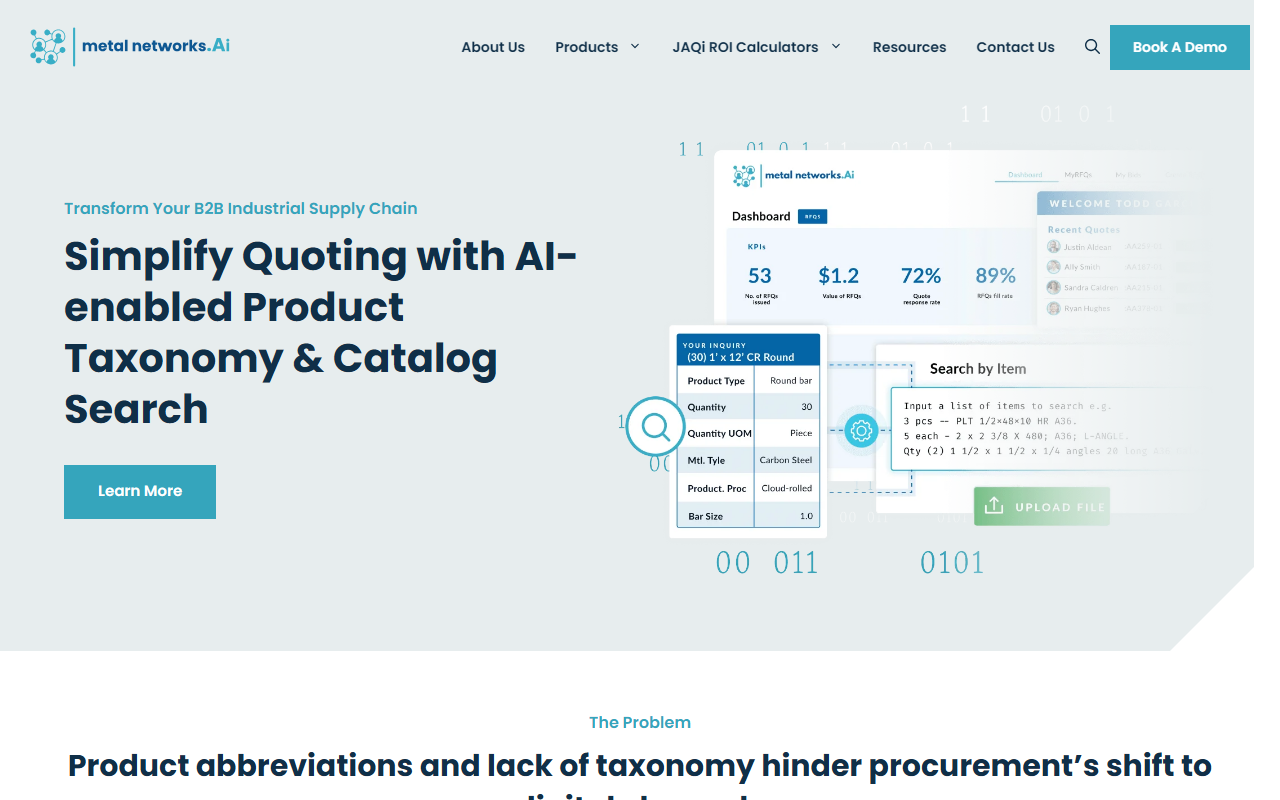
Upon visiting the Metal Networks homepage, I was immediately struck by the clarity of its value proposition: a B2B industrial supply chain platform powered by AI. The site’s design is clean and professional, with a clear focus on showcasing three products: JAQi Ai (for product search and matching), RFQs (request-for-quote automation), and CPQ (configure-price-quote). The navigation is intuitive, and the use of calculators to predict ROI suggests a company that understands the importance of quantifiable value in the enterprise space. I tested the JAQi Ai ROI calculator by entering some hypothetical figures; it returned a projected time savings estimate that felt grounded in the claim that 11.6 hours per week is wasted on product search. The onboarding flow is not public, but the site strongly emphasizes integration with existing systems—a critical feature for any B2B software.
What Metal Networks Does (and the Problem It Solves)
Metal Networks addresses a specific, painful bottleneck in industrial supply chains: the lack of standardized product taxonomy and the proliferation of messy catalog data. In industries like metals and commercial materials, buyers use abbreviations and non‑standard part numbers, making it nearly impossible to migrate RFQs and procurement to digital channels. The platform’s AI engine, JAQi Ai, translates those messy product descriptions into a searchable, matchable taxonomy. It then feeds into two workflows: RFQ automation (which speeds up sourcing from weeks to days) and CPQ for inside sales teams. The technology appears to rely on natural‑language processing and semantic matching, though the site does not specify underlying models. There is no mention of a public API, but the focus on integration with existing systems suggests API availability is part of their enterprise offering. Pricing is not publicly listed on the website; instead, prospects are directed to contact sales.
Positioning, Strengths, and Limitations
Market context: Metal Networks competes with broader B2B commerce platforms like Salesforce CPQ or Zoho Inventory, but those lack its deep focus on messy industrial catalog data. Another rival is Parthean (for supply chain AI), though Parthean is more about carbon footprint tracking. Metal Networks laser‑focuses on the quoting and catalog management pain point, making it uniquely suited for heavy‑industry distributors and manufacturers. Strengths: The platform directly tackles a measurable pain point (96% of organizations take nearly a month for sourcing; 11.6 hours lost per week searching). The three‑product trio offers a clear, modular path to digitization. The ROI calculators are a nice touch for building a business case. Limitations: The site uses placeholder text (“Lorem ipsum dolor sit amet”) in several sections, which undermines trust and suggests the page may be incomplete. There is no pricing transparency, no customer case studies or logos, and no live demo available. The platform’s AI model details are not disclosed, making it hard to evaluate its accuracy against established players. Also, the tool is heavily B2B‑industrial focused; small‑scale procurement teams or retailers may find it too specialized.
Who Should Try Metal Networks
This tool is best suited for mid‑to‑large wholesale distributors, metal service centers, and industrial manufacturers who deal with thousands of non‑standard product codes and need to automate RFQ and quoting processes. Procurement managers and e‑commerce managers in such organizations will find the most immediate value. CTOs looking to future‑proof their tech stack with a customizable AI layer will also appreciate the integration‑first approach. Who should look elsewhere: Small businesses or startups with simple product catalogs would be overpaying for the complexity. Also, companies that need a full ERP/CRM integration out of the box might find Metal Networks too narrow—it’s a complement, not a replacement.
Recommendation: Metal Networks shows strong potential for a niche market, but the lack of pricing transparency and limited public evidence of real‑world adoption (no case studies, testimonials, or user numbers) makes it difficult to fully endorse. I recommend that teams in heavy‑industry supply chains request a demo and a paid pilot before committing. The problem it solves is real, and the ROI calculators suggest the company is genuinely focused on delivering measurable value. Visit Metal Networks at https://metalnetworks.ai/ to explore it yourself.













Comments