

First Impressions and Platform Overview
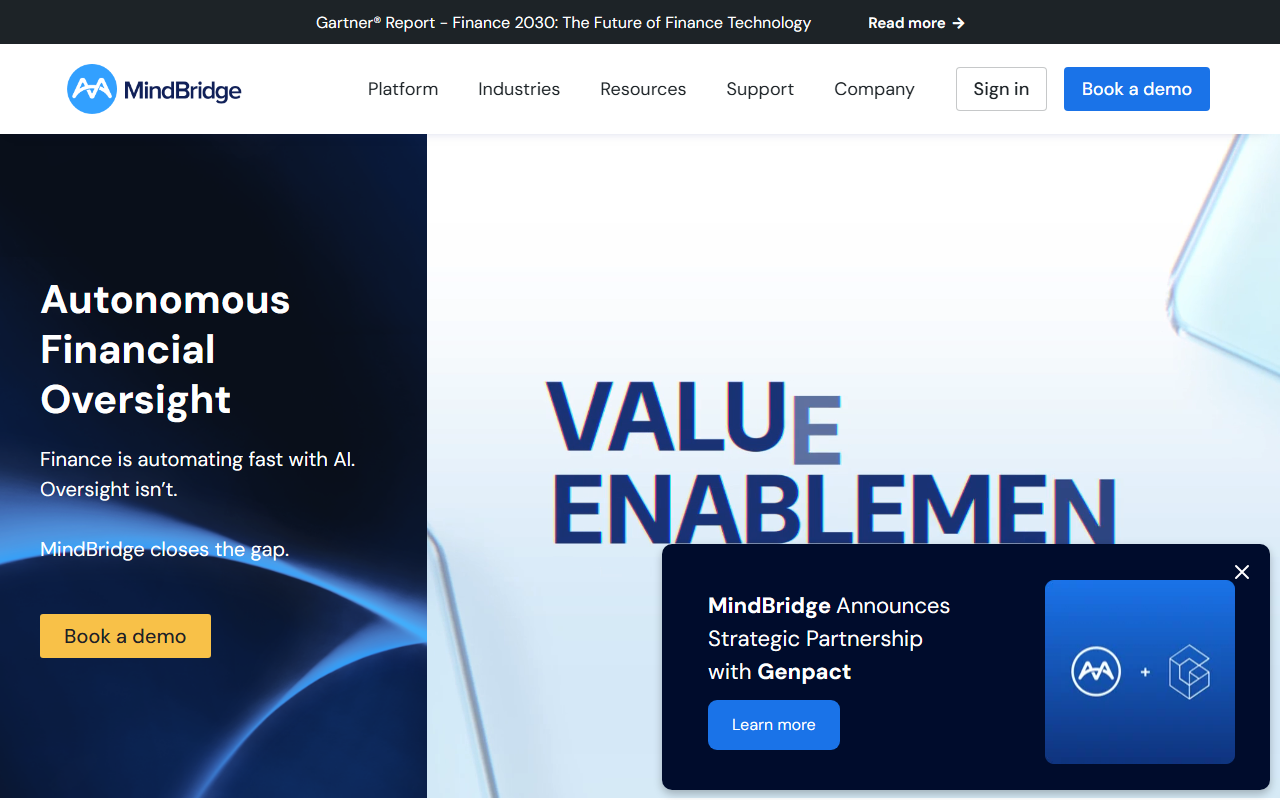
Upon visiting MindBridge's website, I was immediately struck by the clarity of its value proposition: autonomous financial oversight for a world where finance is automating fast. The homepage wastes no time positioning itself as “the global leader in AI-powered financial intelligence.” A prominent call-to-action invites you to book a demo, and the copy targets a specific pain point—outdated systems exposing companies to fraud, leakage, and compliance failures. The design is clean, enterprise-focused, with case studies and a Gartner report prominently featured.
The platform essentially provides an independent oversight layer that runs alongside AI agents handling transaction processing. It monitors 100% of financial transactions across all systems, surfaces errors, anomalies, and policy breaches before they compound into major issues. I appreciated the emphasis on “contextual explainability” and “deterministic outputs”—this is clearly built for auditors who need an auditable chain of evidence, not just a black-box AI score. A webinar on “Auditing AI-Enabled Processes” reinforces that MindBridge understands the regulatory and trust challenges its users face.
Core Features and Technical Depth
MindBridge’s technical backbone is impressive. The platform is built on a decade of finance-native AI trained on over 260 billion transactions analyzed across 3,000+ ERP systems. It embeds over 8,000 GAAP rules directly into its models. During my exploration, I noted three core pillars: Central Insights Factory, Unified Data Strategy, and Unsupervised Machine Learning. The Insights Factory powers use cases for enterprise finance, internal audit, and accounting teams—scanning the entire organization for anomalies and patterns. The Unified Data Strategy seamlessly integrates with existing tech ecosystems, modernizing audit methodologies without requiring a rip-and-replace.
What sets MindBridge apart from generic AI audit tools is its unsupervised machine learning approach. Instead of relying solely on labeled historical data, it can detect unknown unknowns—patterns that no one thought to flag. This is critical for catching sophisticated fraud or novel errors. The platform also offers continuous assurance, meaning it can monitor transactions before the books close, providing real-time protection against risks introduced by AI agents. For any organization moving toward autonomous finance, this oversight layer feels essential.
Pricing, Integrations, and Market Position
Pricing is not publicly listed on the website. MindBridge targets enterprise clients, so costs are likely negotiated per deployment based on transaction volume and custom integrations. The platform supports major ERP systems (over 3,000 systems cited), which suggests broad compatibility with SAP, Oracle, Microsoft Dynamics, and similar. Competitors in this space include ACL (now Galvanize), Oversight Systems, and traditional audit analytics tools from firms like SAS. Unlike many of those, MindBridge leans heavily into unsupervised AI and continuous real-time monitoring, positioning itself as a next-generation solution for AI-driven finance teams.
The company boasts trust from “global leaders” and holds certifications and awards that underscore its credibility. A white paper on how Pinion Adopts the MindBridge AI platform for time savings and other case studies are available. Given the depth of its training data and the number of GAAP rules embedded, MindBridge likely has a strong moat in terms of domain-specific intelligence. It is best suited for large enterprises with complex financial operations, internal audit departments, and accounting firms that need to audit AI-enabled processes. Smaller businesses should look elsewhere, as the platform appears designed for scale.
Strengths and Limitations
MindBridge’s greatest strength is its comprehensive, unsupervised approach to financial oversight. It doesn’t just flag known risks—it surfaces the unknown unknown. The auditable reasoning and deterministic outputs are a major plus for compliance-minded teams. Another strong point is its continuous assurance capability, which can detect issues before period-end close, saving countless hours of manual review.
However, limitations exist. The lack of transparent pricing may deter smaller firms or those with limited budgets. The platform’s heavy reliance on ERP data means it’s only effective if an organization already has solid system integration. Additionally, while the supervised ML on 260 billion transactions is impressive, the tool may still struggle with edge cases in highly customized ERP environments. From a reviewer’s standpoint, I would have liked to see a demo or sandbox to test a small dataset—currently the site only offers a brochure download after email submission.
Overall, MindBridge is a powerful solution for enterprises ready to automate financial oversight. If you’re an audit lead or finance executive grappling with AI-induced risks, this platform is worth a demo. For everyone else, watch for pricing details and integration prerequisites before diving in.
Visit MindBridge at https://mindbridge.ai/ to explore it yourself.













Comments