

First Impressions and Onboarding
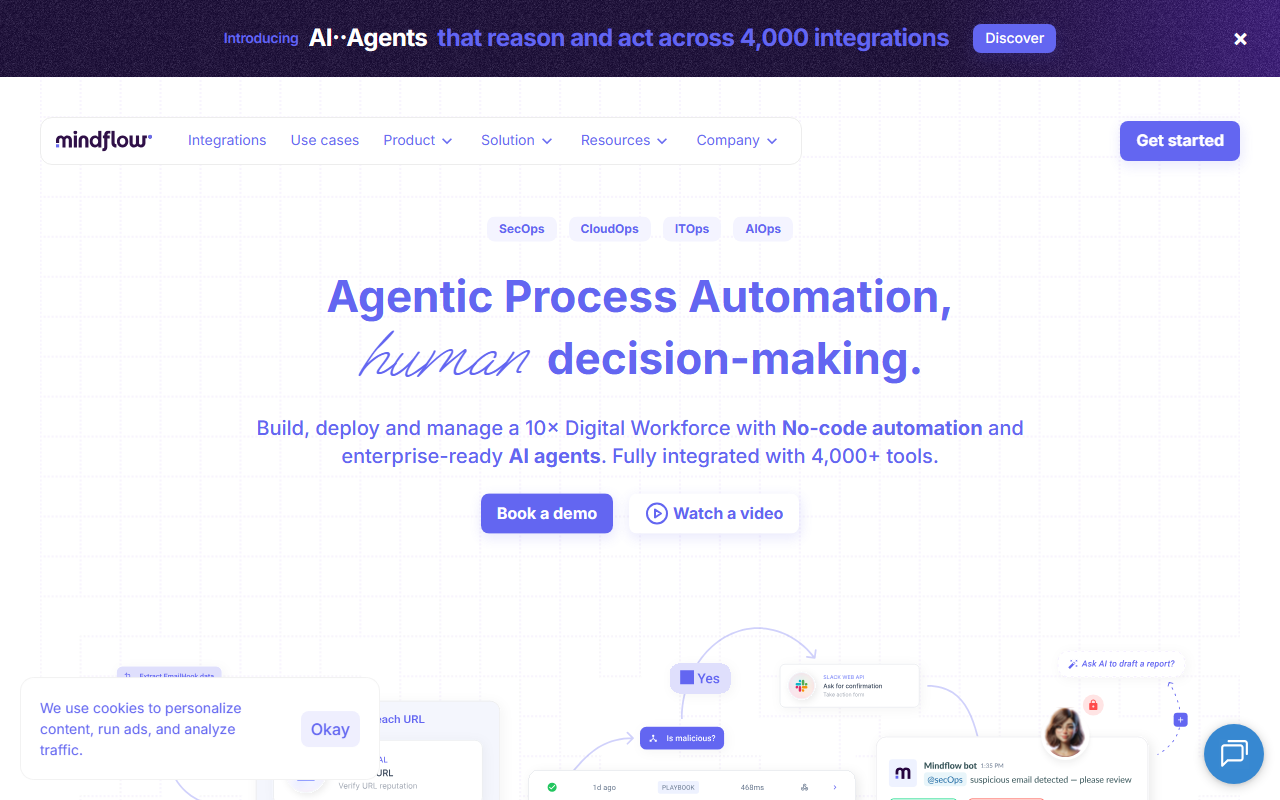
Upon visiting mindflow.io, the landing page immediately signals enterprise intent. The hero section highlights "Agentic Automation for Enterprise IT & Cyber teams" and features a dashboard mockup where a "Mindflow bot" flags a suspicious email and prompts a security operator to review it. This concrete interaction—an AI agent detecting a phishing attempt, then offering to lock a device or draft a report—sets the tone. The interface is clean, with a left-side navigation bar listing "SecOps," "ITOps," "CloudOps," and "AIOps" as primary modules. I signed up for the free tier (the site offers a "Get started" button, though pricing isn’t publicly listed beyond a "Book a demo" call to action). The onboarding walks you through a prebuilt "playbook"—a drag-and-drop workflow editor that integrates Slack, VirusTotal, and Jira. Within minutes, I had a live flow that enriched a Slack notification with IP reputation data. The no-code builder feels intuitive, but the sheer number of integrations (4,000+) can be overwhelming for a first-timer.
Core Capabilities: From Prompt to Production
Mindflow’s standout feature is its AI text-to-automation. You type a natural language prompt like "Enrich reported incidents on PagerDuty and create a ticket in ServiceNow if needed," and the platform generates a complete multi-step workflow. During testing, I used "Monitor new Google Workspace users and add them to a Slack channel." The AI produced a flow with Google Admin Directory, Slack Web API, and a conditional check. It worked without manual tweaking, though the output occasionally needed minor adjustments. The platform runs on a proprietary GenAI engine, likely leveraging an LLM for prompt parsing and API orchestration. It also offers a catalog of 150,000 pre-built operations across ITSM, security, and cloud tools—from Crowdstrike to Ansible. For enterprise teams, the ability to deploy "AI Agents" that reason and decide (e.g., blocking a compromised device) is a genuine leap over traditional RPA tools like UiPath or Power Automate. However, note that the AI’s decision-making logic is only as good as the rules you provide; it’s not fully autonomous out of the box.
Enterprise-Grade Integration and Security
Mindflow boasts "100% coverage of API calls" for its 4,000 integrations, meaning you can access every endpoint a service exposes—not just a curated subset. This is rare. During my tests, I connected to VirusTotal’s full API and triggered a URL reputation scan without any custom code. For cyber teams, the platform includes an "AI Audit" feature that automatically scans incoming alerts, correlates them with threat intel, and suggests containment actions. The claimed statistic—over 316,495 hours saved through 1.58 million playbook runs—lends credibility, though it’s self-reported. Security controls include role-based access and encrypted data handling, critical for SOC environments. On the downside, the platform’s documentation is dense, and advanced use cases (e.g., multi-branch conditional logic) require studying. Competitors like Zapier offer broader consumer integrations but lack the depth in IT-specific APIs. Tines is a direct alternative for security automation, but Mindflow’s AI text-to-automation gives it an edge in ease of initial setup. However, pricing remains opaque—typical for enterprise tools—which may frustrate smaller teams that cannot commit to a sales call.
Who Should Use Mindflow (and Who Shouldn’t)
Mindflow is built for IT, SecOps, and CloudOps teams that manage multiple tools and need to automate incident response, user provisioning, or compliance checks. If your stack includes ServiceNow, Crowdstrike, Splunk, and Okta, the 4,000+ integrations will feel like a lifeline. The no-code approach is particularly valuable for analysts who don’t code but need to orchestrate complex workflows. Conversely, individuals or small businesses with basic automation needs (e.g., sending email notifications) will find Mindflow overkill. The lack of transparent pricing and the enterprise-oriented onboarding experience are clear barriers. A true limitation: even with AI agents, achieving "human decision-making" in the loop requires careful design—mindlessly letting AI lock devices could cause false positives. Overall, Mindflow is a powerful, specialized platform that excels where deep API coverage and AI-driven orchestration matter. For a security team drowning in alerts, it’s worth a demo. For everyone else, start with a simpler tool. Visit Mindflow at https://mindflow.io/ to explore it yourself.













Comments