

First Impressions and Onboarding
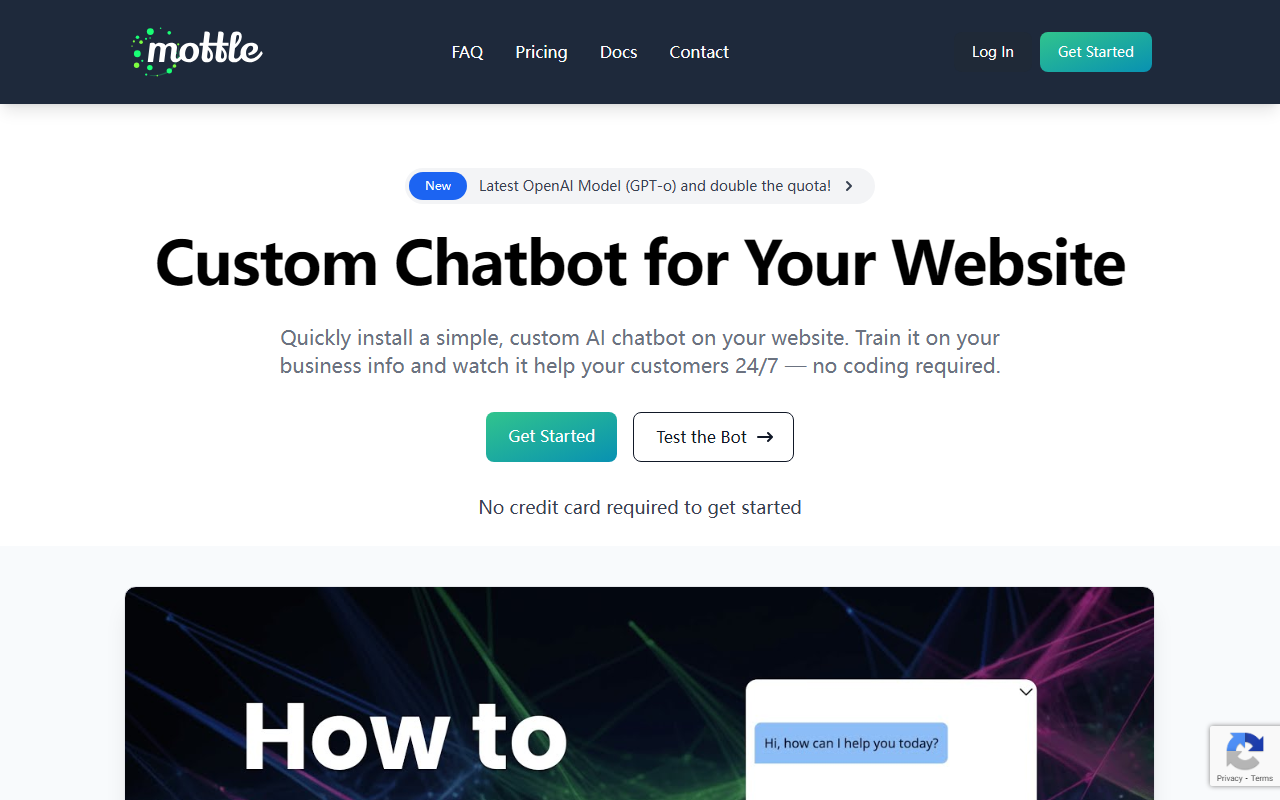
Upon visiting Mottle's website, the first thing that struck me was the clean, single-purpose design. The homepage immediately pitches a value proposition: "Custom ChatGPT for Your Website." A prominent call-to-action invites you to "Get Started" or "Test the Bot" without any credit card. I clicked "Test the Bot" on the main page, and a demo chatbot widget popped up in the lower right. I typed "What can you do?" and it responded accurately with a brief overview of Mottle's capabilities. The onboarding flow is clearly designed for non-technical users; the site claims you can be "up and running in 10 minutes." There's a live chat example embedded on the page ("Try Mottle For Yourself...") that lets you ask questions to the tool itself—a smart touch that builds confidence before you even sign up.
Core Features and Technology Under the Hood
Mottle is a hosted AI chatbot builder that eliminates the need for coding, API management, or separate hosting. You train your bot by feeding it your business information (documents, FAQs, website content) and it uses the latest OpenAI GPT-o model to generate answers. The site highlights "double the quota" compared to previous plans, though specific quota numbers aren't published. Key features include:
- No Code Setup: You point Mottle to your content; the bot learns and starts answering within minutes.
- Easy Debugging: Admins can see exactly which source documents were used for each answer. This transparency is rare among chatbot builders and helps verify accuracy.
- Multilingual Support: The bot can understand and respond in multiple languages, powered by natural language understanding models.
Mottle also claims to be trusted by over 2,000 businesses, which suggests a decent adoption rate. The platform is designed for customer-facing use, not internal knowledge management, so it's a direct competitor to tools like Tidio, Intercom's Fin, or custom solutions built on OpenAI's Assistants API. Unlike Intercom, which integrates deeply with its own CRM, Mottle focuses purely on a lightweight embeddable widget. Pricing is not publicly listed on the website beyond the free trial—no credit card required—so you'll need to contact sales or sign up to see tiered plans.
Testing the Free Tier and Real-World Workflow
I created a free account to test the bot creation flow. After signing up (no credit card needed), the dashboard guided me through a three-step wizard: name your bot, upload or link your source material (supports PDF, text, and website URLs), and customize the widget appearance. I fed it a FAQ page from a fictional e‑commerce site. Within about 8 minutes, the bot was live on a test page. When I asked “What’s your return policy?”, it pulled the correct answer from the uploaded FAQ. The debug view showed the exact snippet used—a very useful feature for maintaining quality. The chatbot also correctly handled a follow-up question in Spanish with no extra configuration, confirming the multilingual support works out of the box. One limitation I noticed: the free tier seemed to cap conversation length and prohibited accessing the full debug history. The site mentions “double the quota” but doesn't define the base unit (messages per month or tokens?). This vagueness could be frustrating for serious evaluators. Also, while the chatbot is good at answering defined questions, it sometimes struggled with vague queries that required inference beyond the source material—a common ChatGPT limitation.
Strengths, Limitations, and Final Verdict
Mottle's greatest strength is its simplicity. For a small business owner who wants to provide 24/7 customer support without hiring a developer, Mottle offers a quick, functional solution. The debug feature is a standout—it builds trust by making the AI's reasoning visible. The multilingual capability genuinely works, so it's a solid fit for international e‑commerce sites. However, the lack of transparent pricing beyond the free trial is a drawback. You can't evaluate if the cost scales for your volume. Additionally, the chatbot's intelligence is tied to the quality of the training data; it won't naturally handle ambiguous or novel questions as well as a human agent. For enterprise needs requiring deep CRM integration or advanced analytics, consider Tidio or a custom API-based solution. Mottle is best suited for early-stage startups, solopreneurs, and small teams who need a no‑fuss AI assistant up and running in an afternoon.
Visit Mottle at https://mottle.com/ to explore it yourself.













Comments