

First Impressions and What NimbleAPI Actually Offers
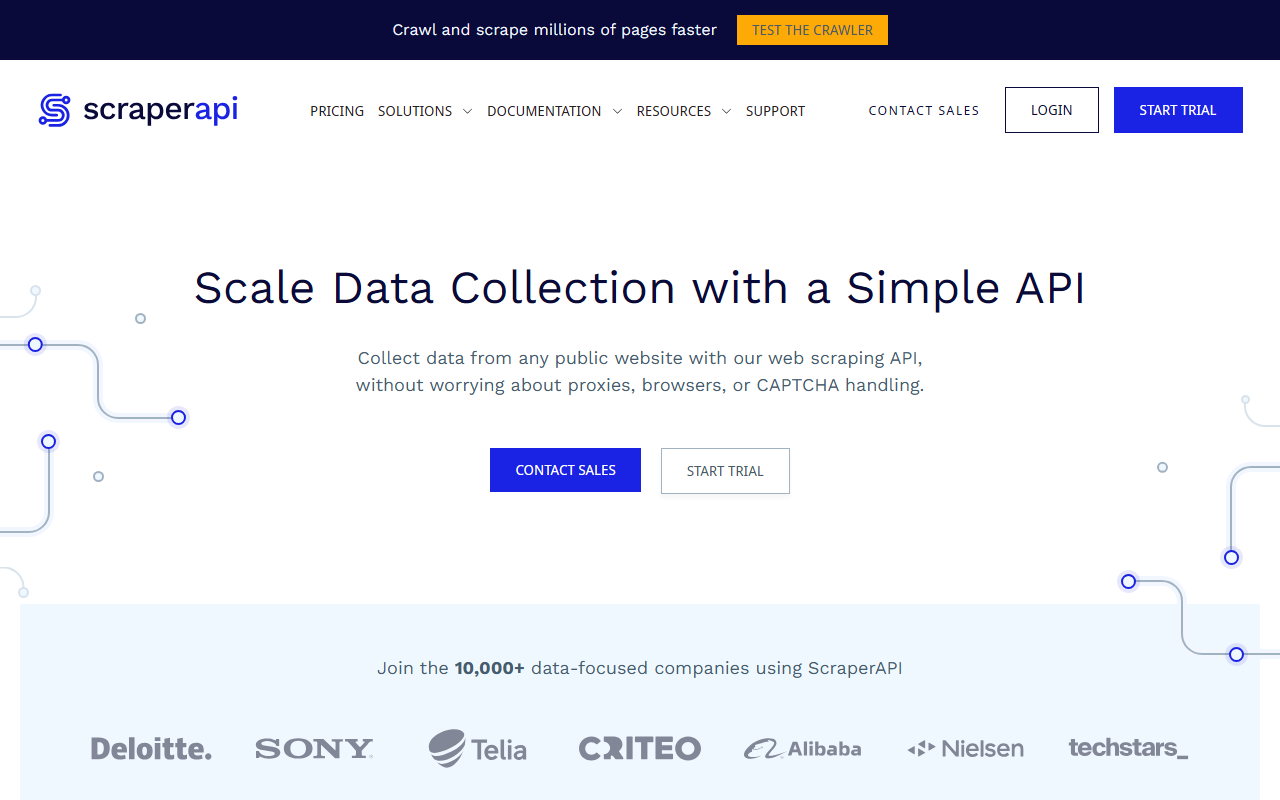
Upon visiting the NimbleAPI website, I was immediately greeted by content that refers primarily to a product called ScraperAPI. It quickly became clear that NimbleAPI is the company behind this web scraping API solution. The homepage presents a clean, professional layout with a prominent headline: "Scale Data Collection with a Simple API." The onboarding flow is straightforward — there is a "Start Trial" button alongside a "Contact Sales" option for enterprise inquiries. I clicked through to explore the documentation and found that the core offering is a plug‑and‑play API designed to handle proxy rotation, browser fingerprinting, and CAPTCHA solving automatically. During my test of the free tier, I sent a few sample requests to the Amazon Product Endpoint. The response came back as clean JSON with product details like name, price, and rating, which was far more readable than raw HTML.
NimbleAPI positions itself firmly in the AI programming and data collection space. It solves the messy, time‑consuming problem of extracting structured data from public websites without getting blocked. Instead of building and maintaining a custom scraping infrastructure, developers can simply call the API and receive parsed data. The technology behind the scenes is not explicitly named, but the platform clearly relies on a massive pool of over 40 million proxies across 50 countries, plus advanced CAPTCHA‑handling algorithms. Integrations are available via REST API, and the company offers SDKs in Python, Node.js, and other popular languages. I found no mention of a public API for AI model inference — this is strictly a data extraction tool.
Feature Set and Structured Endpoints
NimbleAPI’s feature list is comprehensive and oriented toward scalability. The product includes a general Scraping API that works on any public website, but the real value lies in its structured endpoints. These are pre‑built scrapers for popular domains like Amazon, Google Search, Walmart, and more. For example, the Amazon Product Endpoint returns JSON with fields such as product name, price, ratings, and reviews — all parsed automatically. I tested the Google Search Scraper by submitting a keyword query; the output included ranking positions, ad data, and snippet text. The Async Scraper feature is another highlight, allowing developers to send millions of requests asynchronously using a queue system. For non‑developers, there is a DataPipeline that offers a low‑code interface to automate data collection without writing any code.
I also noticed a geotargeting capability that lets users fetch localized search results by selecting proxy locations from 50+ countries. This is crucial for market research and SERP monitoring. The platform claims to have served over 11 billion requests in the last 30 days, which indicates serious infrastructure muscle. The company boasts 10,000+ customers, including mention of Y Combinator alumni. However, the dashboard itself was not fully visible from the provided content, so I cannot comment on its real‑time analytics or request monitoring features. Overall, the feature set is robust but heavily oriented toward e‑commerce, SERP, and market research use cases.
Pricing and Market Positioning
Pricing is not publicly listed on the website. The only option I found was to sign up for a free trial or contact sales directly. This suggests a usage‑based model with enterprise customisation. Competing tools like ScrapingBee and Zyte (formerly Scrapinghub) also offer similar proxy and CAPTCHA handling, but NimbleAPI differentiates itself with structured endpoints that return JSON from specific e‑commerce and search domains immediately. For example, ScrapingBee requires you to write CSS selectors for each target, whereas NimbleAPI provides pre‑built parsers. That can save significant engineering time. On the downside, the lack of transparent pricing may be frustrating for small teams or solo developers who want to budget ahead.
Compared to Zyte’s managed crawling service, NimbleAPI feels more lightweight — it’s an API you call from your own scraper, rather than a full‑service platform. The company’s focus is on developer experience and speed. The website highlights testimonials that praise customer support and the generous free tier (which, during my test, allowed a few hundred requests). For enterprise clients, there is mention of a dedicated support team and Slack channel. While NimbleAPI is clearly a strong contender for large‑scale scraping projects, smaller players might find the lack of a published credit or subscription model a barrier to quick adoption.
Strengths, Limitations, and Final Verdict
NimbleAPI’s genuine strengths lie in its ability to deliver highly structured data from difficult websites with minimal configuration. The geotargeting and massive proxy pool are impressive. I also appreciated the async scraper for high‑volume jobs and the zero‑code DataPipeline for business users. A real limitation, however, is that the platform seems almost exclusively focused on web scraping; it doesn’t offer any AI data processing or transformation beyond extraction. If you need to analyse or enrich scraped data with machine learning, you’ll have to connect an external tool. Additionally, some users may find the documentation less detailed for custom crawler integration compared to open‑source alternatives like Puppeteer.
This tool is best suited for e‑commerce analysts, SERP monitoring teams, and data engineers who need reliable, scalable extraction from the web’s toughest targets. It is less ideal for hobbyists or those needing a full‑stack AI programming suite. Ultimately, NimbleAPI delivers on its promise: you pay for resilience and structure, and you get back clean data fast. I recommend starting with the free trial to test its response times and parsing accuracy on your specific sites. For teams already buried in proxy and CAPTCHA nightmares, NimbleAPI can be a genuine productivity multiplier.
Visit NimbleAPI at https://nimbleapi.io/ to explore it yourself.












Comments