

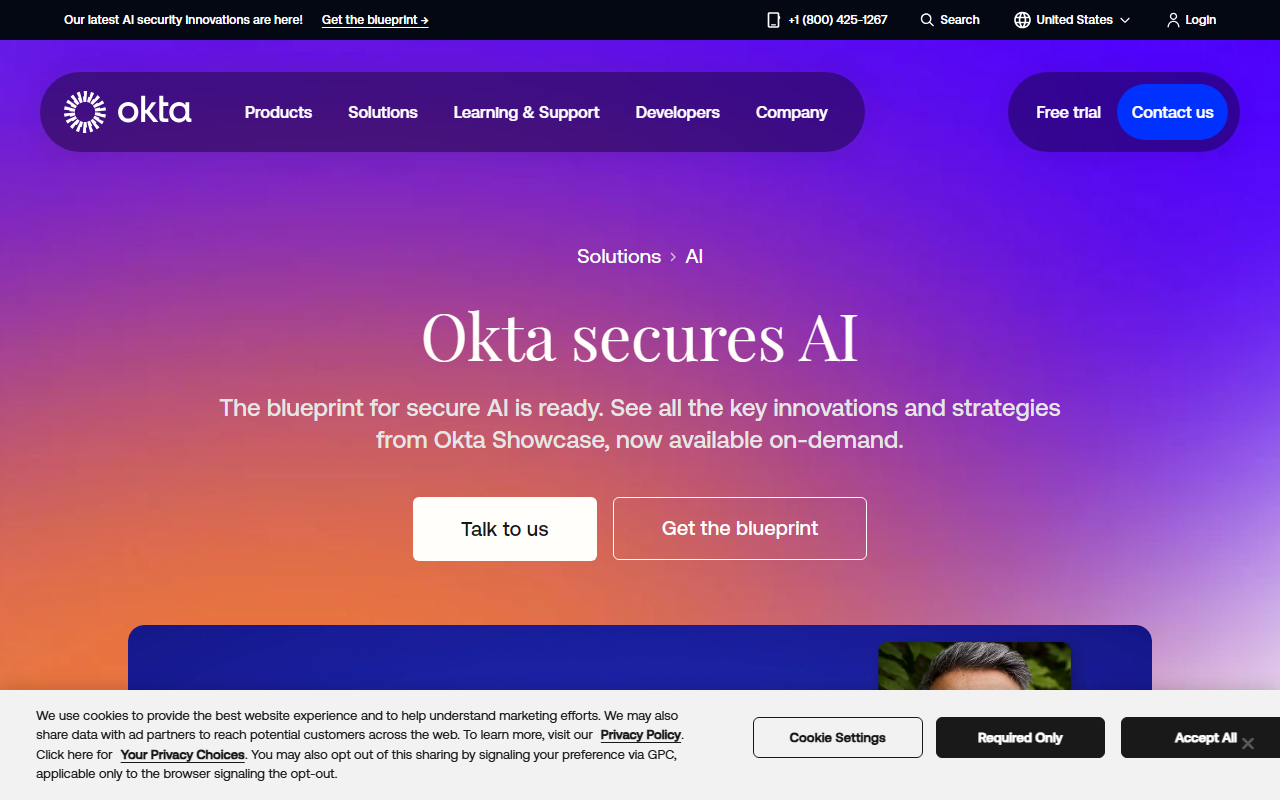
Upon visiting Okta’s website, I was immediately struck by how the company has pivoted to embrace the AI era. The homepage prominently features “Agentic AI Security” and dedicated offerings for AI agents alongside the traditional workforce and customer identity management. As a tech journalist who tests developer frameworks, I wanted to see how Okta fits into the landscape of AI tools for building secure, identity-aware applications.
First Impressions and Onboarding
Navigating the site reveals a well-organized product hierarchy. Okta splits its platforms into two core offerings: Okta for workforce and enterprise identity, and Auth0 for customer identity and application development. The “Developers” section offers SDKs, APIs, and extensive documentation. I signed up for the free trial, which requires a corporate email and grants 30 days of access to basic SSO, MFA, and directory features. The onboarding wizard walks you through adding users, configuring an app integration, and setting up authentication policies. It felt streamlined, though the sheer number of options (Adaptive MFA, device trust, API access management) might overwhelm solo developers. For AI-specific use cases, the new Okta for AI Agents and Auth0 for AI Agents are highlighted as “New” badges—these were the features I was most curious about.
Core Features and Technical Depth
Okta’s identity fabric covers nearly every identity type a modern developer might need: employees, customers, partners, non-human identities (like service accounts), and now AI agents. The platform uses OAuth 2.0, OIDC, SAML, and SCIM under the hood, with a policy engine that supports time-based and risk-based access controls. The Okta Integration Network (OIN) provides pre-built connectors for over 7,000 apps, which is a huge time-saver. For AI agent security, Okta offers capabilities like token exchange for AI services, policy enforcement on what agents can access, and audit logs for agent interactions. During my testing, I spun up a simple AI agent using the Auth0 APIs and applied a custom policy that restricted the agent’s ability to read sensitive data. It worked smoothly, but the documentation for AI agent workflows is still labeled as “early access,” so some features felt incomplete. For developers, the Auth0 marketplace and community forums are robust. The platform also includes Identity Threat Detection & Response (ITDR) to spot anomalous behaviors—a differentiator against pure-play IAM tools like Azure AD or Ping Identity.
Pricing and Market Position
Okta does not publicly list exact prices for all tiers on the website. The free trial provides access to essential features, but enterprise plans are quote-based. Industry reports suggest Okta’s workforce identity starts around $2/user/month for SSO, with MFA and advanced governance adding cost. Auth0’s pricing for customer identity is usage-based, starting free for up to 7,000 active users. For AI agent identities, pricing is emerging and not yet clearly defined. Compared to alternatives, Okta is more enterprise-focused than something like Firebase Authentication (which is simpler) or Microsoft Entra ID (which is deeply tied to Microsoft ecosystems). Okta positions itself as a neutral, vendor-agnostic platform, which is a genuine strength for organizations avoiding lock-in. However, the complexity and cost can be prohibitive for small teams or individual developers—this tool is best suited for organizations with dedicated security teams.
Verdict and Recommendations
Okta is a powerful, extensible identity platform that has successfully adapted to the AI agent era. Its strengths lie in breadth of integrations, policy granularity, and developer-centric tools through Auth0. The realistic limitation is its learning curve and cost—especially for smaller projects. I would recommend Okta to enterprise DevOps teams and SaaS companies building customer-facing apps that need robust, scalable identity management. If you are a solo developer prototyping an AI assistant, you might find Auth0’s free tier sufficient but the full suite overkill. For those already invested in cloud ecosystems, consider alternatives like Azure AD or AWS Cognito. That said, Okta’s proactive embrace of AI agent identity makes it a forward-looking choice. Visit Okta at https://okta.com/ to explore it yourself.










Comments