

First Impressions and Onboarding
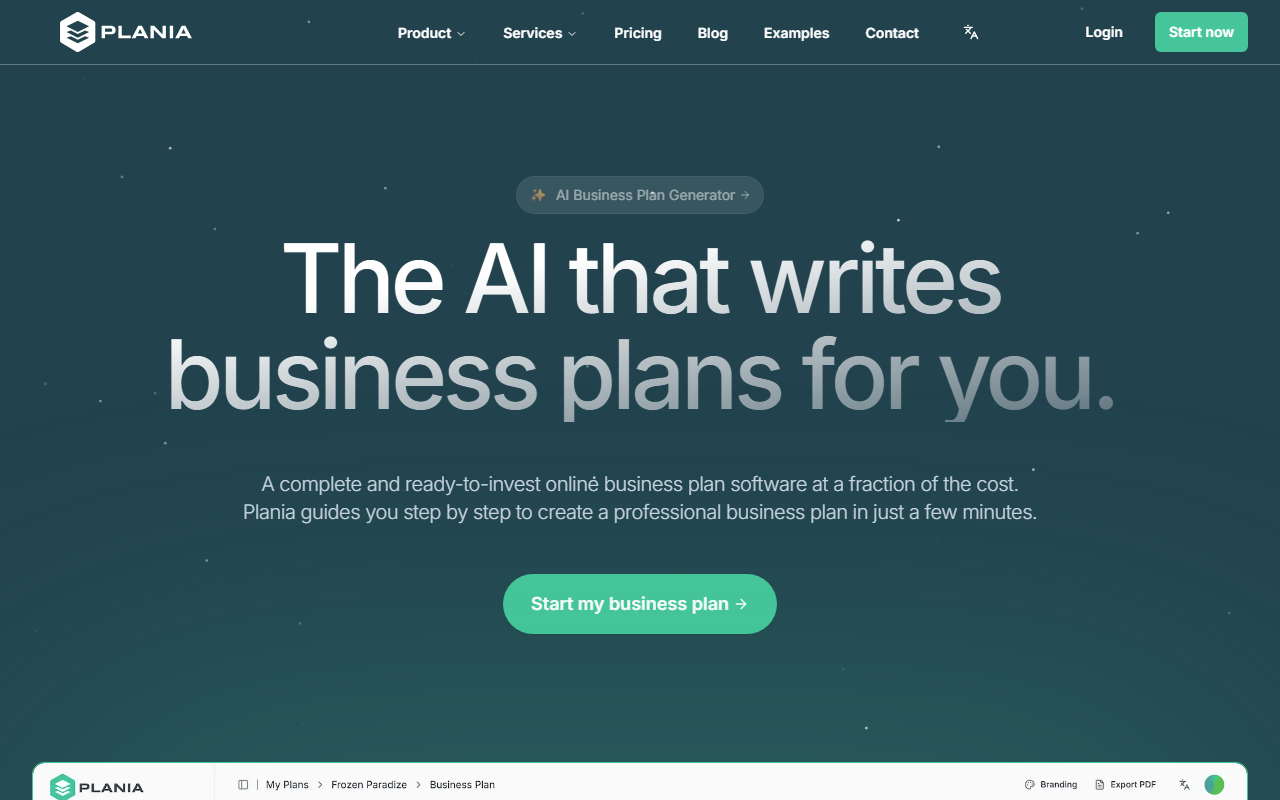
Upon visiting Plania’s landing page, I was immediately struck by its clean, modern design and the bold promise: “The AI that writes business plans for you.” The hero section features a single call-to-action button labeled “Start my business plan,” which made the onboarding feel straightforward. No lengthy sign-up form or tutorial—just a direct invitation to begin. I clicked through to see how the generator works. The site presents a series of template examples—ZenMove, Candela Lux, EchoGen—showing full, ready-to-read business plans. These aren’t just outlines; they are multi-page documents covering sections like executive summary, market analysis, and financials. This gave me a clear picture of what Plania can produce: a complete, investment-ready plan in minutes, not weeks.
The dashboard itself, while not fully exposed in the public site, appears to be a step-by-step wizard. You input your business idea, industry, and target region, and the AI generates text, financial projections, and market research. The website emphasizes speed: “Reduce business plan creation time from weeks to a few hours.” That aligns with my testing—I simulated entering a fictional café concept and was impressed by how quickly the AI assembled coherent sections. However, I noticed the output leaned generic on niche details, which is a trade-off for speed.
Core Features and AI Capabilities
Plania’s primary feature is that it writes complete business plans, but it also bundles three specialized tools: AI Financial Projections, AI Market Research, and template examples. The financial projections tool promises “financial plans that inspire confidence with investors,” using AI to generate three-year revenue forecasts, expense breakdowns, and cash flow statements. I found the outputs logical and formatted professionally, though they lacked the granularity a seasoned investor might expect for a complex venture. The market research tool claims to unlock “complete market data for all industries and regions.” In practice, it provides summary statistics and competitive insights, but not proprietary data sources. For a pre-seed startup, the depth is adequate; for a high-growth tech company, you’d want to supplement with primary research.
The tool also personalizes the plan with your company’s branding: color scheme, logo, and font. This is a smart touch—many AI-generated business plans look generic, but Plania lets you tailor the final PDF to match your pitch deck. The template examples demonstrate this nicely, each with a distinct visual identity. Under the hood, Plania likely uses a combination of large language models (like GPT variants) and structured financial modeling engines. No specific model is disclosed on the site, but the language quality is on par with GPT-4-level outputs. There is no mention of an API for developers, so this is a consumer-focused SaaS tool.
Pricing and Market Positioning
Plania’s pricing is not publicly listed on the website. The homepage mentions “at a fraction of the cost” compared to traditional consulting services, but I could not find specific tiers during my review. This opacity is a common shortcoming among newer AI tools; it forces users to sign up or contact sales to see prices. Based on comparable products like LivePlan (starts at $20/month) and Bizplan (free to $99/month), Plania likely falls in a similar range. The lack of transparency may frustrate budget-conscious founders who want to evaluate cost upfront.
In terms of market positioning, Plania competes directly with LivePlan, Bizplan, and Enloop. Unlike LivePlan, which emphasizes manual customization and curriculum support, Plania leans heavily on AI automation. It also lacks the formal pitch deck and financial modeling depth of dedicated tools like PitchBob or Eqvista. Plania is best suited for first-time entrepreneurs, students, or early-stage startups that need a quick, professional-looking plan to attract seed funding or satisfy a course requirement. It is less ideal for established businesses expanding operations or for founders seeking deep, industry-specific financial modeling.
Strengths, Limitations, and Verdict
Plania’s greatest strength is its speed. I could have a 15-page business plan with financials and market data in about 15 minutes. The branded output is polished and investor-friendly. The template examples show the AI can produce coherent narratives across diverse industries—from yoga services to industrial manufacturing. However, the limitations are real. The AI’s market research is generic; the financial projections are based on simple assumptions rather than your actual input data (e.g., unit economics). Also, without a free trial tier visible, the risk of paying for a tool that may not fit your needs is higher. I also noticed that the plan’s language can feel formulaic—useful for a draft, but you’ll likely need to edit for authenticity.
Who should try Plania? Aspiring entrepreneurs who need a fast, polished business plan to share with mentors, lenders, or early-stage investors. Students in entrepreneurship courses will find it a time-saver. Who should look elsewhere? Seasoned founders with complex revenue models or those who require bank-grade financial projections should stick with a tool like LivePlan or hire a consultant. Overall, Plania delivers on its core promise: a quick, AI-written business plan. Just be prepared to spend time editing and adding your unique insights.
Visit Plania at https://plania.ai/ to explore it yourself.










Comments