

First Impressions: Purpose and Scope
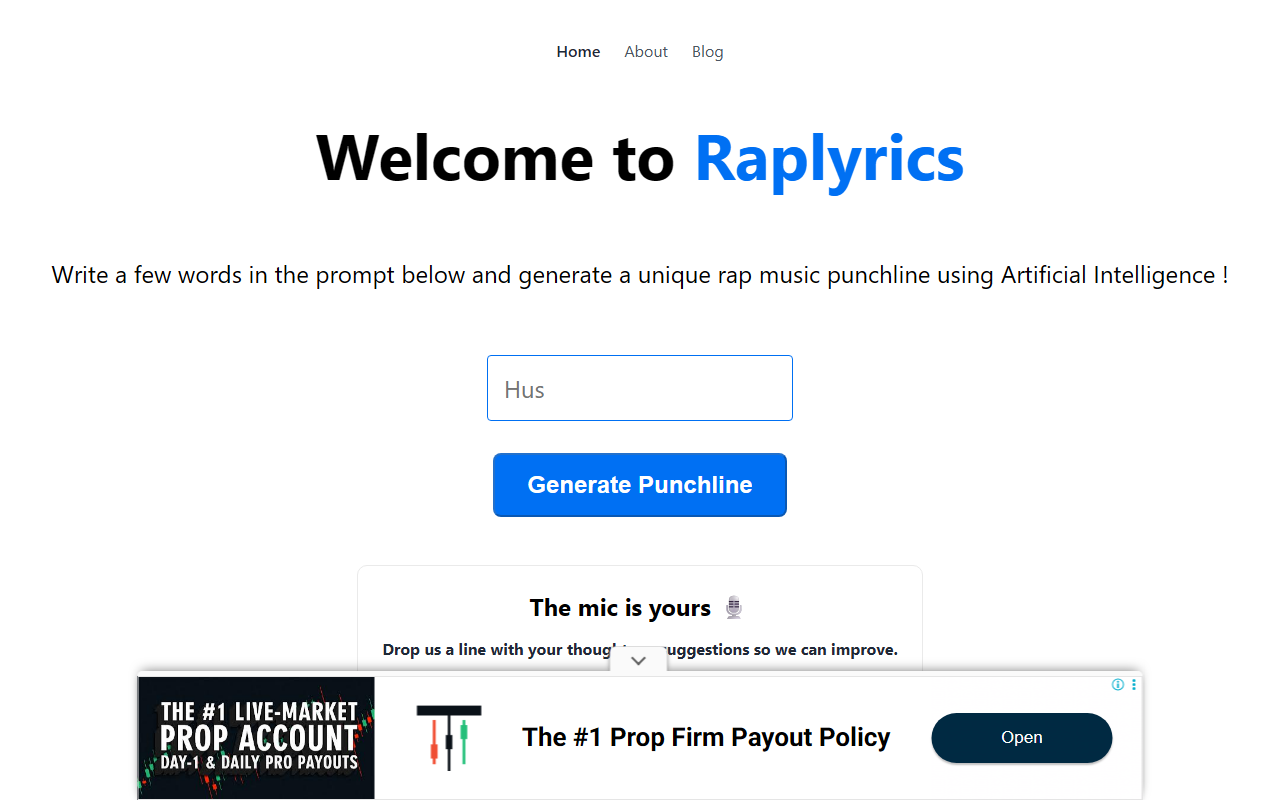
Upon visiting Raplyrics, you're greeted by a clean, minimal interface. The landing page features a single prompt box with the instruction 'Write a few words in the prompt below and generate a unique rap music punchline using Artificial Intelligence!' Below that, a bright 'Generate Punchline' button invites you to click. There's also a link to a blog about rap culture and a separate page about the ML engine and API. The tool is laser-focused: it exists to turn short phrases into rap punchlines. It solves a specific problem for songwriters who need a creative spark or a clever rhyme to finish a bar. No other writing assistance is offered—this is a single-purpose utility.
Interface and User Experience
The dashboard is essentially a one-page tool. I typed in 'late night studio' and clicked generate. The response appeared within a few seconds: a punchline that rhymed and fit a hip-hop cadence. The result was decent—not groundbreaking, but contextually relevant. I tested a few more prompts like 'money and success' and 'street hustle.' Outputs ranged from average to occasionally witty. The simplicity is a double-edged sword: it's easy to use, but there are no customization options like mood, tempo, or syllable count. The blog section contains genuine stories about rap culture, which adds a layer of authenticity, but the 'Learn' page about the machine learning engine and API requires a deeper dive. No login or account creation was required to test the free tier—if there is one. I didn't encounter a paywall during my session, but the website does not explicitly state whether usage is free or limited.
Technology, Pricing, and Market Position
Raplyrics appears to rely on a custom ML engine, as hinted by the separate 'Learn' page. No specific model (e.g., GPT-4, Llama) is named. An API is mentioned, suggesting potential for developers who want to integrate punchline generation into their own apps or DAWs. Pricing is not publicly listed on the website. There are no subscription tiers or one-time purchase buttons visible. This lack of transparency is a limitation for anyone evaluating cost before committing. Compared to general AI writing tools like ChatGPT or Jasper, Raplyrics offers a narrower but deeper specialization. Unlike competitors such as RapScript (a non-AI generator), this tool uses machine learning to produce nuanced, lyrical wordplay. However, it lacks the versatility of a general assistant or the depth of a dedicated lyric-writing platform like MasterWriter. The tool is best suited for bedroom producers, aspiring rappers, or beatmakers who need quick punchlines to spark ideas. It is less useful for professional songwriters who require complex rhyme schemes or multi-syllabic patterns.
Verdict: Strengths and Limitations
The genuine strength of Raplyrics is its focus. It delivers exactly what it promises—a punchline from a few words—without bloat. The interface is so straightforward that anyone can start using it immediately. The existence of an API also hints at a potential for integration in larger music production workflows. However, the limitations are clear: you get one type of output, with no control over style, tone, or length. The lack of visible pricing and unclear usage limits makes it hard to recommend for serious, repeated use. After a handful of generations, the novelty may wear off. I also noticed occasional repetitions in rhymes, indicating the model may have a limited vocabulary. For a budding lyricist experimenting with flow, Raplyrics is a fun, free tool to test. For anyone needing a robust songwriting assistant, look toward more comprehensive solutions. The tool is a niche curiosity rather than a daily driver. Visit Raplyrics at https://raplyrics.eu/ to explore it yourself.













Comments