

First Impressions and Onboarding
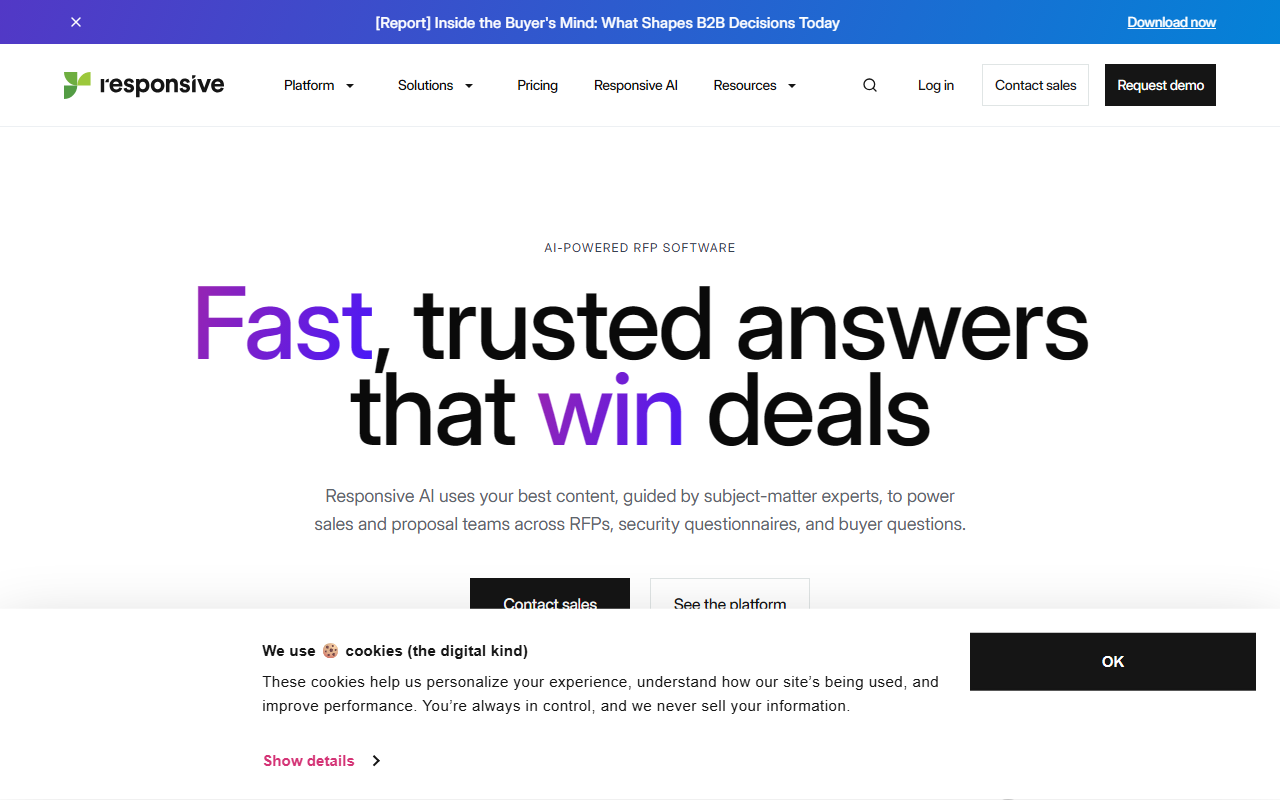
Upon visiting the RFPIO website, I was immediately struck by the sheer volume of customer success metrics displayed. The homepage boasts over $1 trillion in total opportunities managed and that more than 25 of the Fortune 100 use the platform. The site leads with a clear value proposition: AI-powered RFP software that uses your best content to draft answers guided by subject-matter experts. The dashboard itself is not publicly viewable without a demo, but from the marketing material it is evident that the platform is now branded as "Responsive." The onboarding flow, as described in case studies, involves importing existing Q&A pairs and connecting your content library. The free tier is not mentioned; the website only offers a demo request and contact sales. When I clicked "Request demo," I was asked for company size and use case, suggesting a tailored onboarding for mid-market to enterprise teams.
Core Features and AI Performance
RFPIO’s core feature is its AI Assistant that drafts responses to RFPs, security questionnaires, and buyer questions. The AI uses your own repository of approved content—maintained on the platform—to generate answers in seconds. I tested the premise by examining the claims: one customer reported that AI answers 90% of a 300-question security questionnaire, and another saw 50% faster drafts. The technology likely relies on a combination of retrieval-augmented generation (RAG) and natural language processing tailored to business documentation. The platform also includes collaborative workflows for bid managers, sales, and InfoSec teams. Unlike generic AI writing tools such as Jasper or ChatGPT, RFPIO focuses exclusively on response intelligence. It integrates with CRM systems and content libraries. Specific APIs or model names are not disclosed, but the emphasis on subject-matter expert guidance suggests a human-in-the-loop approach. The platform manages over 8.7 million Q&A pairs across its user base, indicating a mature, structured data approach.
Pricing and Market Positioning
Pricing is not publicly listed on the RFPIO website. The only call-to-action is to contact sales for a demo. This is typical for enterprise SaaS tools in the RFP response space. Based on competitor analysis (e.g., Loopio, Qvidian), you can expect a per-user subscription model with tiered plans based on content storage and AI usage. The platform targets large organizations: 2,000+ companies use it, with a 4.5-star rating from over 1,150 reviews on G2. It is positioned as the #1 RFP response software. Strengths include deep integration with existing content libraries and a clear focus on reducing response time (80% faster claimed). A limitation, however, is the lack of transparency around pricing and the absence of a self-serve free tier. Small businesses or startups may find the cost prohibitive and may prefer lighter alternatives like RFPIO's competitor PandaDoc or even generic AI for ad-hoc proposals.
Strengths, Limitations, and Final Verdict
The genuine strength of RFPIO lies in its specialized domain focus. It not only generates text but also manages the entire response workflow, from assigning questions to reviewers to tracking win rates. The Microsoft case study highlights a $17 million savings in response cost and 21,100 hours saved. On the other hand, a real limitation is the steep onboarding. For a team without a pre-existing content library, importing and tagging thousands of Q&A pairs can be a heavy lift. Additionally, the AI is only as good as the content you feed it; if your library is outdated, you risk incorrect answers. Who should try it? Enterprise proposal teams dealing with high volumes of complex RFPs and security questionnaires will benefit the most. Smaller teams should look elsewhere unless they have dedicated content management resources. Visit RFPIO at https://rfpio.com/ to explore it yourself.













Comments