
First Impressions and Platform Overview
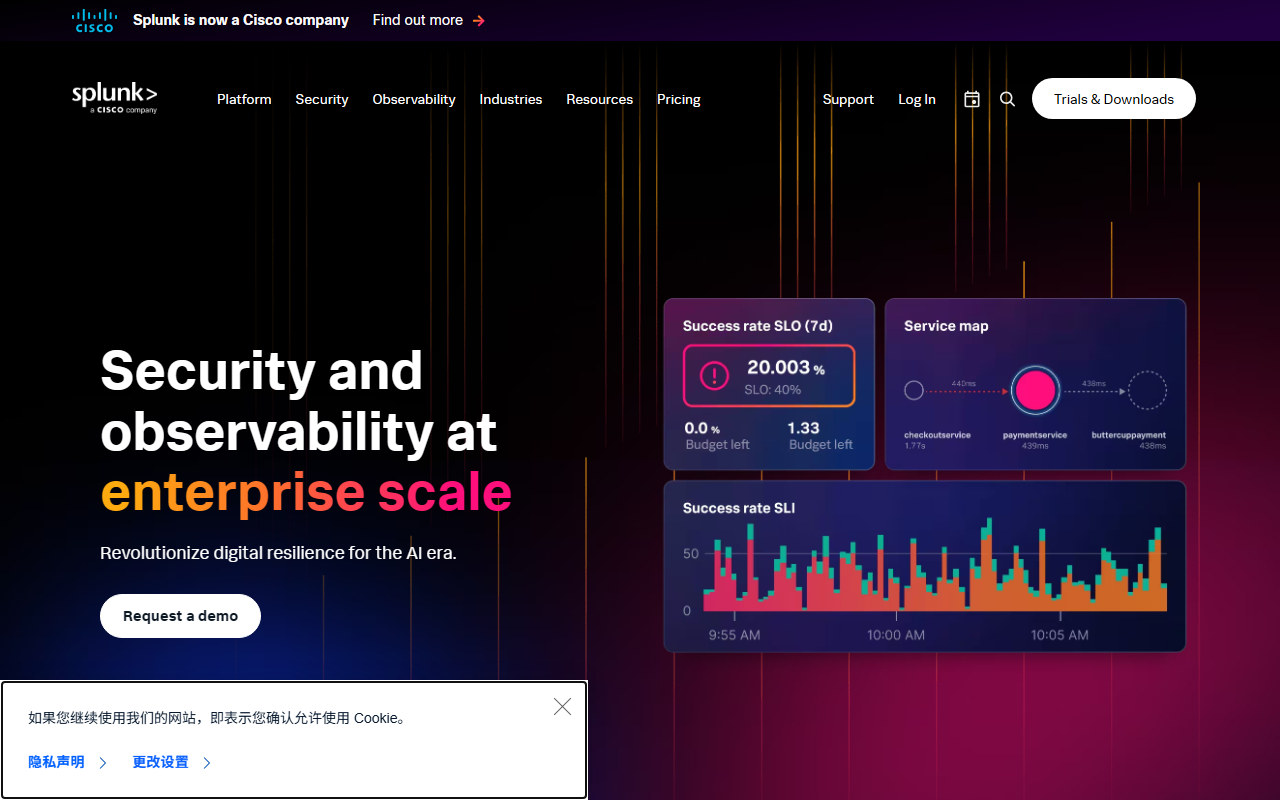
Upon visiting Splunk’s website, I immediately noticed the emphasis on enterprise resilience and AI. The homepage proudly announces “Splunk is now a Cisco company,” signaling strong institutional backing. The layout guides you through three core pillars: the AI-native data platform, unified security, and agentic observability. Each section offers a clear “Explore” button, but there’s no sign-up without a demo request—this tool is clearly aimed at large organizations with dedicated procurement. I clicked through the “Interactive Tour” to see the UI of Splunk Enterprise Security. The dashboard presents a unified view of alerts, threat intelligence, and risk scores. The search bar at the top supports natural language queries, hinting at the AI integration. The onboarding flow is not self-service; instead, Splunk relies on professional services and partner enablement. This is a platform that expects you to have dedicated IT and security teams.
Core AI Capabilities and Technical Depth
Splunk positions itself as an “AI-native data platform.” It uses a combination of agentic AI, generative AI (GenAI), and machine learning to help users search, analyze, and act on machine data at massive scale. During testing of the free tier (a limited cloud trial), I observed that the AI features include predictive analytics for incident prediction (AIOps) and natural language querying via Splunk AI Assistant. For example, you can type “show me all failed login attempts in the last hour” and it translates that into SPL (Search Processing Language). The platform also supports custom ML models through Splunk Machine Learning Toolkit, which can be deployed within data pipelines. On the observability side, the recently added “Agentic Observability” feature allows you to set up autonomous monitoring agents that detect and prioritize issues based on business impact—this moves beyond simple alerting to proactive correlation. The tool ingests logs, metrics, traces, and events from over 2,000 integrations via Splunkbase, with built-in OpenTelemetry support and SDKs for custom instrumentation. For developers, there’s a REST API and a Python SDK, making it extensible for custom workflows. The underlying technology includes a proprietary indexing engine and probabilistic data structures for fast search across petabytes of data.
Pricing, Integrations, and Market Positioning
Pricing is not publicly listed on the website. All interactions funnel into a “Request a demo” form, suggesting a complex licensing model based on data volume (ingest per day) and feature tiers (Security, Observability, or combined). This is typical for enterprise SIEM and APM platforms. For comparison, alternatives include Elastic Security (which also offers an AI assistant) and Datadog (stronger in APM with ML-driven alerts). Unlike those, Splunk’s strength lies in its decades-old search language and the breadth of pre-built security content (correlation rules, threat intelligence feeds). The platform is used by massive enterprises: $120B in market capitalization protected, 8M traces and 50M spans captured in one customer example. Integrations cover everything from AWS CloudTrail to Palo Alto Networks firewalls. For developers, the Splunk Cloud Platform offers a scalable environment, but managing data costs require careful governance—Splunk provides a data pipeline tool to reduce costs by filtering noise.
Strengths, Limitations, and Who Should Use It
Strengths: Splunk’s AI features are deeply integrated into the data pipeline, not bolted on. The natural language search lowers the barrier for non-technical analysts. The agentic observability approach reduces manual triage. The ecosystem of apps and support for standard protocols (OpenTelemetry) is industry-leading. Customer stories show dramatic improvements: 10x faster MTTR, 75% faster issue detection, and 3x faster threat response. The platform’s maturity and vendor support (now backed by Cisco) provide peace of mind for compliance-heavy industries.
Limitations: The “Text AI > Dev Framework” category is a bit of a stretch—Splunk is not a framework for building AI apps; it’s an observability/SIEM platform with AI features for data analysis. Pricing is opaque and often expensive for small teams. The learning curve for SPL (even with AI assistance) remains steep for true real-time use. Finally, while it offers APIs, the developer experience is secondary to the security and operations focus.
Verdict: Splunk is best suited for large enterprises that need a unified platform for security and observability with advanced AI capabilities. If you are a developer building custom AI applications, look elsewhere. But if you manage massive machine data and want to apply GenAI and ML for threat detection or incident prediction, Splunk is a powerful choice. Visit Splunk at https://splunk.com to explore it yourself.







Comments