

First Impressions and Onboarding
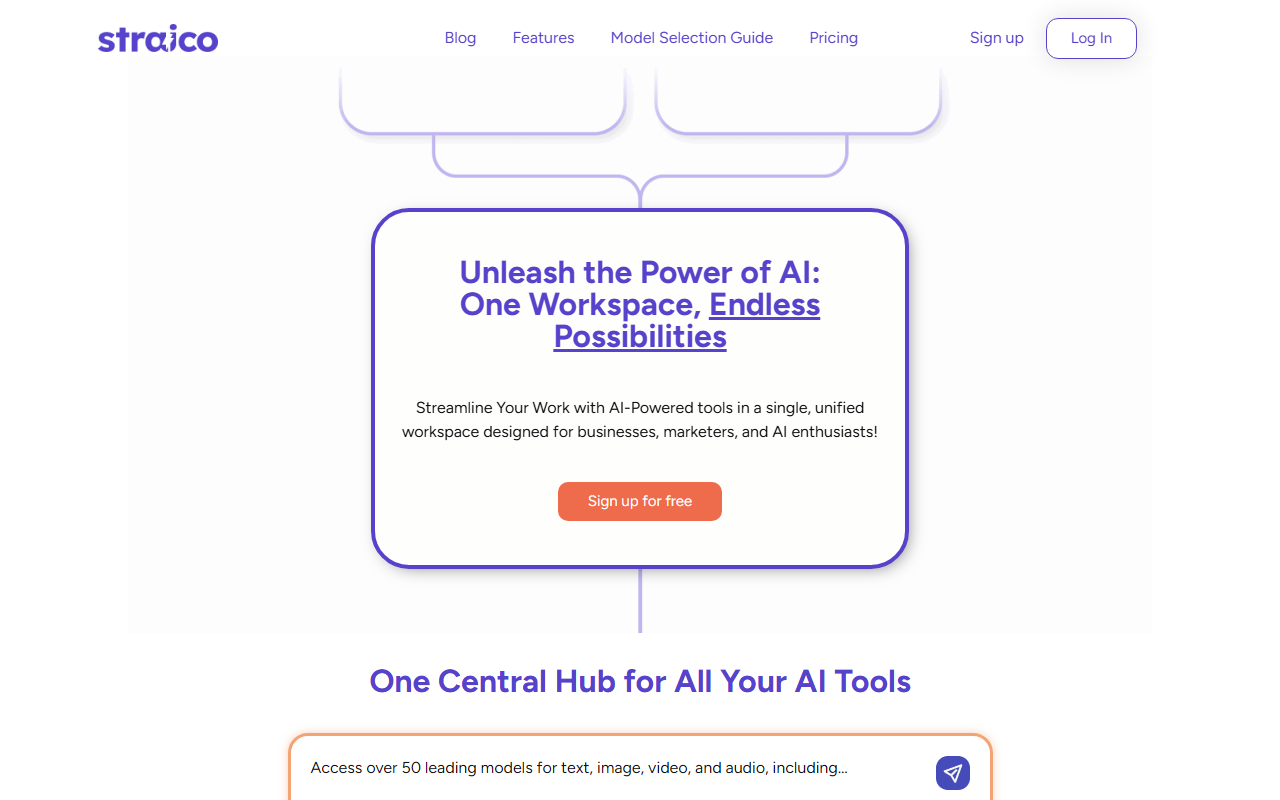
Upon visiting the site, I was greeted by a clean, modern dashboard that immediately communicates the tool's value proposition: one workspace for dozens of AI models. The sign-up process is frictionless — I created a free account in under a minute without needing a credit card. The free tier grants access to a limited number of models and monthly coins (the site advertises 40,000 coins for paid plans), which is enough to explore the interface. Once logged in, the left sidebar lists your chats, templates, and model combos, while the main area is a chat window with a model selector dropdown. The layout feels familiar to anyone who has used ChatGPT or Claude, but the model selector is far more advanced: it shows popularity, use cases, and strengths for each LLM.
Core Features and Workflow
Straico’s standout feature is the ability to interact with over 50 models in one place. These include GPT 5.2, Claude Opus 4.5, DeepSeek V3.2, Perplexity Sonar Deep Research, as well as image generators like Flux 2 Pro, Ideogram V3, and video models like Runway Gen-4 Turbo and Sora 2. I tested side-by-side comparisons by selecting two models — GPT 5.2 and Claude Opus 4.5 — and asking the same question about market trends. The responses appeared in parallel panels, and I could use the “Smart Merge” feature to unify them into a cohesive answer or highlight differences. This is incredibly useful for researchers and marketers who want to compare outputs before committing to a model.
The Visual Tree Layout provides a graphical overview of your conversation flow, showing how inputs and outputs connect. This helps when you have branching discussions with multiple models. I also explored the Model Combos feature: I created a custom combo of three models (a reasoning model, a creative writer, and a code assistant) and could switch between them within the same chat. The template library includes over 130 pre-built prompts for tasks like SEO, copywriting, and code generation. I tried the “Blog Post Outline” template and was impressed by how it automatically selected a recommended model and prompt structure.
For developers, Straico offers a RESTful API with detailed documentation, enabling integration into custom workflows. There’s also a dedicated n8n node for automation, which is a smart addition for no-code enthusiasts. The 2,500+ member Discord community is active and helpful, with channels for sharing templates and getting prompt advice.
Pricing and Value Proposition
Straico offers a single paid plan: $19.99 per month (or $16.99 per month billed yearly). This includes access to all models, 40,000 monthly coins, and all features. Coins are consumed per request, with different models costing different amounts — for example, video generation models like Sora 2 or Runway Gen-4 Turbo likely use more coins than simple text queries. The site does not provide a detailed coin cost per model publicly, but the model guide explains limits. Compared to subscribing to individual tools (Claude, ChatGPT, Gemini, etc.) which would total over $160 per month, Straico’s pricing is extremely competitive for power users. However, the coin system can be a limitation for heavy users who generate many images or long videos; you may run out before the month ends. There is no unlimited tier offered.
Strengths and Limitations
Straico’s main strength is the breadth of models in a unified workspace. Side-by-side comparisons, model combos, and the template library make it an excellent productivity tool for professionals who need to evaluate or combine AI outputs. The API and n8n integration extend its utility to automated workflows. The community and expert recognition (with case studies showing 77% efficiency gains) add credibility.
On the flip side, the coin-based system introduces friction — you have to manage usage carefully, especially with media generation. Some models may not be as up-to-date as their standalone counterparts (e.g., the latest Claude Opus 4.5 is listed, but update frequency is not guaranteed). The dashboard can feel overwhelming for beginners due to the many options and settings. Also, while there is a free tier, its model selection and coin allowance are very limited — you’ll likely need to upgrade to evaluate the tool properly.
Overall, Straico is best suited for marketers, content creators, and AI enthusiasts who regularly need to compare outputs from multiple models and want to avoid juggling subscriptions. Casual users who only need one model (e.g., ChatGPT) may find the interface overkill and cheaper standalone options more appropriate. If you value consolidation and side-by-side analysis, Straico is worth the trial.
Visit Straico at https://straico.com/ to explore it yourself.













Comments