

First Impressions and What Tonkean Does
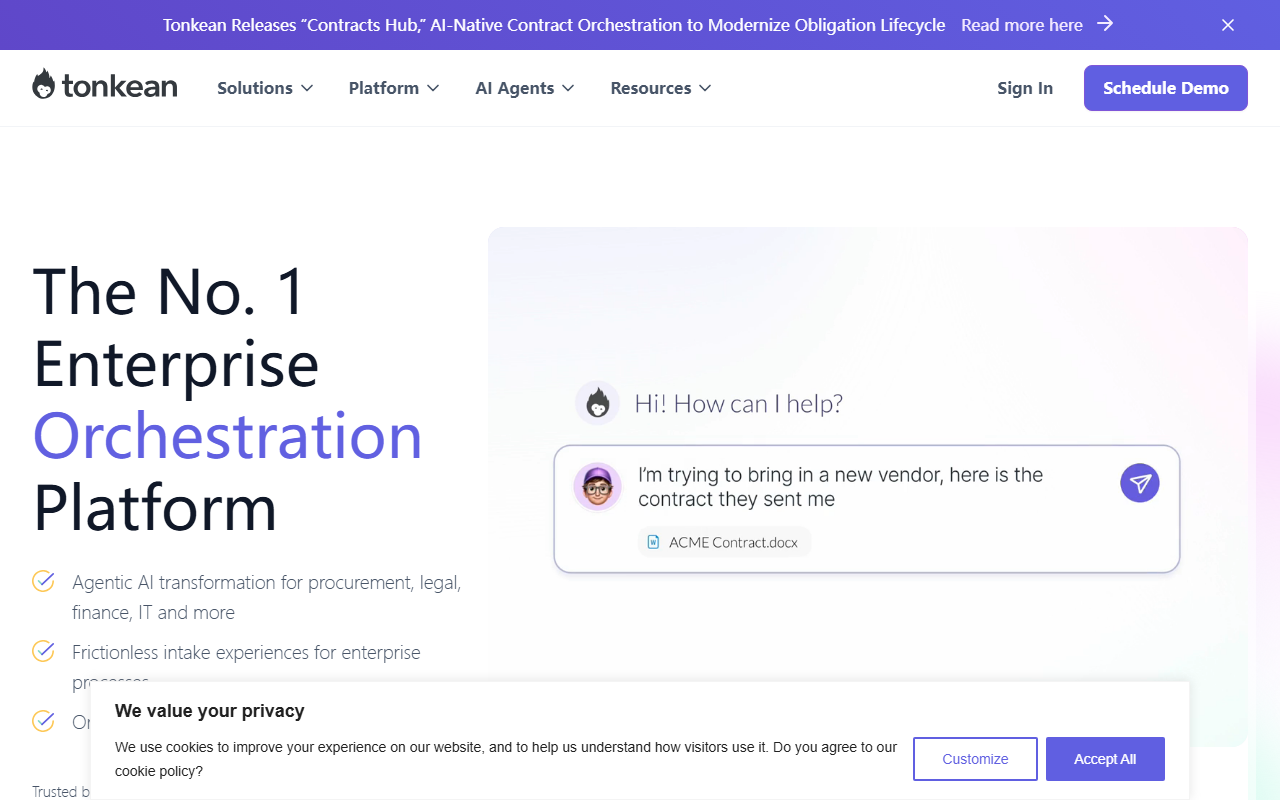
Upon visiting the Tonkean website, the tagline immediately sets expectations: "The No. 1 Agentic Orchestration Platform for the Enterprise." The site is polished, enterprise-focused, and makes a clear case that most AI projects fail without proper orchestration. Tonkean solves a specific pain point: how do you move AI from personal productivity tools to company-wide, mission-critical processes? The answer, according to the platform, is an orchestration engine that combines AI agents with deterministic process logic and a context graph. This allows teams to build end-to-end workflows that handle intake, approvals, data syncing, and output generation—all without heavy IT involvement.
The homepage highlights two primary use cases: procurement and legal. For procurement, Tonkean offers AI-first intake that interprets plain-language requests, routes them to the right workflow, and can autonomously handle routine purchases. For legal, an AI Front Door fields questions and dynamically guides requesters through context-aware intake. Both solutions connect to over 250 applications including Coupa, SAP, CLM systems, DocuSign, and CRM tools. The platform is essentially a no-code builder for AI agents that operate within your governance framework. Pricing is not publicly listed on the website, but the presence of a "Schedule Demo" button suggests custom enterprise pricing.
Exploring the Interface and Workflows
When I dived deeper into the platform's description, I found a dashboard that emphasizes simplicity for process owners. Tonkean uses a drag-and-drop skills builder where you can set plain-language instructions for agents. For example, the AI Sourcing Agent can create purchase orders, conduct supplier analysis, and orchestrate approvals across departments—all from a single pane. The AI Contract Manager Agent drafts contracts, reviews terms, and tracks renewals. The interface appears to abstract away coding entirely; one-click publish allows subject-matter experts to deploy and refine agents without IT. This is a major differentiator from low-code platforms that still require technical know-how.
I also looked at the testimonials from actual customers. Workday achieved "Nearly 100% adoption" for a key intake process and is now leveraging Tonkean's AI Front Door to make submitting intake even easier. Semrush reduced cycle times from 19 days to 10 for procurement intake. Cockroach Labs cut ticket-creation time from 30 minutes to 5. These concrete metrics suggest the platform delivers measurable efficiency gains. The orchestration engine appears to wrap around existing tech stacks rather than replacing them, which is a pragmatic approach for enterprises with legacy systems. Real-time dashboards provide visibility into process status, cycle-time KPIs, and savings metrics—key for operations teams.
Strengths, Limitations, and Market Position
Strengths: Tonkean's biggest strength is its focus on agentic orchestration with governance. It's not just an AI chatbot; it's a platform that actually executes work—creating records, sending approvals, syncing data. The no-code builder empowers ops teams without IT bottlenecks. The deep integration library (250+ apps) and support for enterprise compliance are crucial for procurement and legal departments. Testimonials from well-known companies like Workday and Semrush add credibility. Additionally, the platform offers pre-built agents (NDA, Sourcing, Contract Manager, etc.) that can be customized quickly.
Limitations: The lack of publicly available pricing is a barrier for smaller teams evaluating the tool. Tonkean is clearly built for enterprises; SMBs may find the full feature set overkill or too costly. The focus is narrowly on procurement and legal use cases; while the platform is extensible, marketing heavily biases toward these two verticals. There is also no obvious API documentation or self-service trial mentioned on the public site—most evaluations likely require a demo. Competitors like ServiceNow provide similar workflow automation for IT and legal but with less emphasis on AI agent autonomy, while tools like Zapier or Make offer cheaper integration but lack enterprise governance and agentic orchestration.
Verdict: Who Should Use Tonkean?
Tonkean is best suited for enterprise operations teams in procurement, legal, and finance departments that are dealing with high volumes of intake requests, manual handoffs, and fragmented system landscapes. The platform excels when you need to automate complex, multi-step processes with AI while maintaining compliance and audit trails. It is not designed for small businesses or individual productivity use—those users would be better served by simpler automation tools. If your organization is already investing in AI but struggling to embed it into real workflows, Tonkean's agentic orchestration approach is worth exploring via a demo. The customer success stories from Workday, Semrush, and Cockroach Labs demonstrate tangible ROI. Visit Tonkean at https://tonkean.com/ to explore it yourself.










Comments