

First Impressions: A Platform Built for Privacy, Not Chat
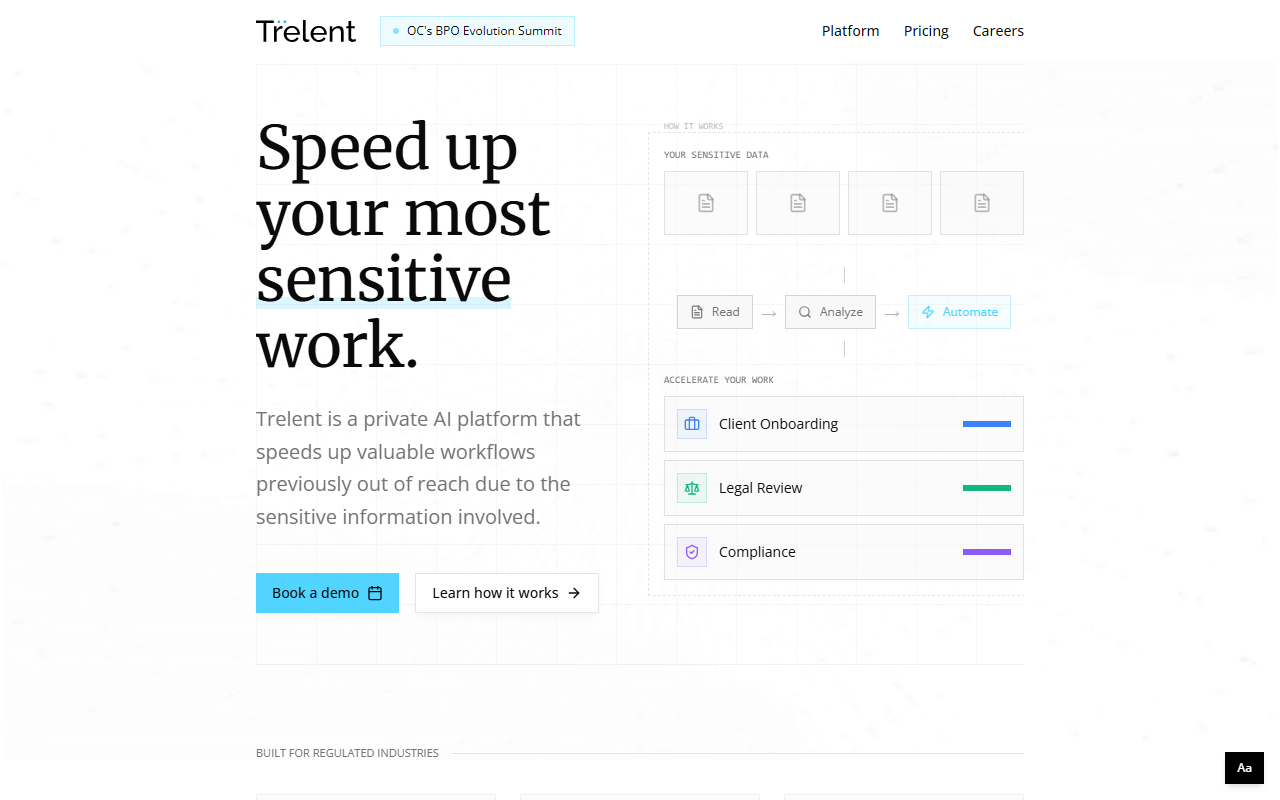
Upon visiting Trelent's website, I was struck by how clearly they position themselves against the generic AI chatbot trend. The headline — “Infrastructure for high-value, private AI workflows” — immediately tells you this isn't another content generator. The homepage wastes no time explaining the core problem: most AI tools expose sensitive data, making them unusable for legal, financial, or compliance work. Trelent promises a private environment where your data never leaves your control. The design is clean, with a straightforward flow: “Read → Analyze → Automate.” Booking a demo is the primary call-to-action, which hints that setup is tailored rather than self-serve. I appreciated the immediate clarity — this is for professionals who have already tried conventional AI and hit a privacy wall.
Core Capabilities: Three-Layer Architecture for Sensitive Data
Trelent's platform is built on three distinct layers: Data Ingestion, Intelligent Search, and Agent Orchestration. Based on my reading of their materials, this is not a single chatbot but an infrastructure that integrates into existing workflows. The data ingestion layer connects to your files and databases, transforming them into “AI-ready context” without sending data externally. Intelligent search uses semantic understanding rather than keyword matching, which is critical for legal contracts or financial statements where exact phrasing matters less than meaning. The agent orchestration layer handles multi-step AI workflows, pulling the right context at the right time. I observed that the website emphasizes “just working systems that solve real problems, fast” — a direct contrast to many tools that require extensive prompt engineering. While the specific underlying models aren't disclosed, the focus is clearly on privacy compliance from day one, which likely means on-premises or virtual private cloud deployment.
Use Cases and Target Audience: Regulated Industries First
Trelent explicitly targets financial services, legal, and cybersecurity sectors. The website details three use cases: client onboarding, financial intelligence, and legal intelligence. For client onboarding, the platform speeds up reviews and compliance checks, which are often manual processes involving sensitive personal data. Financial intelligence involves scanning statements for automated compliance and risk assessment tailored to a business's unique requirements. Legal intelligence automates document review, automatically spotting red flags in contracts or filings. I noticed that each use case promises specific outcomes: “increase your margins,” “speed up manual workflows,” “win more cases.” This suggests Trelent's value proposition is operational efficiency paired with strict privacy — exactly what a bank or law firm needs to avoid regulatory fines while adopting AI. Unlike generic AI tools like ChatGPT or Claude (which can be fine-tuned but lack built-in enterprise privacy guarantees), Trelent positions itself as an infrastructure layer that guarantees compliance from the start. That said, smaller businesses or individual practitioners may find the platform overkill if their data sensitivity is moderate or if they have low-volume workflows.
Pricing, Limitations, and Verdict
Pricing is not publicly listed on the website. The main call-to-action is “Get started” which leads to a demo request. This is typical for enterprise B2B products, but it can be frustrating for potential users who want upfront cost estimates. I also noticed no mention of API availability or integration with common tools like Microsoft 365 or Salesforce — though given the privacy focus, custom integrations are likely handled during onboarding. One genuine strength is the privacy-first architecture, which is a major differentiator in a market where most AI products send data to third-party servers. A limitation is the lack of visible benchmarking or independent case studies — the website uses aspirational language but doesn't share specific performance metrics. Another limitation: the platform's success heavily depends on the quality of your data ingestion and workflow design, which may require technical expertise or vendor consulting.
Who should use Trelent? Organizations in regulated industries handling sensitive documents — law firms, banks, cybersecurity teams — where data privacy is non-negotiable. If you're an individual developer or a small startup without strict compliance needs, you may find cheaper or open-source alternatives workable. Trelent is best suited for teams willing to invest in a tailored demo and setup in exchange for ironclad privacy.
Visit Trelent at https://trelent.com/ to explore it yourself.













Comments