

First Impressions and Onboarding
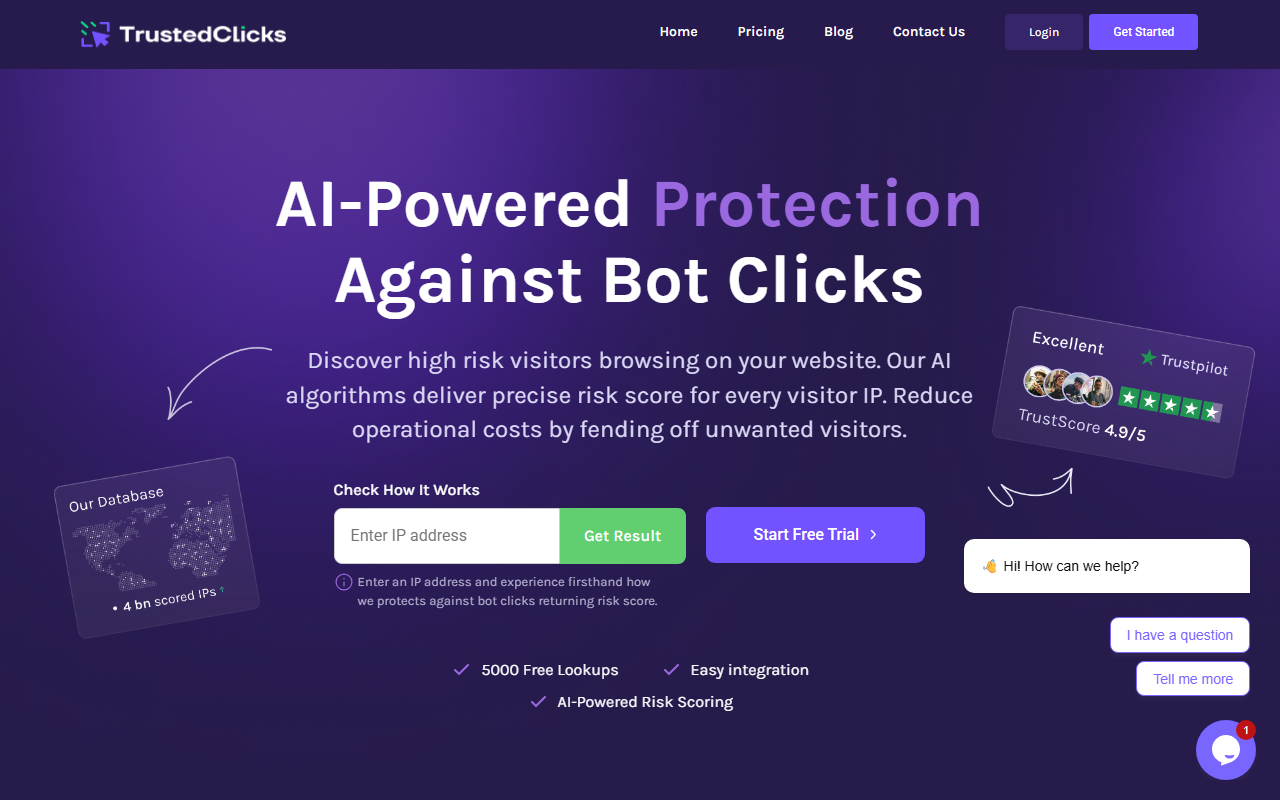
Upon visiting Trusted Clicks at trustedclicks.ai, I was greeted with a clean, no-nonsense landing page. The headline "AI-Powered Protection Against Bot Clicks" immediately clarifies the tool's purpose: scoring visitor IP addresses to identify bot traffic and fraudulent behavior. The site offers a prominent IP lookup field right on the homepage, inviting immediate testing. I entered a sample IP address and received a risk score displayed in a pop-up, along with details like TOR exit node status, proxy, VPN, trust level, and connection type. However, after five free lookups, the prompt locks further checks behind account creation. This friction is understandable for a B2B security tool, but the free tier is quite limited—only five IPs without registration. The "Start Free Trial" button suggests a more generous trial after sign-up, but I did not proceed to test that flow. The dashboard itself is not shown pre-login, but the integration section promises a 10-minute API setup, which is a strong claim for rapid adoption.
How Trusted Clicks Works and Core Features
Trusted Clicks is essentially an IP intelligence API. It analyzes each visitor's IP address in real time and assigns a dynamic risk score from 0 (low risk) to 100 (high risk). The higher the score, the more likely the IP belongs to a bot, a known fraudulent actor, or a visitor using proxies or VPNs to hide their location. This is extremely useful for e-commerce platforms where bot clicks can inflate ad costs, skew analytics, or even attempt checkout fraud. The AI algorithm behind the scoring is proprietary; the website does not specify which models or frameworks are used, but it claims to leverage "cutting-edge AI technology" for accuracy. Features include instant risk scoring, detection of TOR, VPN, and proxy usage, and a trust level indicator. The tool also offers a "Location" field, though in my test it only showed country/region. Integration is via a RESTful API, with clear documentation promised for developers. A notable strength is the promise of 5000 free lookups for new users—far more generous than the initial 5-IP cap suggests—but the exact conditions (time-limited or permanent) are not explained on the site.
Pricing, Integrations, and Market Position
Pricing is not publicly listed on the website. The only concrete numbers are "5000 Free Lookups" (likely a trial quota) and the mention of "5 free IP look-ups" before sign-up. There is no pricing page visible without logging in, which is a drawback for transparency. Competitors in this space include IPQS (IP Quality Score) and MaxMind, both of which also offer fraud scoring and IP risk analysis. Unlike those established players, Trusted Clicks focuses specifically on bot-click detection for websites, whereas IPQS covers email verification, phone, and proxy detection more broadly. The tool claims "easy integration" with any programming language and a 10-minute setup, which is comparable to API-first services like IPQS. The homepage includes a testimonial from "Nodemaven," but no contact or company details are provided, so I cannot verify its authenticity. The site footer shows "© 2024 TructedClicks" (note the typo in "TructedClicks"), which suggests a relatively new or small team. Without clear pricing or case studies from known brands, Trusted Clicks feels like a promising but unproven solution for enterprises.
Verdict: Who Should Use Trusted Clicks
This tool is best suited for small to medium-sized e-commerce businesses, affiliate marketers, or ad publishers who need a quick, affordable way to filter bot traffic from their analytics or ad campaigns. The AI-powered scoring is straightforward, and the 5000 free lookups allow for thorough testing before any commitment. However, large enterprises with complex fraud prevention needs may find the lack of detailed documentation, transparent pricing, and custom integration support a dealbreaker. A real limitation is the absence of any mention of data retention policies, compliance (GDPR/CCPA), or SLA guarantees. Additionally, the website itself has a few typos and inconsistent messaging (e.g., "5 free lookups" vs "5000 free lookups") that erode trust. If you need a simple, AI-driven IP check for blocking suspicious clicks, Trusted Clicks is worth a trial. But for robust enterprise use, look to IPQS or MaxMind for proven reliability. Visit Trusted Clicks at https://trustedclicks.ai/ to explore it yourself.













Comments