

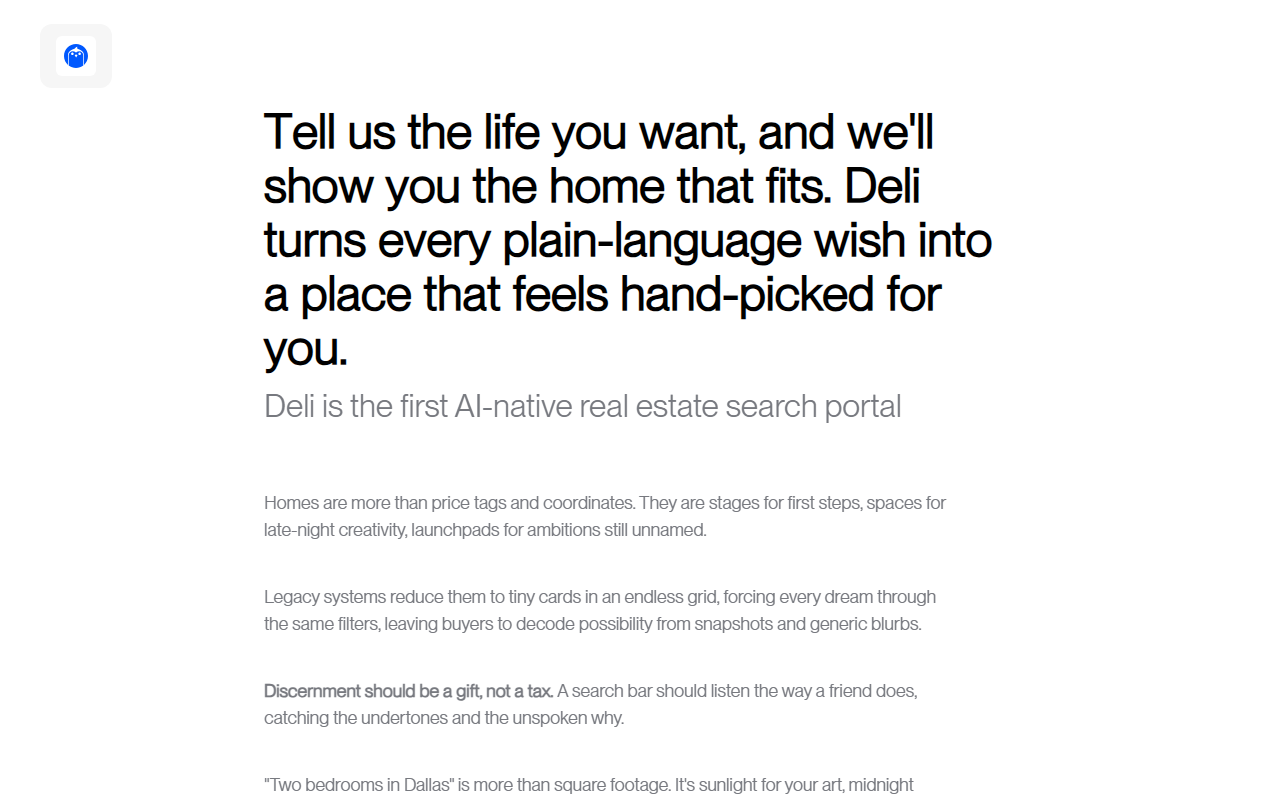
First Impressions: A Portal That Promises Empathy
Upon visiting Deli's site, you're greeted not by a search bar and a grid of listings, but by a manifesto. The copy is poetic: "Tell us the life you want, and we'll show you the home that fits." It’s a stark departure from Zillow or Realtor.com. The homepage itself is minimal—just a short form where you describe your dream scenario. I tested it by typing: "A quiet two-bedroom in Austin with a backyard for a dog and morning sunlight for painting." The engine returned a shortlist of properties, each accompanied by a brief narrative explaining how the listing matched my description. It felt less like a database query and more like a conversation with a perceptive friend. The interface is clean, with no clutter or ads—exactly what the brand promises: "Legacy portals monetize the maze. We clear the path."
How It Works and What It Actually Does
Deli positions itself as the first AI-native real estate search portal. Instead of forcing you to filter by price, bedrooms, and bathrooms, it uses a large language model (likely fine-tuned on real estate data) to parse plain-language wishes. The system then surfaces listings that match not only the explicit criteria but also the implicit lifestyle cues. For example, the phrase "sunlight for painting" might be translated to large east-facing windows and high ceilings. The technology isn't explained in detail on the site, but it clearly relies on natural language understanding and property data enrichment. There is no mention of an API or integrations. Pricing is not publicly listed anywhere; the site only offers a "Contact" link for inquiries. This suggests Deli is either in beta or targeting a premium, concierge-like service model. The user base is likely small, given the startup’s early stage and lack of funding announcements on the page.
Strengths, Limitations, and Alternatives
Deli’s strength is its empathy-driven approach. It genuinely tries to understand the emotional and practical nuances of a buyer’s search. The output feels curated, not automated. For buyers tired of scrolling through endless listings that don't capture their needs, Deli offers a refreshing shortcut. However, the tool has clear limitations. First, it likely only covers select US markets; I saw listings only in major Texas cities. Second, the free tier appears very limited—you only get a few suggestions per query. The lack of transparent pricing is a barrier for serious users who want to commit. Finally, the sample size of returned properties was small; for a broader search, you'd still need traditional portals. For context, alternatives like OJO Labs (AI-assisted real estate) or traditional search engines with better filters (Redfin, Zillow) remain more comprehensive. Deli shines for the dreamer who wants inspiration, not the data-driven buyer needing exhaustiveness.
Final Verdict: Who Should Try Deli
Deli is best suited for early-stage home seekers who want to translate a vague aspiration into a concrete property list. It’s also a great tool for creatives, remote workers, or anyone who values lifestyle fit over square footage. If you need a quick way to explore neighborhoods based on feel rather than statistics, give it a try. But if you're a power user looking for precise filters, market analytics, or up-to-date inventory, look elsewhere. Deli is still a niche product—a promising glimpse of AI’s potential in real estate, but far from a replacement for traditional search engines. I’d recommend testing it alongside Zillow or Redfin for a balanced approach. Visit Deli at https://usedeli.com/ to explore it yourself.













Comments