

First Impressions: A Chat-Based Mental Health Ally
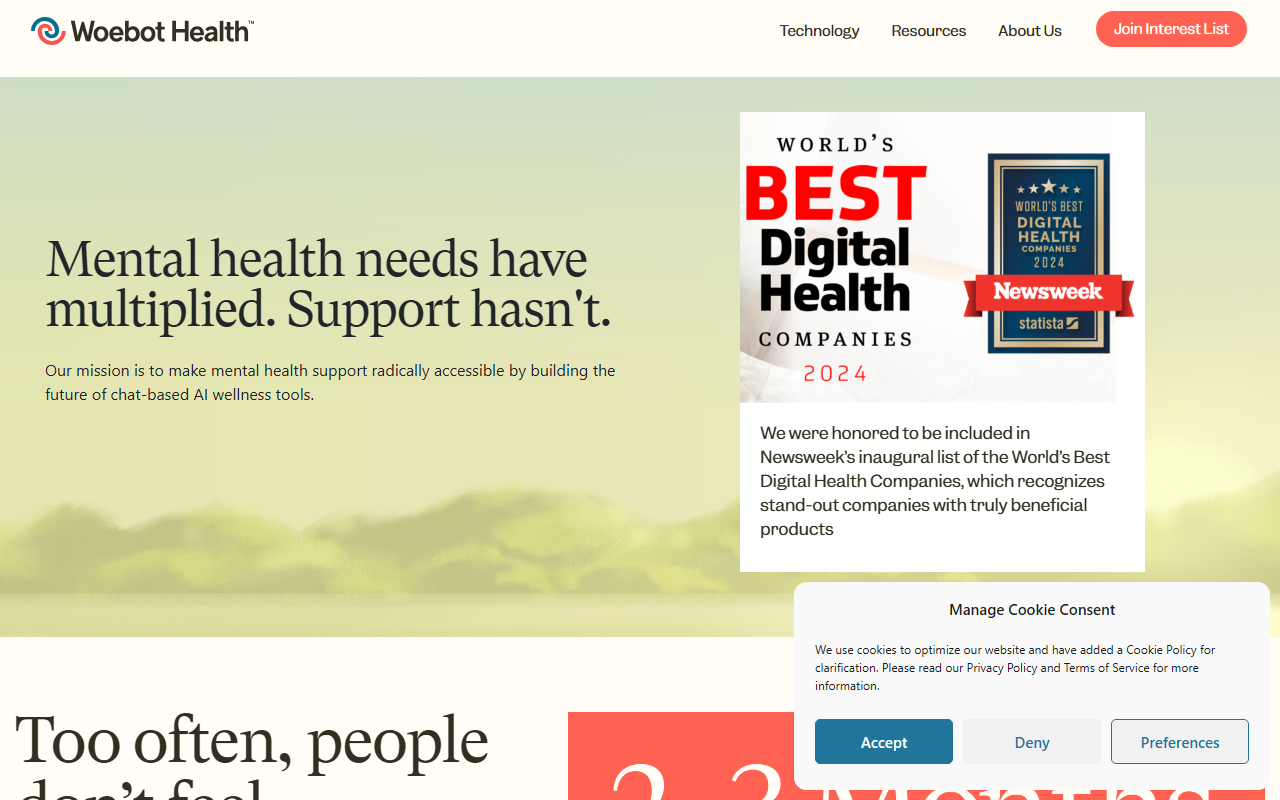
Upon visiting the Woebot Health website, I was greeted by an age verification prompt asking if I am 18 or older. This immediately signals that the tool is designed for adults and takes compliance seriously. The homepage is clean and mission-driven, emphasizing that mental health needs have multiplied while support hasn't. The dashboard-like layout presents key information about their philosophy of care, achievements, and a cookie consent banner. There is no live demo or immediate chat window, which suggests that Woebot is accessed via a separate mobile app or through partner organizations. I observed that the site heavily leans on clinical credibility, mentioning their founder Dr. Alison Darcy, a clinical research psychologist, and their inclusion in Newsweek's World's Best Digital Health Companies. The tone is empathetic and professional, making it clear that this is not a casual wellness app but a serious mental health tool.
How Woebot Works: The Tech Behind the Therapy
Woebot is an AI-powered chatbot that delivers cognitive behavioral therapy (CBT) techniques through conversational text. It uses natural language processing to understand user inputs and guide them through exercises, mood tracking, and psychoeducation. The underlying technology is not explicitly detailed on the site, but given the founder's background in clinical research, it likely incorporates rule-based logic combined with machine learning models trained on therapeutic conversations. Unlike generic AI writing tools, Woebot is purpose-built for mental health support. The website emphasizes that empathy and rigor are central to their approach, and they offer integrations for employers and healthcare organizations. A notable technical detail is the ORCHA certification mentioned in the footer, though the site clarifies that this does not denote FDA approval. The tool is designed to be a scalable ally, supplementing rather than replacing human therapists.
Pricing and Accessibility: What You Need to Know
Pricing is not publicly listed on the website. Woebot Health appears to operate on a business-to-business model, selling access to companies, insurers, or healthcare systems rather than directly to consumers. This means individual users may not be able to sign up independently. The site mentions offerings that "grow alongside the people and organizations they serve," suggesting tiered plans based on population size. For direct-to-consumer access, a separate mobile app may exist with a freemium or subscription model, but this is not confirmed from the website alone. The age gate and strict cookie consent indicate a focus on privacy and regulatory compliance, which aligns with healthcare applications. Without transparent pricing, potential users should contact the company directly or check app stores for availability and cost.
Who Should Use Woebot? Strengths and Limitations
Woebot's main strength is its accessibility: it provides evidence-based mental health support at any time, without scheduling appointments or navigating insurance jargon. The clinical foundation and recognition from Newsweek and TIME100 AI lend it strong authority. However, it has clear limitations. As an AI chatbot, it cannot handle crises or severe mental health conditions—users in immediate danger should call emergency services. The age restriction also excludes younger teens who might benefit from support. Compared to alternatives like BetterHelp (human therapists) or Wysa (another AI chatbot), Woebot focuses more on clinical validation and B2B partnerships. It is best suited for adults looking for a low-cost, on-demand way to practice CBT skills, or for organizations wanting to scale mental health support. Those needing personalized human therapy or who dislike text-based interactions should look elsewhere. Overall, Woebot is a promising tool for bridging the gap in mental health care, but it is not a standalone solution.
Visit Woebot Health at https://woebothealth.com/ to explore it yourself.












Comments