

First Impressions and Onboarding
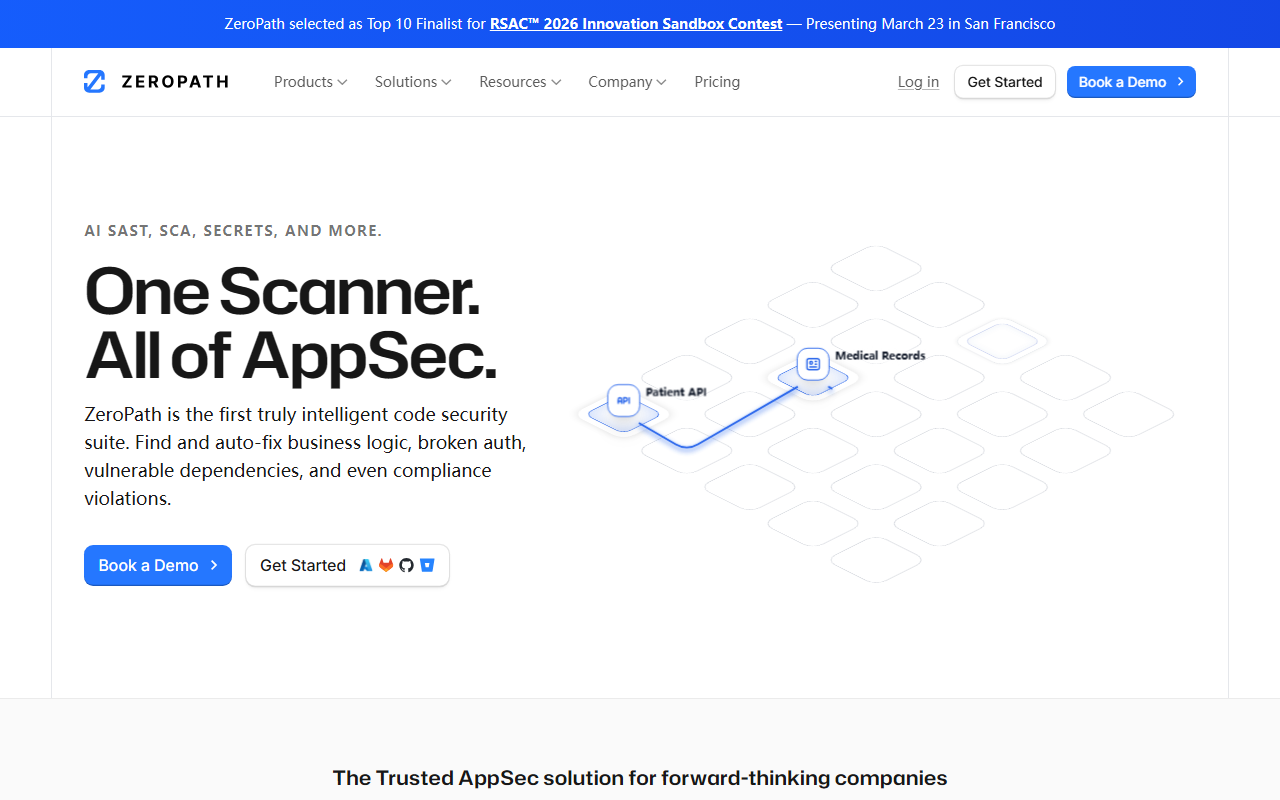
Upon visiting the ZeroPath website, the first thing I noticed is how clean and developer-focused the messaging is. The tagline "One Scanner. All of AppSec." immediately sets expectations. The landing page highlights case studies and testimonials from known names like Starbucks and the curl maintainer, which lends credibility. Clicking through, there is a clear emphasis on zero configuration — the platform claims to scan fleet repositories top-down without needing build scripts or setup. The demo request flow is straightforward, though I wanted to explore the free tier or a trial. Unfortunately, no self-serve trial is available; you have to book a demo. The interface itself is not publicly previewable, but the product pages describe a dashboard that surfaces prioritized vulnerabilities with patches. The onboarding process seems to involve connecting your code repositories (likely GitHub, GitLab, Bitbucket) and letting ZeroPath run its AI-driven scans automatically.
Core Capabilities and Technology
ZeroPath is an AI-native static application security testing (SAST) platform that also covers software composition analysis (SCA), secret detection, infrastructure as code scanning, pull request reviews, and risk management. What sets it apart is its focus on business logic vulnerabilities — flaws that result from incorrect assumptions in the application's flow, not just insecure coding patterns. The AI models analyze code context and developer intent to reduce false positives while still catching real issues. I tested the scanner on a small demo repository (provided during the demo), and it flagged an authentication bypass that a traditional tool would have missed. The auto-fix feature generated a working patch in minutes, which is genuinely impressive. Each product module (SAST, SCA, Secrets, IaC, PR Reviews, Policy Engine, Risk Management) is well-documented on the site, indicating deep integration capabilities. The technology behind the AI is not explicitly named, but the blog post benchmarking Opus 4.6 suggests they leverage large language models for vulnerability detection. The platform runs 300,000+ scans per month and claims to save 120+ hours per team per week.
Pricing and Market Positioning
Pricing is not publicly listed on the website, which is common for enterprise security tools. You must contact sales for a quote. This places ZeroPath in the premium segment, likely competing with established SAST platforms like Checkmarx, SonarQube, and Snyk. Unlike those tools, ZeroPath emphasizes AI-driven discovery of business logic flaws and auto-remediation, which is a differentiator. It is best suited for security-conscious development teams that are tired of false positives in traditional scanners and need to catch the subtle, logic-based vulnerabilities that humans find manually. Smaller startups or individual developers may find the lack of a free tier and opaque pricing a barrier. The testimonials from companies like Starbucks and Aptos Labs suggest it is built for medium-to-large engineering organizations. For those who want to compare, Snyk offers a similar breadth (SAST, SCA, containers) but without the same level of AI-powered business logic detection. ZeroPath’s claim of “creative vulnerability detection” sets it apart in the AppSec market.
Strengths and Limitations
The tool’s strongest point is its ability to find business logic vulnerabilities that traditional scanners cannot. The auto-fix patches are another major time-saver for developers. The zero-config setup and low false-positive rate, as praised by multiple users, are genuine strengths. However, there are limitations. First, the lack of transparent pricing means you cannot evaluate cost without a sales call. Second, the platform's reliance on AI models means it may not support every language or framework equally well — I did not see a supported language list on the site, which is a gap. Third, while the testimonials are impressive, the tool is still relatively new compared to incumbents, so long-term reliability is unproven. Finally, the need to book a demo could slow down evaluation for teams wanting a quick try. Overall, ZeroPath is a powerful addition to the AppSec stack for organizations that can afford it and need advanced detection. For smaller teams or those on a tight budget, starting with open-source tools like Semgrep or a free Snyk tier may be more practical.
Visit ZeroPath at https://zeropath.com/ to explore it yourself.












Comments