
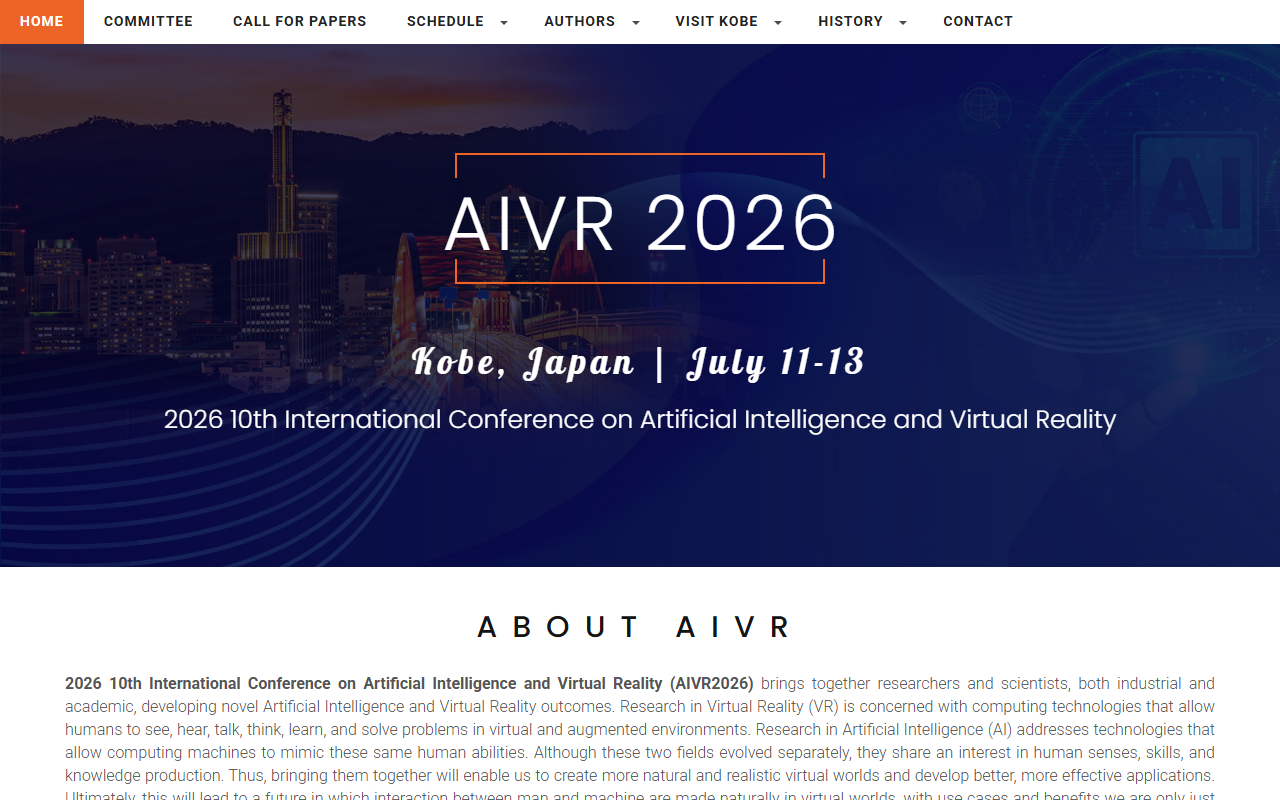
First Impressions and Site Layout
Upon visiting aivr.org, I immediately realized this is not a typical AI tool or interactive learning platform. The website is an academic conference portal for the 10th International Conference on Artificial Intelligence and Virtual Reality (AIVR 2026), to be held in Kobe, Japan from July 11-13, 2026. The homepage presents a clean, professional layout with navigation tabs for committee, call for papers, schedule, keynotes, and registration. There is no dashboard, no sign-up for an AI service, and no free tier to test. Instead, the site serves as an information hub for researchers, academics, and industry professionals interested in submitting papers or attending sessions on AI and VR technologies. The conference tracks cover systems, content creation, AI technologies, cognitive aspects, and applications — all relevant to the category “Video AI > Learning Platform,” though the term “learning platform” here refers to academic knowledge exchange rather than an automated training tool.
What AIVR Offers as a Learning Platform
AIVR provides a structured environment for learning about the latest advances at the intersection of AI and virtual reality. The conference accepts original research papers that are peer-reviewed and published in Springer’s Smart Innovation, Systems and Technologies series, indexed by SCOPUS, EI Compendex, INSPEC, and DBLP. This means that for researchers and graduate students, attending or reading the proceedings is a credible way to stay current. The website highlights key dates — paper submission by May 20, 2026, notification by June 10, and the conference in July. Submission requires following Springer templates, available in LaTeX and Word. Past proceedings from 2018 to 2025 have been published by either ACM ICPS or Springer, ensuring quality. Extended versions of selected papers are also recommended for a journal (International Journal of Reasoning-based Intelligent Systems). This model is a traditional academic conference, not an interactive AI tool. I tested the submission system link, which redirects to an external online system. There is no direct AI model to interact with, no API, and no hands-on learning modules. The learning occurs passively through paper presentations and networking.
Audience and Market Positioning
This “tool” is best suited for researchers, professors, and Ph.D. students in AI, VR, or human-computer interaction. Industry professionals seeking cutting-edge academic insights may also benefit. However, for someone looking for a practical AI learning platform like Coursera, Udacity, or Google’s AI Hub, this conference is not a direct alternative. Unlike those platforms, AIVR does not offer tutorials, code labs, or sandbox environments. Competitors in the conference space include IEEE VR, ACM SIGGRAPH, and NeurIPS — but AIVR deliberately focuses on the synergy between AI and VR. The conference series has been running since 2018, with past locations across Asia (Nagoya, Singapore, Kumamoto, Fukuoka, Osaka). It is supported by a technical committee but the website does not list major corporate sponsors clearly. The lack of pricing information for attendees (registration fees) is a limitation — only submission deadlines are given. The website is well-structured but lacks details on keynote speakers for 2026.
Final Verdict
AIVR is an academic conference, not a software tool. Its strength lies in its targeted scope (AI + VR) and reputable publication channels (Springer, EI Compendex). Researchers will find it valuable for publishing and networking. However, its limitations are significant for the general public: there is no interactive AI, no accessible learning materials, and no free content beyond the website. I cannot recommend it as a learning platform for beginners or practitioners seeking hands-on AI experience. If you are a scholar with a paper ready on AI/VR topics, AIVR 2026 is a credible venue. For everyone else, look to dedicated online courses or open-source AI tools. Visit aivr.org to explore it yourself.


Comments