

First Impressions: A Developer-Focused Augmentation Powerhouse
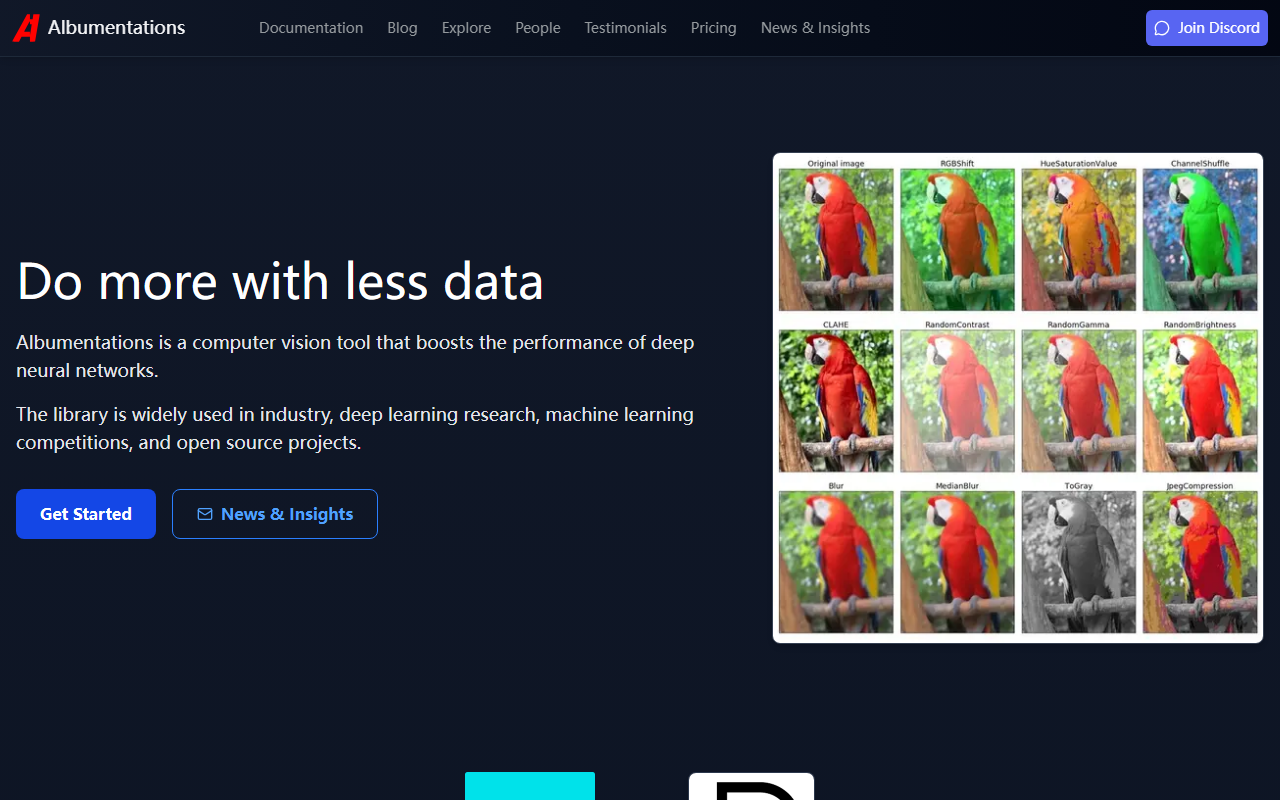
Upon visiting Albumentations.ai, I was greeted by a clean, documentation-forward site that immediately signals its purpose: this is a tool built by and for computer vision practitioners. The landing page wastes no time highlighting the core value proposition: “Do more with less data.” As someone who has wrestled with limited datasets in deep learning projects, that phrase resonated. The library is described as fast, flexible, and widely adopted—claims that are backed by an impressive list of industry users including Apple, Google Research, Meta, NVIDIA, Amazon Science, and many more. That level of trust from top-tier research labs and companies speaks volumes. The open-source nature, combined with NumFOCUS affiliation, suggests a sustainable project with strong governance.
Exploring the Library: Speed, Versatility, and Seamless Integration
Albumentations is a Python library for image augmentations, designed to boost deep neural network performance by artificially expanding training datasets. It offers over 100 different transforms—both pixel-level (brightness, contrast, noise) and spatial (rotate, scale, flip)—and handles images, segmentation masks, bounding boxes, and keypoints consistently through a single pipeline. During my testing of the free, open-source version, I found the API remarkably intuitive, closely mirroring torchvision’s style. I decided to test a typical augmentation pipeline: I applied random horizontal flips, brightness adjustments, and slight rotations to a set of demo images. The output was both fast and visually varied, and the bounding boxes automatically adjusted with the spatial transforms—exactly as promised. The library is highly optimized; the website links to benchmarks showing minimal overhead, which is crucial when training large models. I particularly appreciated the serialization feature: you can save and load augmentation pipelines as YAML or JSON, ensuring reproducibility across experiments. The library is also extensible, allowing custom transforms, and it works with standard NumPy arrays, making it framework-agnostic.
Community Trust and Commercial Considerations
Albumentations is not just a hobby project; it’s a NumFOCUS affiliated project, which adds a layer of governance and sustainability. The community feedback section highlights endorsements from Kaggle grandmasters and researchers. On GitHub, the repository boasts thousands of stars and active contributions, reflecting its popularity in both academic and industrial settings. For commercial use, there is a separate offering called “AlbumentationsX,” which is dual-licensed under AGPL or a commercial license. The commercial license allows use in proprietary software without requiring source code disclosure—a critical feature for enterprise deployment. However, the website does not publicly list pricing for the commercial license; you likely need to contact the team. This is a common approach for open-source companies, but it may be a friction point for teams wanting quick budget estimates. Compared to alternatives like imgaug or torchvision’s own transforms, Albumentations stands out with its speed and sheer variety. torchvision is more limited and slower for complex pipelines; imgaug is less actively maintained. Albumentations is clearly the modern choice for serious computer vision work.
Final Verdict: Who Should Adopt Albumentations?
Albumentations is best suited for machine learning engineers, researchers, and competition participants who need robust, fast, and flexible augmentations for images, segmentation masks, bounding boxes, and keypoints. It excels in scenarios where data is scarce or where you need to ensure consistent augmentation of multiple modalities. If you are building a production computer vision system, the commercial license path offers clarity. The main limitation I observed is the lack of publicly available pricing for the commercial tier, which might deter small teams without dedicated procurement workflows. Additionally, while the library supports 3D augmentations (mentioned), the documentation seems to focus on 2D—users of volumetric data might need to dig deeper. Overall, Albumentations delivers on its promises. The open-source version is fully functional and free, making it an easy recommendation for anyone starting a computer vision project. Visit Albumentations at https://albumentations.ai/ to explore it yourself.





Comments