

First Impressions and Onboarding
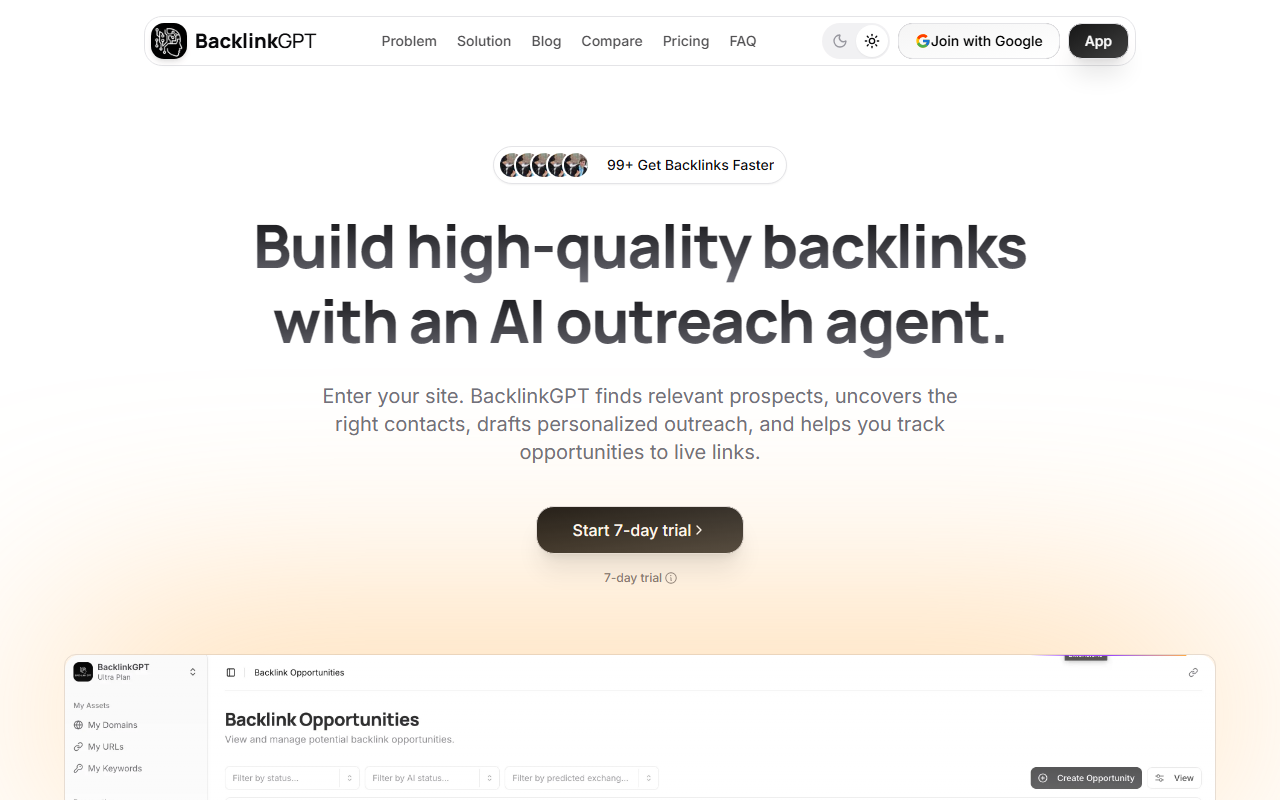
Upon visiting the BacklinkGPT site, I noticed a clean, action-oriented dashboard. The homepage immediately showcases a campaign counter with 2,450 campaigns launched and 48,900 prospects sourced — numbers that signal a tool already used by real teams. The founder, Felix Vemmer, introduces himself with a personal note about building BacklinkGPT to eliminate the busywork of link building. That transparency sets a trustworthy tone.
Onboarding is streamlined into three steps: create a workspace, add a target site, then review and send. The free tier is a 7-day trial (card required), which gives you full access to the Starter plan. During setup, you tell the tool which site you want backlinks for, and it extracts topics and keywords automatically. No manual keyword research required for framing prospects.
When I clicked through the demo flow (available on the site), I saw the prospecting window: you enter a keyword, and BacklinkGPT pulls relevant domains and pages from search results. It then enriches contacts (email, LinkedIn) and generates AI drafts based on the prospect page content. The entire process feels like a guided workflow rather than a set of disconnected features.
Core Features That Impressed Me
BacklinkGPT bundles three critical link-building activities into one place. First, prospecting: it lets you convert SERP results into a clean target list, using metrics, fit signals, and exclusions to filter out low-value domains. I observed how you can set criteria like Domain Rating minimums or topical relevance before generating prospects. This eliminates the days spent manually hunting for link opportunities.
Second, contact enrichment goes hand‑in‑hand with prospecting. The tool surfaces email addresses and LinkedIn profiles for editors, marketers, and writers — a major time‑saver. Unlike generic email finders, BacklinkGPT ties each contact directly to the opportunity you’re pursuing. Third, the AI‑personalized outreach drafts are grounded in the prospect page’s content. You provide your angle, and the AI writes a draft that references specific details from the target site. You can edit, approve, and send directly from the platform, or use the built‑in LinkedIn integration to message contacts without leaving the app.
An often‑overlooked feature is backlink monitoring. After a link goes live, BacklinkGPT tracks it over time. If the link breaks or gets removed, you get alerted. This closes the loop that many link‑building tools ignore. The entire pipeline — from pitch to live link to monitoring — is designed to prevent dropped follow‑ups and lost results.
Pricing and Market Position
BacklinkGPT offers three paid tiers: Starter at $149/month (4,000 prospect credits, 1 connected account), Growth at $399/month (11,000 credits, 3 accounts), and Scale at $999/month (30,000 credits, 6 accounts, plus API access and custom integrations). A 7‑day free trial is available, billed monthly or yearly (20% discount). Annual pricing brings Starter down to ~$119/month, which is competitive for a dedicated outreach tool. Additional connected accounts cost $10 each.
Compared to alternatives like Pitchbox or BuzzStream, BacklinkGPT feels more like a single‑purpose AI agent than a full CRM. Pitchbox offers broader campaign management but often requires manual data entry. BuzzStream excels at relationship tracking but lacks native AI drafting. BacklinkGPT’s focus on automated prospecting and contact enrichment sets it apart, especially for teams that want to minimize manual research. The tool is best suited for SEO professionals, content marketers, and agencies that run recurring link‑building campaigns. Freelancers on a tight budget might find the $149 entry point steep, especially if they have limited prospects per month.
A limitation I noticed is the lack of detailed AI model information. The site doesn’t specify which LLM powers the outreach drafts. Also, the MCP Server is listed as “Coming Soon,” meaning advanced API integrations aren’t fully ready yet. For power users who need custom automation, the Scale plan is required to unlock API access — a significant jump from the Growth tier.
Who Should Use BacklinkGPT? (Strengths and Limitations)
BacklinkGPT is a strong choice for teams that treat link building as a repeatable process. Its strengths are clear: automated prospecting, contact enrichment, AI‑drafted outreach, and backlink monitoring all in one workflow. The LinkedIn integration is a nice touch for modern outreach. The tool genuinely reduces the busywork that stalls campaigns.
However, it’s not for everyone. If you only need occasional outreach (e.g., one campaign per quarter), the recurring subscription may feel wasteful. The 4,000 prospect credits on Starter are generous for small teams, but larger agencies will need to jump to Growth or Scale quickly. Additionally, the AI drafts require human review; I saw no option for fully autonomous sending, which is appropriate for quality control but adds a manual step. The tool also lacks A/B testing for subject lines or messaging — a feature some competitors offer.
Overall, BacklinkGPT delivers on its promise: it turns link‑building busywork into a structured, repeatable workflow. I recommend trying the 7‑day free trial if you spend more than five hours per week on prospecting or outreach. For agencies shipping multiple campaigns, the Growth plan will likely pay for itself in time saved. Visit BacklinkGPT at https://backlinkgpt.com/ to explore it yourself.





Comments