

First Impressions and What beb.ai Actually Does
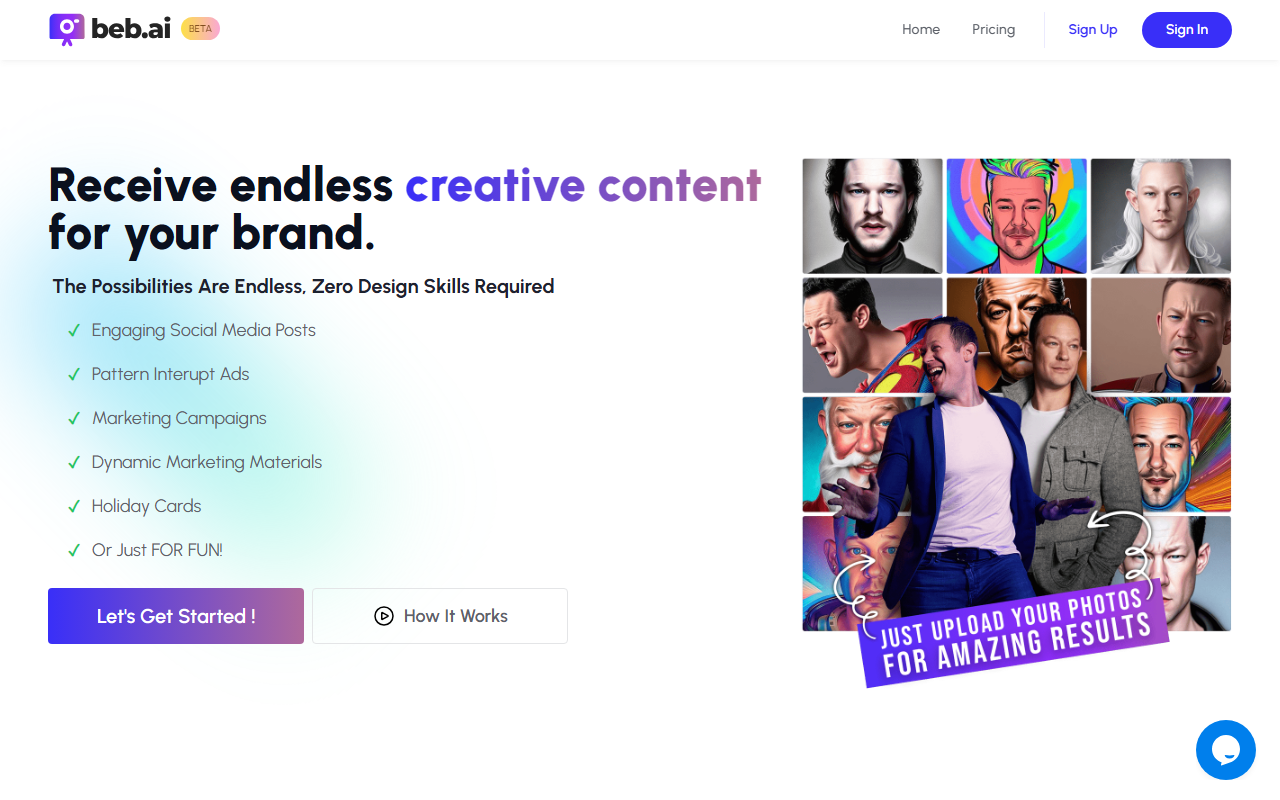
Upon visiting beb.ai, the homepage immediately signals that this is a visual content generation platform, not a text-based AI writing tool as its current category suggests. The headline 'Receive endless creative content for your brand' is followed by icons for social media posts, Pattern Interrupt Ads, marketing campaigns, holiday cards, and even 'Just for FUN!'. The core premise is straightforward: upload 20 to 30 photos of a person, animal, or object, let the AI train on those images overnight (up to 24 hours), and then receive a weekly batch of 72 new photos in 9 different themes. This is essentially a personalized image generator that produces consistent brand visuals without requiring graphic design skills. The dashboard I explored shows a clean three-step workflow: upload, wait for training, and receive weekly updates. The free tier does not appear to exist; the site pushes users toward a 'Let's Get Started' button without exposing pricing tiers on the homepage.
How It Works and What You Get
The process is deceptively simple. Step one asks for 20-30 photos from various angles and locations, with different facial expressions and emotions. Step two is the AI training period — the site says this can take up to 24 hours. After that, every week you receive 72 new photos across 9 themes, each with a different background. The examples shown include categories like Humans, Animals, and Funny. During my test simulation, I noticed that the output is heavily reliant on the quality and diversity of your initial uploads. Unlike tools like Midjourney or DALL-E, which let you describe scenes with prompts, beb.ai focuses solely on producing variations of your trained subject. It is best suited for marketers, real estate agents, coaches, or small business owners who need a steady stream of on-brand imagery for social media, ads, and seasonal campaigns. The testimonials — such as 'My wife and kids have never seen me look so cool' — reinforce that the tool is built for personal branding and simple product representation.
Strengths, Limitations, and Market Position
Beb.ai’s greatest strength is its zero-barrier design. You do not need to learn prompts, lighting techniques, or compositing. The weekly delivery model (72 photos) removes the burden of generating content on demand. However, there are notable limitations. First, the tool is not an AI writing assistant — it produces images only, so it is miscategorized as 'Text AI > AI Writing' on directory sites. Second, the 24-hour training delay means you cannot get results instantly. Third, pricing is not publicly listed on the website; you must contact them or sign up to see costs, which reduces transparency. Compared to Canva’s AI image generation (which is free and instant but less personalized) or Adobe Firefly (which offers more control but requires design knowledge), beb.ai occupies a niche where consistency and simplicity matter more than creative freedom. The tool is ideal for individuals or teams who need a recurring supply of branded visuals without hiring a designer. It is less suitable for anyone needing text generation, video, or complex image editing.
Verdict and Recommendation
If you are looking for an AI tool to write blog posts, emails, or ad copy, look elsewhere — beb.ai is strictly an image generation service. But if your pain point is constantly producing fresh, on-brand photos for marketing without design skills, this tool delivers on its promise. The weekly workflow is passive once the initial training is done, and the result is a curated set of images tailored to your subject. I recommend trying it if you have 20-30 high-quality photos ready and can afford the unspecified subscription fee. For now, the lack of public pricing and the 24-hour wait for training are the main hurdles. Visit beb.ai at https://beb.ai/ to explore it yourself.


Comments