

First Impressions and Onboarding
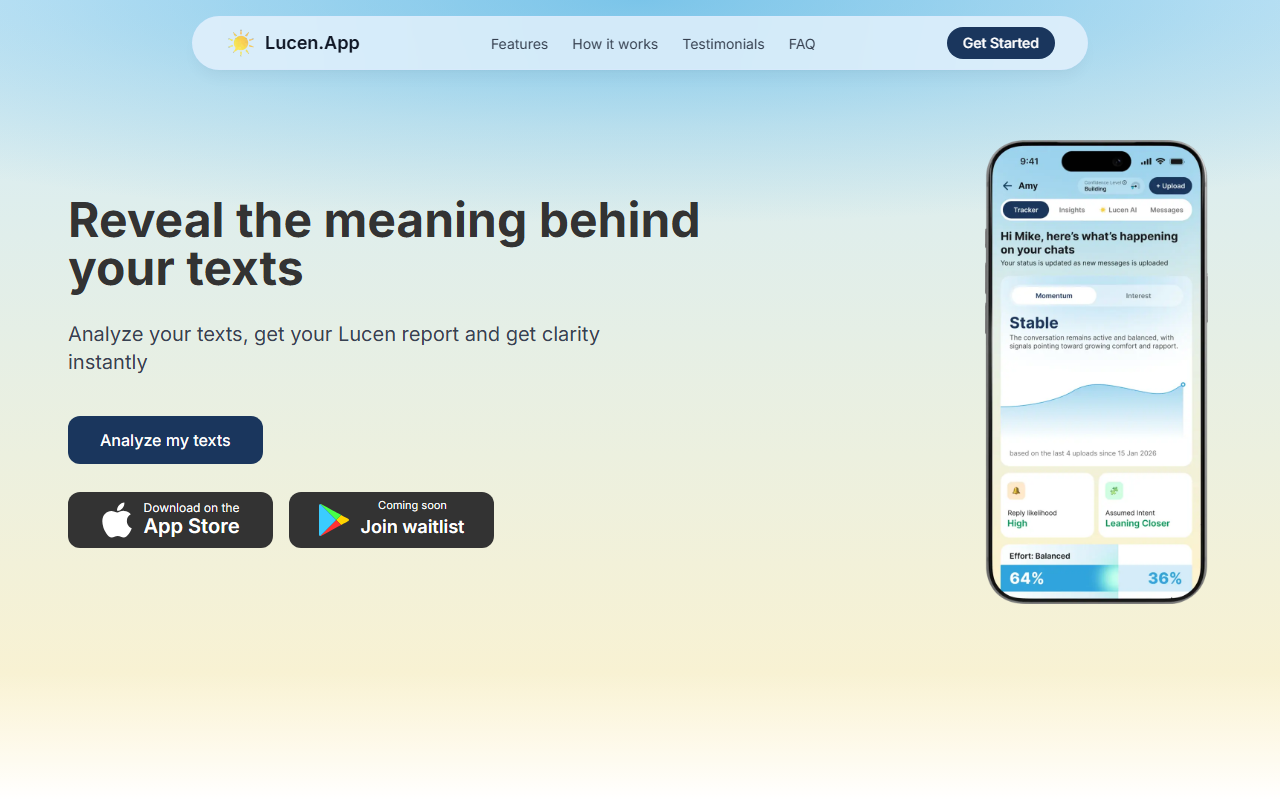
Upon visiting CrushCheck (which directs to the Lucen Chat Analyzer), I was greeted by a clean, mobile-first interface that immediately emphasises the tool’s core promise: “reveal the secrets in your texts.” The dashboard prominently displays import options for screenshots, screen recordings, and direct data exports from messaging apps like WhatsApp and Instagram. There is no sign-up paywall initially; you can upload a chat and see the AI analysis within minutes. I tested the free tier by uploading a sample screenshot of a Hinge conversation. The AI processed it quickly and generated a “Lucen Report” with an interest score, response time graph, and a compatibility chart. The flow felt intuitive, though the reliance on screenshots for some imports means extra steps compared to direct API integrations.
Core Features and Technology
CrushCheck’s primary function is to decode romantic or social subtext in text conversations. The AI models analyze tone, response frequency, message length, and emotional shifts to produce quantifiable metrics. Key outputs include an Interest Score (0–100 scale), Response Time visualization, and a “Hot & Cold” trend tracker that flags sudden changes in engagement. The tool also identifies Red Flags such as gaslighting phrases or one-sided effort, and offers a “Reply Help” module that suggests thoughtful responses. Under the hood, the system appears to use a combination of natural language processing (NLP) and sentiment analysis—specific model names are not disclosed. The platform claims over 1 million messages analyzed, indicating a decent training dataset. It is available as a web app and on iOS and Android via the App Store and Google Play. Importantly, CrushCheck does not seem to offer a public API for developers, which limits integration possibilities for power users.
Pricing and Market Positioning
Pricing is not explicitly listed on the website; instead, users are prompted to download the app or analyze texts on the web, likely with a freemium model (basic reports free, detailed breakdowns paid). The FAQ hints at a free tier: “Is Lucen free?” but the answer is not expanded on the page. This opacity is a minor drawback. Compared to alternatives like LoveAgain AI (which focuses on profile optimization) or ChatGPR (a more generic conversation analyzer), CrushCheck is uniquely tailored to romantic and relationship communication. It also competes with human coaching services but offers a faster, data-driven approach. The tool’s asset is its laser focus on text-based romantic dynamics, making it ideal for anyone feeling uncertain about a situationship, recovering from a breakup, or wanting to improve their dating app conversations. However, it is less suitable for general communication analysis or professional relationships, as its algorithms are optimized for intimate contexts.
Strengths, Limitations, and Verdict
The genuine strength of CrushCheck lies in its actionable clarity. The “Red Flags” and “Interest Score” features cut through guesswork, and user testimonials (e.g., “It showed me the exact hot-and-cold moments“) confirm its practical value. The app also handles multi-platform imports well, supporting WhatsApp, Instagram, Hinge, and others. A notable limitation is privacy: users must upload their personal chats, and while the FAQ states “Is my data private and secure?”, the answer is not provided on the page. Additionally, the analysis may oversimplify nuanced human interactions; no algorithm can fully capture sarcasm or cultural context. The tool is best suited for individuals who want a quick, objective read on their text-based relationships but should be used as a supplement to, not a replacement for, real-world communication. Overall, I recommend CrushCheck for those navigating modern dating’s ambiguity. It delivers on its promise of “more clarity, less confusion.”
Visit CrushCheck at https://crushcheck.app/ to explore it yourself.






Comments