

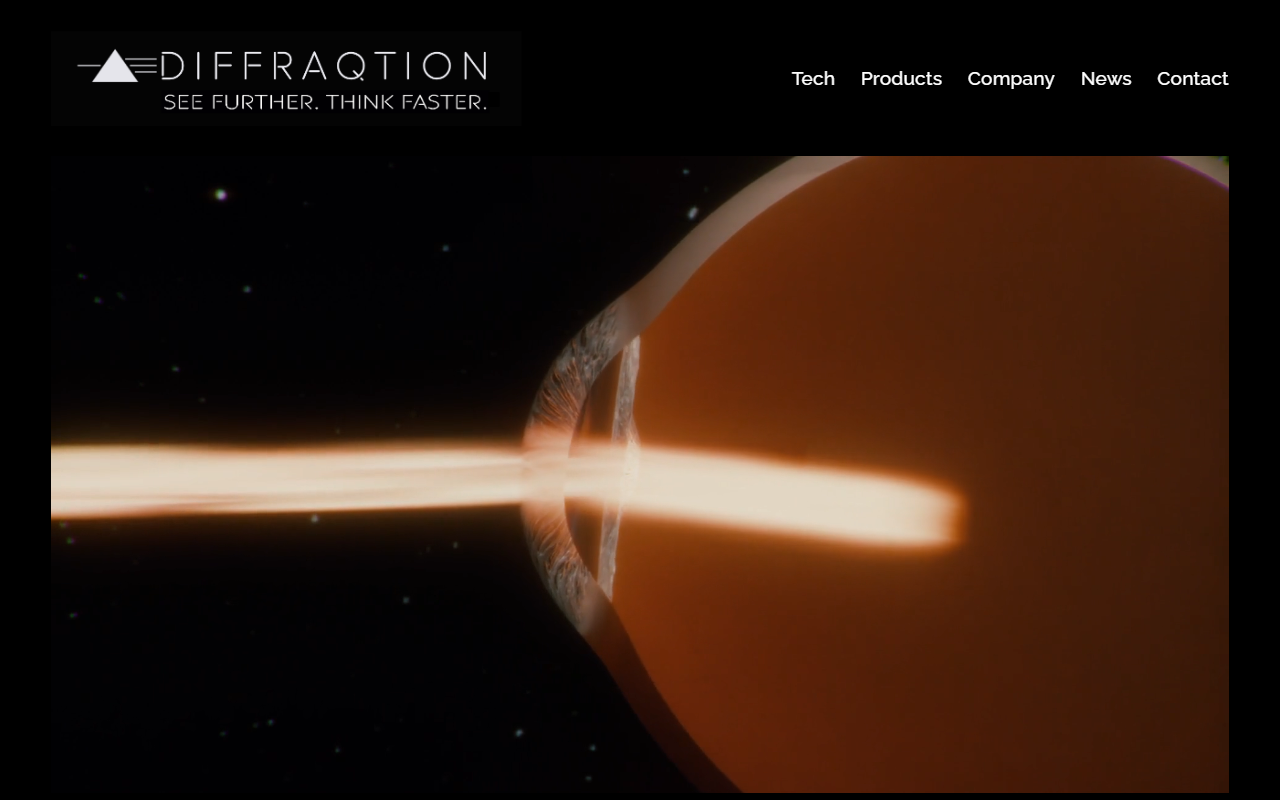
When I first landed on Diffraqtion’s website, the claim that conventional cameras lose 95% of light information struck me as both provocative and familiar. The startup, spun out of MIT, the University of Maryland, and the University of Arizona, is building what they call “quantum cameras” that break the diffraction limit—a physical boundary that limits resolution in traditional optics. Their technology, originally developed for NASA’s Habitable Worlds Observatory and funded by DARPA, aims to identify objects at 20 times the distance of any existing camera. This is not a software filter; it’s a hardware revolution rooted in quantum photonics.
First Impressions: A Leap Beyond Conventional Imaging
Upon visiting Diffraqtion.com, the minimalist design directs attention to a single bold statement: “See Further, Think Faster.” The hero section introduces the problem—traditional cameras lose 95% of light information—and immediately presents their solution: award-winning quantum cameras that see beyond the diffraction limit. The site provides a brief technical background, mentioning a 10-year development led by Prof. Saikat Guha, with backing from NASA and DARPA for space situational awareness. A notable highlight is their win at SLUSH 2025, where they took first prize among 1,000 startups, earning $1.2 million. The site also lists TechConnect’s “Best Space Innovation of 2025” prize of $100,000. While the site lacks a product demo or interactive dashboard, the narrative is compelling for anyone familiar with the limitations of classical optics.
Technology Breakdown: What Makes Diffraqtion Different?
Diffraqtion’s core technology revolves around quantum cameras that exploit photon correlations to overcome the diffraction limit—a fundamental constraint in conventional imaging. Typical cameras (including those on satellites) are bound by the Abbe diffraction limit, meaning the smallest resolvable detail is roughly half the wavelength of light. Diffraqtion’s approach, rooted in quantum metrology, uses entangled photons and advanced detection schemes to extract information that classical sensors miss. According to the site, their cameras are the first to “see beyond the diffraction limit” and can identify objects 20 times farther than any existing camera. This isn’t just a software enhancement; it’s a new class of sensor. The technology was originally conceived for high-precision space situational awareness as part of the Habitable Worlds Observatory—the successor to James Webb and Hubble. While the site doesn’t specify the exact quantum model (e.g., NOON states or squeezed light), the credentials of the founder and the NASA/DARPA pedigree add credibility. The startup is based in Somerville, MA, with investors and supporters listed vaguely (names not disclosed on the site).
Market Position and Use Cases
Diffraqtion sits at the intersection of space imaging, quantum photonics, and defense intelligence. Unlike conventional high-resolution imaging companies (e.g., Planet Labs or Maxar), Diffraqtion’s approach is hardware-driven rather than software-upscaled. Competitors in quantum imaging include companies like Q-CTRL and Xanadu, but Diffraqtion focuses specifically on Earth and space intelligence rather than general quantum computing. The clear use case is satellite-based surveillance and astronomical observation—any scenario where detecting faint or distant objects is critical. The technology also has potential for microscopy and autonomous navigation, though the site emphasizes space. The startup is best suited for government agencies (NASA, DARPA), defense contractors, and deep-tech investors. For commercial drone operators or consumer photographers, the cost and complexity are likely prohibitive at this stage. Pricing is not publicly listed on the website, and no API or integration details are provided, which is expected for a pre-commercial deep-tech hardware company.
Strengths, Limitations, and Verdict
Diffraqtion’s genuine strength lies in its scientific foundation: a technology developed over a decade with top-tier institutional support, validated by NASA and DARPA, and winning major startup competitions. The performance claims—20x further identification—are extraordinary and, if real, would be transformative for space intelligence. However, there are real limitations. The site provides no independent test data, no customer case studies, and no timeline for commercial availability. As of now, the product appears to be in an R&D phase, with no working demo shown. The lack of detailed technical specifications (e.g., resolution, frame rate, cost) makes it hard to verify the claims. Additionally, quantum cameras typically require cryogenic cooling or highly controlled environments, which may limit deployment. For now, Diffraqtion is a promising but early-stage technology. It is best suited for investors and research partners who can tolerate high risk for potentially massive payoff. Consumers and enterprise users should wait for validation. Visit Diffraqtion at https://diffraqtion.com/ to explore it yourself.






Comments