

First Impressions: A Promise to Kill AI Slop
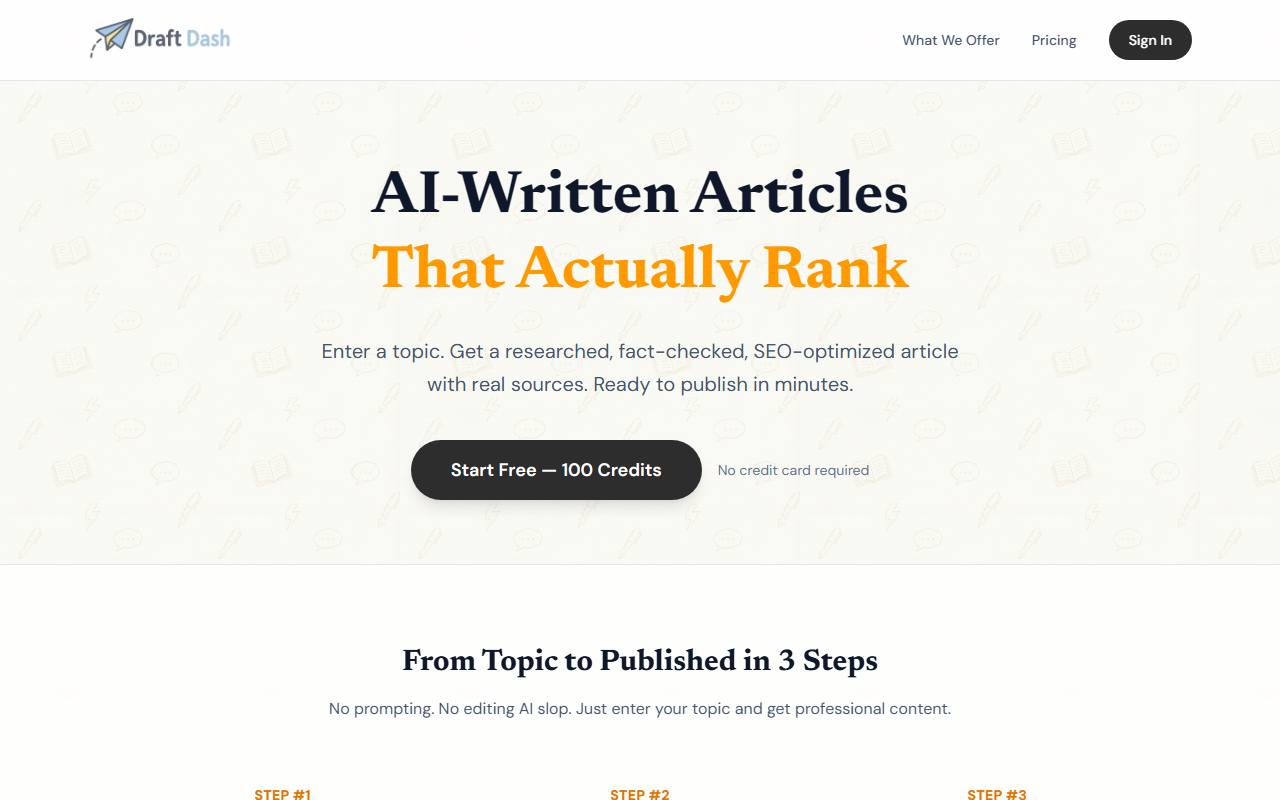
Upon visiting Draft Dash, I was struck by the blunt tagline: “No AI slop.” The homepage immediately promises research-backed, fact-checked articles with real citations — a direct jab at the hallucination-prone outputs common in tools like ChatGPT or Jasper. The onboarding is frictionless: you sign up with just an email, get 100 free credits, and land on a clean dashboard. No tour, no tutorial — just a text box asking for a topic. That minimalism sets the tone.
The interface is sparse but functional. A sidebar shows credit balance and history; the main area is a single input field. I typed “sustainable packaging trends 2025” and clicked generate. Within seconds, three article angles appeared — each with a unique headline and a brief summary of the approach. I chose “Eco-Friendly Materials Driving the Next Wave” and waited. The generation took about 45 seconds, producing a 1,650-word article with headings, a FAQ section, and a small data table. Citations were inline hyperlinks to sources like Reuters and industry reports. The tone was professional, factual, and free of overused AI phrases like “delve” or “landscape.” Coming from a senior journalist’s perspective, this felt refreshingly human.
How Draft Dash Works: Research-First Architecture
Draft Dash operates on a three-step pipeline: topic entry, angle selection, and article generation. Behind the scenes, the tool performs live web searches, pulling current data, statistics, and expert sources. The claims are then verified by an internal audit system that flags potential inaccuracies and adds proper citations. This is a significant departure from traditional AI writers that rely solely on pre-trained knowledge, which quickly becomes stale.
The SEO optimization is baked in: proper H2/H3 headings, keyword placement, and a built-in FAQ schema. The tool also filters out common AI-sounding phrases, a feature Draft Dash calls “No AI Slop Filter.” While I couldn’t verify the exact models used (likely a fine-tuned GPT-4 or Claude variant based on output style), the quality was consistent. There is no API currently listed, limiting integration possibilities for power users. Export options include plain text and Markdown — fine for most content managers, but missing direct WordPress or Google Docs integration.
Strengths: Real Citations, Real Time Savings
The greatest strength is the reduction of editorial friction. Instead of spending hours fact-checking and rephrasing AI drafts, I received a publish-ready piece with verifiable sources. The three-angle approach also helps overcome writer’s block. During testing, the third angle for “remote work productivity” suggested a data-driven comparison that I hadn’t considered — a genuine creative nudge.
However, not everything is flawless. The article length (1,500+ words) is fixed; you cannot request shorter or longer outputs without regenerating. The free tier (100 credits) runs out quickly — one article costs about 30 credits, so you get roughly three articles for free. After that, pricing tiers are not explicitly listed on the website, only a “sign up” prompt. This opacity is frustrating for budgeting. Additionally, while citations are real, the audit system doesn’t provide a confidence score, so you still need to manually verify some claims — especially for niche topics with limited web sources.
Pricing, Competition, and Final Verdict
Pricing is not publicly listed on the website beyond the free credits. This lack of transparency is a notable drawback. Competitors like Frase and Writesonic offer clearer pricing and similar research features. Frase, for example, also integrates with Google Search Console for deeper SEO insights. Draft Dash, by contrast, focuses purely on the article creation process and does not offer content optimization metrics or SERP analysis.
Draft Dash is best suited for content marketers, bloggers, and SEO specialists who need quickly generated, citation-heavy articles without the “AI voice.” It’s less ideal for writers who want granular control over tone, word count, or formatting — or who require API access for automation. If you value authenticity and speed over deep customization, Draft Dash delivers on its core promise. For a no-nonsense first test, the 100 free credits are worth the click.
Visit Draft Dash at https://draftdash.net/ to explore it yourself.


Comments