

First Impressions: A Comprehensive Event Tech Platform
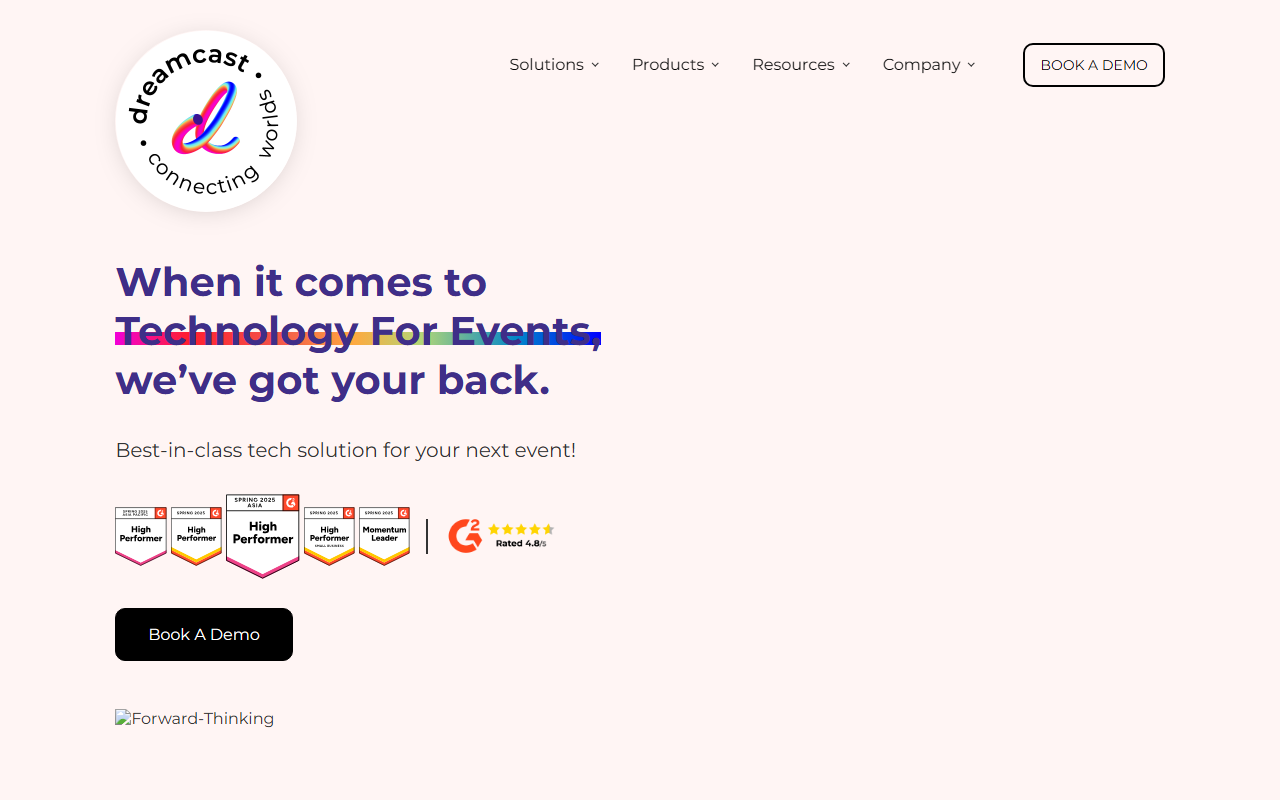
Upon visiting Dreamcast’s website, you’re greeted with a clean, professional dashboard that immediately positions the platform as a full-suite solution for in-person, hybrid, and virtual events. The homepage highlights several modules—Webinar Plus for virtual hosting, Mixhub for brand customization, cashless payments, 1:1 meeting tools, and an AI-based photo sharing feature. I was particularly intrigued by the AI photo tool, which uses facial recognition to let attendees instantly share and collect photos. This is rare among event tech platforms and hints at a deeper AI integration than most competitors offer. The onboarding flow is straightforward: a “Book A Demo” call-to-action dominates the top, suggesting the product is enterprise-focused and not free-tier accessible.
Core Functionality and Technical Depth
Dreamcast powers the entire event lifecycle—from registration and ticketing to post-event analytics. The platform’s architecture appears modular: for instance, the Webinar Plus module handles live streaming and attendee engagement, while Mixhub enables full white-labelling of virtual event spaces. Technical details are sparse on the site, but case studies reveal real-world capabilities: at World Food India 2025, Dreamcast managed high-volume access control; at Zomaland, it delivered cashless payment solutions across multiple cities. The site also mentions a record badge printing of 1,000 per hour at SHRM’s event. While the underlying models or APIs aren’t disclosed, the AI photo sharing tool leverages computer vision, indicating a custom vision model or integration with a third-party SDK. Pricing is not publicly listed—typical for enterprise-grade event tech. Integration-wise, Dreamcast likely supports standard CMS, CRM, and payment gateways, though specifics aren’t listed.
Market Positioning and Competitors
Dreamcast competes with platforms like Cvent, Hopin, and Bizzabo, but it differentiates by offering a more holistic suite that includes cashless payments and AI-powered photo sharing—features often absent in rivals. The company has strong industry recognition: it’s a G2 Momentum Leader, has won Exhibition Excellence Awards and EDCA awards, and boasts over 1,000 leading brands as clients. With 12+ years in the space, Dreamcast has established itself as a trusted partner for high-volume, high-security events. However, unlike Cvent which has a massive ecosystem, Dreamcast appears more regionally focused (India and Middle East are prominent in case studies). It’s best suited for large enterprises, trade shows, and conferences where end-to-end management is critical. Smaller events or budget-conscious organizers may find the lack of transparent pricing and potential high entry cost a barrier.
Strengths, Limitations, and Verdict
Strengths: The platform’s AI photo feature is genuinely novel—it solves a common pain point at events (managing attendee photos) with minimal friction. The cashless payment module reduces queues and enhances security. The comprehensive suite means fewer vendor integrations. Testimonials highlight quick badge printing and responsive support.
Limitations: Without public pricing, small to mid-sized event planners may find it inaccessible. The site lacks detailed documentation on API availability or integrations, which could be a red flag for tech-savvy teams. AI features are limited to photo recognition; other areas (like chatbots or predictive analytics) are absent.
Final recommendation: Dreamcast is a strong choice for large-scale professional event organizers who need a one-stop tech stack with innovative AI elements. If you’ve struggled with photo sharing and on-site payments in past events, this platform is worth a demo. However, if you’re running a small webinar series or need a free starter tier, look elsewhere—at least for now.
Visit Dreamcast at https://dreamcast.co/ to explore it yourself.


Comments