
What Is Eat Fix and How Does It Work?
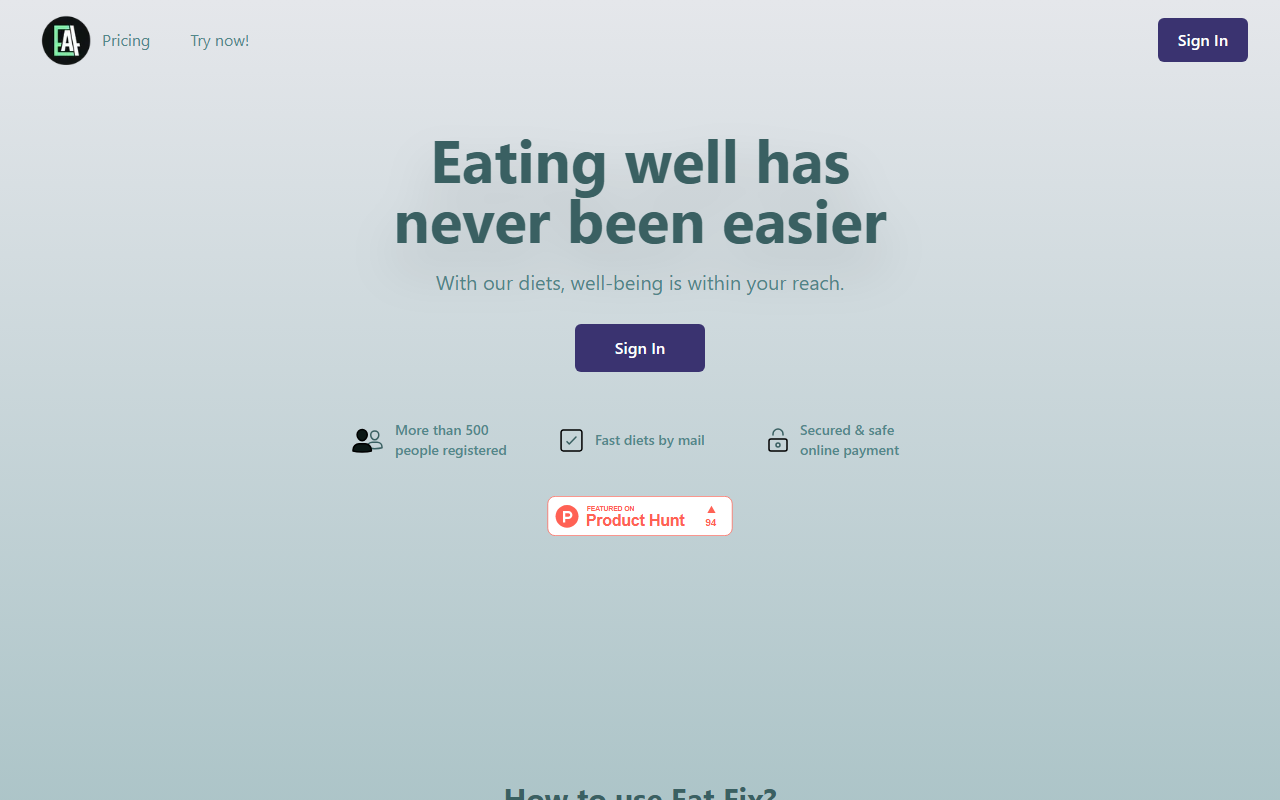
Upon visiting the Eat Fix website, you’re greeted by a stark landing page with a short tagline: “Eating well has never been easier.” The interface is clean but minimal — no dashboard, no demo, just a call-to-action to sign in and a form to fill in your dietary preferences. The tool claims to be an AI-powered diet planner, but the process description says “the team will make the best diet based on your needs.” This leaves some ambiguity: is the diet generated by an AI model, or is there human curation behind the scenes? Given the tool is categorized under Text AI > AI Writing on 345tool, I assume an algorithm creates the plan, but the website doesn’t verify that. After submitting your data (weight, goals, allergies, etc.) and email address, you receive the diet plan directly via email. The entire workflow is manual; there’s no app, no real-time interaction, and no way to view or adjust the plan online. It’s essentially a one-way email service. For a tool marketed as AI, I expected more transparency about the technology (e.g., which model or training data is used) — that information is entirely missing.
Pricing and Plans
The pricing structure is simple and affordable, with three tiers. The Free plan gives you one diet per month, manually requested, plus early access to new features and 24/7 support. For $4.99/month, the Standard plan bumps this to three diets per month. The Premium plan at $6.99/month offers unlimited diets and weekly email delivery. All plans include “early access to new features” and “support 24hs.” Notably, there’s no annual discount mentioned. Compared to competitors like Noom (up to $60/month) or specialized meal-planning apps (often $10–$15/month), Eat Fix is very cheap. However, you pay for that low price with limited automation — the phrase “requests diets manually” suggests you must actively ask for each plan rather than having the system auto-generate them based on recurring needs. The website also highlights “more than 500 people registered,” indicating a very small user base. Payment is listed as “securely & safe online payment,” but I found no details on the payment processor. The site is built by a single developer, Juan Lopez, on a Vercel-hosted page — it feels like a side project rather than a full-fledged startup.
Strengths and Limitations
Strengths: Eat Fix’s biggest advantage is its price — even the Premium tier is cheaper than a single coffee delivery in many cities. The email-based delivery makes it accessible for people who don’t want yet another app on their phone. The form is short, so getting a plan takes only a couple of minutes. For someone who just wants a one-time dietary guide, the free tier is genuinely handy.
Limitations: The most glaring issue is the lack of transparency. There is no information about what AI or model powers the diet plans, no sample output to evaluate quality, and no mention of nutritional science oversight. “The team” could be one person manually writing plans, which wouldn’t scale. The tool also offers no real interactivity — you can’t tweak the plan, track progress, or integrate with fitness devices. The dashboard is nonexistent; after signing in, I’d expect some interface, but the website shows only a sign-in button (I didn’t test sign-up due to lack of demo). Additionally, the “fast diets by mail” promise conflicts with the “requests diets manually” text — how fast is it? No SLA is given. For a truly AI-driven solution, I’d expect instant generation, not a manual or delayed email. Finally, with only 500 registered users, the tool hasn’t been widely tested, which may affect reliability.
Who Should Use Eat Fix?
Eat Fix is best suited for absolute beginners who want a no-frills, low-commitment way to start eating better. If you’re overwhelmed by complex apps or don’t need ongoing tracking, the free tier lets you dip your toes into personalized diet planning. The Premium unlimited plan could serve someone who wants weekly guidance without paying $30+ per month. However, if you require evidence-based nutrition, instant feedback, or the ability to adjust macros on the fly, look elsewhere. Tools like Eat This Much or MyFitnessPal offer far more depth and AI-like adaptive suggestions. I’d also caution anyone concerned about privacy: the website provides no privacy policy or data handling statement. Until the developer adds more info about the AI process, sample outputs, and clearer automation, Eat Fix remains a curiosity rather than a serious diet tool. Try the free plan first — it costs nothing — but don’t rely on it for medical or long-term dietary needs.
Visit Eat Fix at https://eatfix.vercel.app/ to explore it yourself.


Comments