

First Impressions and Platform Overview
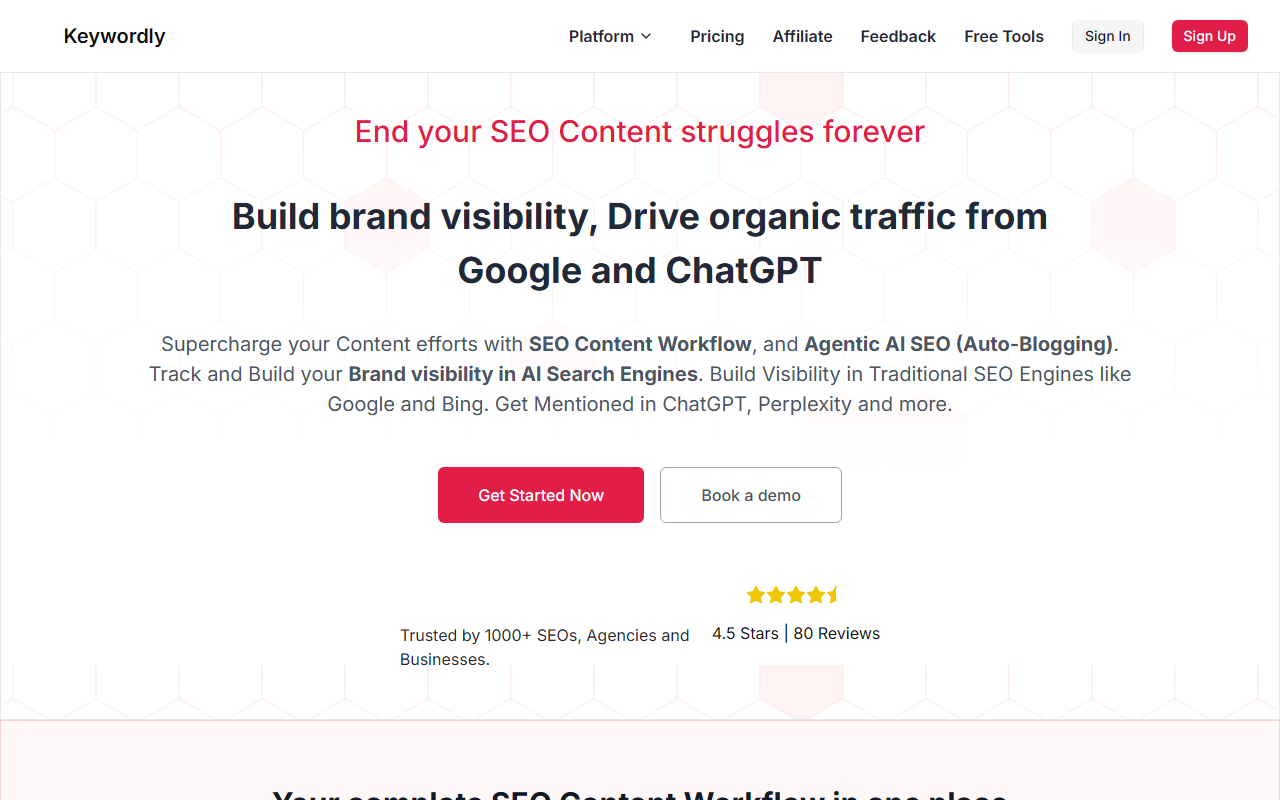
Upon visiting Keywordly, I was greeted by a clean, modern dashboard that immediately communicates its core value proposition: an end-to-end SEO content workflow. The homepage prominently features a four-step pipeline—Research & Plan, Write, Optimize & Repurpose, and Track Rankings—with a visual progress bar. The onboarding flow is intuitive; as a new user, I could quickly see sample data from a demo environment, including keyword research tables, content scores, and SERP competitor analysis. The tool claims to be trusted by over 1,000 SEOs and agencies, and its 4.5-star rating from 80 reviews suggests a solid user base. Notably, Keywordly also markets an 'Agentic AI SEO' auto-blogging feature, which positions it as a proactive content generator rather than just a writing assistant.
What sets Keywordly apart from tools like Surfer SEO or Frase is its explicit focus on a workflow pipeline. Instead of just optimizing a single article, it guides users from keyword discovery through to rank tracking in Google, Bing, and even AI search engines like ChatGPT and Perplexity. This holistic approach is appealing for content teams that want to reduce tool switching. During testing, I explored the step-by-step workflow: Step 1 presents a keyword research table with volume, difficulty, and intent (commercial, informational, etc.), while Step 2 displays a content pipeline with SEO scores (e.g., 97 for a featured article) and estimated traffic. The data seemed realistic and dynamically generated from the demo, not static mockups.
Core Workflow and Features in Depth
Keywordly’s four-stage workflow is its standout architecture. Step 1: Research & Plan helps identify high-value keywords and cluster them into topical maps. The platform outputs a comprehensive content strategy with key deliverables like keyword clusters and content briefs. In the dashboard, I saw actual metrics: 1,247 keywords found, an average difficulty of 65, and 127 opportunities flagged. Step 2: Write SEO/GEO Optimized Articles leverages AI to generate content that aligns with brand voice and search intent. The content editor includes ability to input a topic, set tone, and generate articles with suggested headings. For example, a sample article titled 'Complete Guide to AI-Powered SEO Tools in 2026' appeared with an SEO score of 88 and an estimated 15,600 monthly traffic. Step 3: Optimize & Repurpose offers an AI editor, SERP analysis, and fan-out queries to adapt content for different platforms. I appreciated the 'Update Outline' feature that compares against top 5 SERP competitors (e.g., SearchEngineLand, Moz, Ahrefs) and shows H2/H3 counts and word counts. Step 4: Track SEO Rankings provides ongoing monitoring of impressions, clicks, and positions, with domain authority and traffic growth metrics. The system is designed to close the loop—write, publish, measure, iterate.
A unique addition is the Agentic AI SEO (Auto-Blogging) feature, which promises to automatically publish SEO/GEO-optimized articles daily. While the website doesn't detail the exact AI model (likely a fine-tuned GPT variant), it suggests a shift from passive tools to proactive content generation. This could save teams hours of manual planning, but may also require careful oversight to maintain brand consistency.
Pricing, Positioning, and Limitations
Keywordly does not publicly list pricing on its website. The only call-to-action is 'Get Started Now' and 'Book a demo', which implies a subscription model with custom quotes, likely tiered by usage or team size. This is common for enterprise-oriented tools but can be a friction point for small businesses or freelancers who want upfront transparency. For comparison, Surfer SEO starts at $69/month for an individual plan, while Frase.io costs $14.99/month for basic. Keywordly's lack of visible pricing suggests it targets agencies and in-house teams willing to commit to a demo call.
A real limitation I observed: the interface is information-dense. While the pipeline is clear, the sheer number of tables and metrics (e.g., keyword tables with opportunity scores, content pipeline sortable by SEO score) can overwhelm a new user. A guided tour or more contextual tooltips would help. Additionally, while the demo data is impressive, I couldn't test the actual AI content generation quality beyond the pre-loaded articles. The tool's promise of 'Agentic AI' auto-blogging also raises questions about content uniqueness and over-reliance on automation—SEO experts know that human editing remains essential.
Final Verdict: Who Should Use Keywordly?
Keywordly is best suited for SEO agencies, content teams, and businesses that manage multiple clients or content verticals. Its workflow approach reduces context switching and centralizes strategy, writing, optimization, and tracking in one platform. The inclusion of AI search engine visibility tracking (ChatGPT, Perplexity) ahead of many competitors is forward-thinking. However, freelancers or budget-conscious users may find the lack of transparent pricing a barrier, and the learning curve is steeper than simpler AI writing tools like Jasper or Writesonic. If you're looking for a single pane of glass for SEO content operations and are ready to invest in a demo, Keywordly is definitely worth exploring. Visit Keywordly at https://keywordly.ai/ to explore it yourself.


Comments