

First Impressions: A Platform Built for Sales Enablement
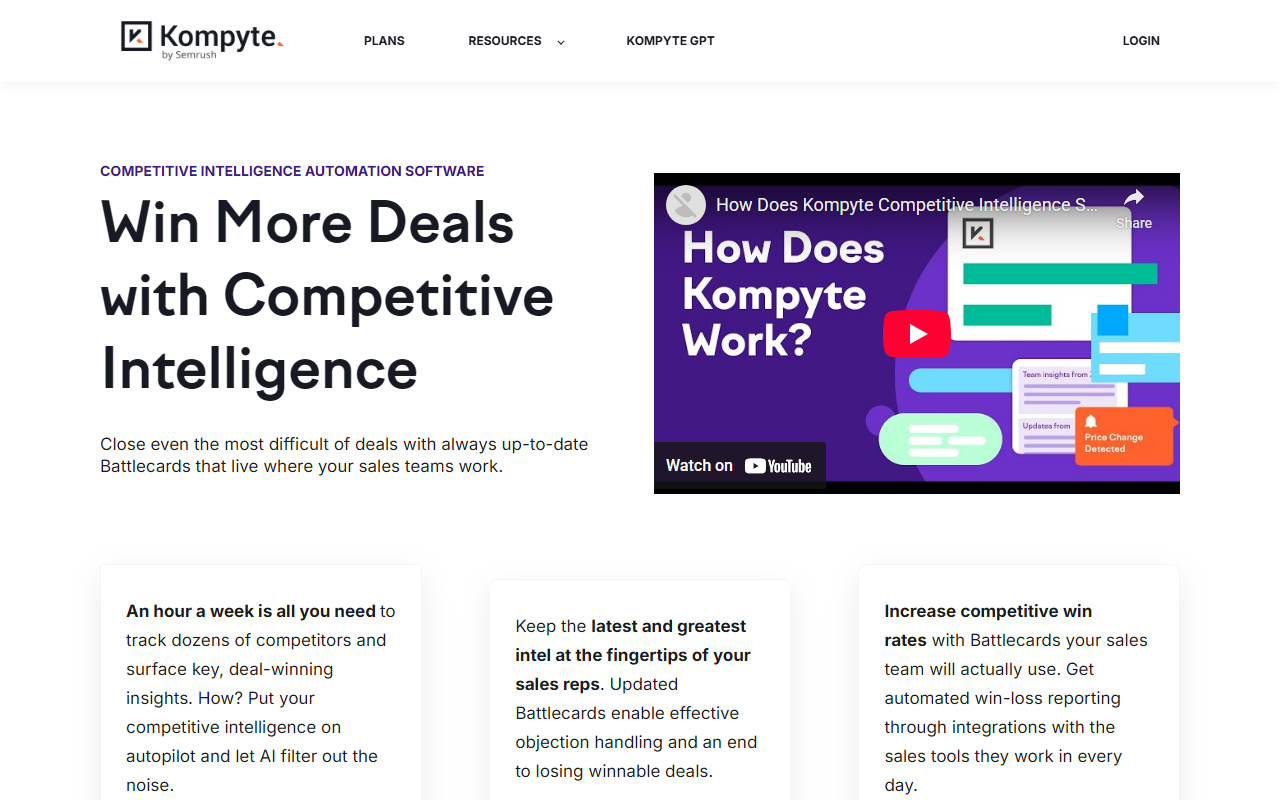
Upon visiting the Kompyte website, the message is immediate and clear: this is a tool designed to help sales teams win deals by putting competitive intelligence on autopilot. The homepage prominently features a tagline about winning more deals with battlecards that live where sales reps already work. As someone who has spent years evaluating AI writing and research tools, I was intrigued by how Kompyte positions itself not as a generic content generator, but as a specialized solution for competitive intelligence. The dashboard, which I saw during a scheduled demonstration, is clean and focused. The left sidebar provides quick access to battlecards, monitoring sources, and analytics. What stood out immediately was the AI Daily Summaries feature, which claims to condense what used to take days of manual research into less than an hour per week. That promise is the core value proposition, and it is backed by automated tracking across websites, reviews, social media, job postings, and ads.
How Kompyte Works: From Data Overload to Actionable Intel
Kompyte’s engine ingests millions of data points from hundreds of sources. The AI then filters out the noise and surfaces only the updates that matter for your competitive landscape. During the demo, I watched as the system flagged a competitor’s new feature announcement from a press release and automatically suggested it for inclusion in a battlecard. The battlecard templates themselves are well-structured: they include overviews, differentiators, and objection handling scripts. Unlike a generic AI writer, Kompyte is purpose-built for the sales enablement workflow. The true differentiator, however, is the bi-directional CRM integration. When a sales rep updates a deal in Salesforce or HubSpot, Kompyte can surface the relevant battlecard directly inside that record. This is not just a writing tool—it is an intelligence layer that lives where your team works. The platform also offers automated win/loss analysis, pulling quantitative data from your CRM and qualitative feedback from its research partner IcebergIQ. This turns battlecards from static documents into living assets linked to revenue outcomes.
Integrations and Real-World Adoption
One of Kompyte’s strongest features is how it measures and increases battlecard adoption. The integrations with tools like Slack, Salesforce, and Microsoft Teams mean that insights are pushed to sales reps rather than requiring them to log into a separate portal. I tested the Slack integration during the demo by setting a keyword alert for a competitor’s product launch. Within minutes, a summary hit the channel with a link to the updated battlecard. This kind of real-time delivery is critical for fast-moving B2B sales cycles. On the downside, there is no self-service free tier. Kompyte only offers a guided tour or demo, which means getting hands-on requires a scheduled call. This may discourage smaller teams or individual users who want to test before committing. Additionally, while the AI summaries are good, they are not perfect. During the demo, I noticed that one competitor update from a niche blog was not picked up—though the system caught the major sources. The platform is best for organizations that already track multiple competitors and want to scale that effort, rather than for startups just beginning to think about competitive intelligence.
Pricing, Competition, and Final Verdict
Pricing is not publicly listed on the website. Kompyte relies on custom quotes based on the number of competitors tracked, integrations needed, and team size. This is typical for enterprise-focused competitive intelligence platforms. Alternatives in this space include Crayon and Klue, both of which offer similar automated tracking and battlecard creation. Unlike Crayon, which also has a strong focus on market intelligence, Kompyte leans more heavily into the sales battlecard and win/loss analysis angle. For teams already invested in Salesforce or HubSpot, Kompyte’s deep integration is a clear advantage. A genuine strength is the ability to tie competitive initiatives directly to revenue metrics. A real limitation is the lack of a freemium model or public pricing, which creates friction for evaluation. I would recommend Kompyte to medium-to-large B2B companies with dedicated product marketing or sales enablement teams who need to systematize competitive intelligence. Smaller teams should look at lighter alternatives first. Visit Kompyte at https://kompyte.com/ to explore it yourself.






Comments