

First Impressions: MindsDB's Shift from ML to BI Agents
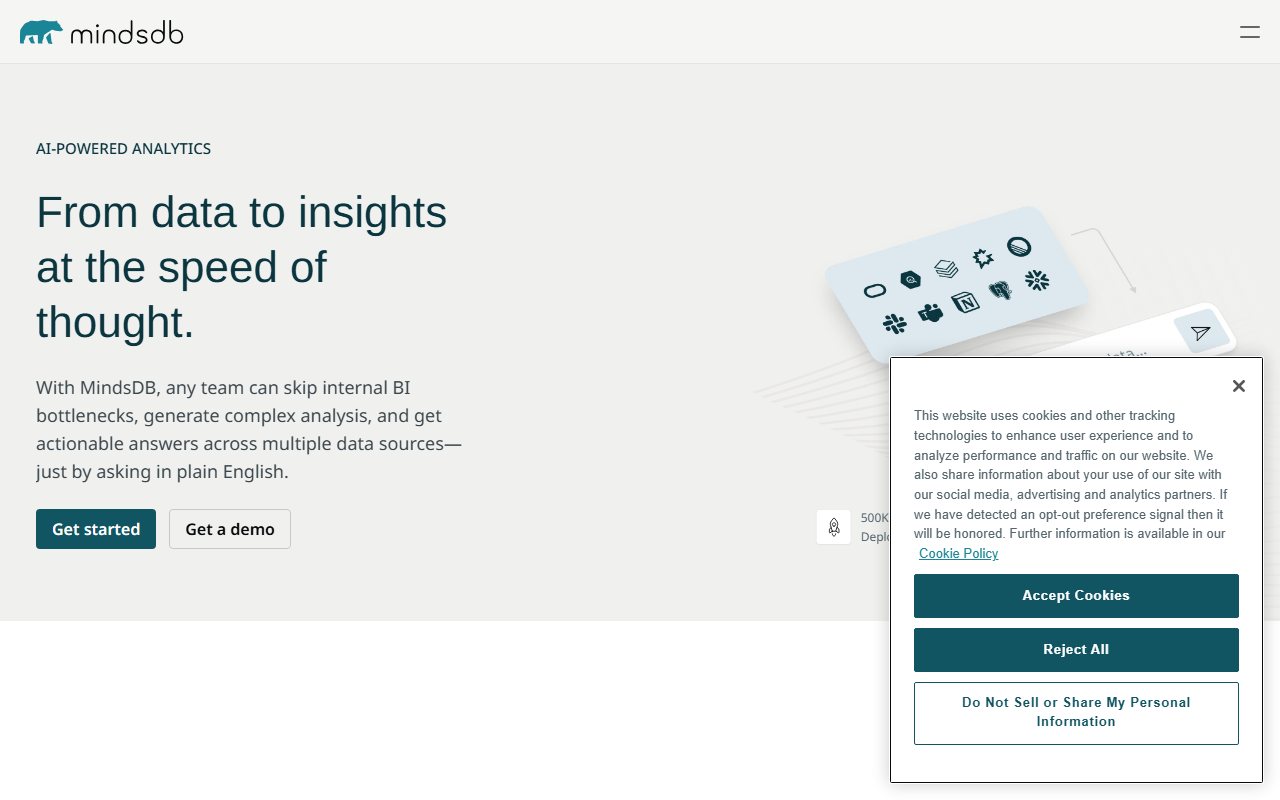
Upon visiting the MindsDB website, the first thing that strikes you is the bold promise: "Business intelligence that doesn't just answer—it acts." The home page immediately pitches conversational analytics over traditional dashboards, featuring autonomous BI agents that reason like human analysts. The site proudly displays 500K+ deployments, 200+ datasources, and 38K+ GitHub stars — impressive numbers for an open-source project that originally focused on machine learning in databases. The product has clearly pivoted: instead of helping developers run ML models inside SQL, MindsDB now positions itself as a full-blown agentic BI platform. The dashboard (I accessed the free tier) presents a clean interface where you connect data sources like databases, cloud storage, or APIs, then ask questions in natural language. The onboarding flow is smooth: after signing up, you're guided to create a “BI Agent,” select a data source, and within minutes you can type a question and get back charts and tables. I tested a simple query against a sample PostgreSQL database, and the agent responded with a multi-step breakdown — first identifying relevant tables, then running a SQL-based aggregation, and finally rendering a bar chart. The entire process took under 30 seconds.
How MindsDB Works: A Hands-On Look
MindsDB’s core technology is an autonomous reasoning engine that breaks down a user’s plain-English question into a plan of analysis steps. It then executes those steps — querying databases, running aggregations, generating visualizations — without requiring you to write SQL or Python. The system supports over 200 datasources including Postgres, MySQL, Snowflake, BigQuery, and even APIs like Salesforce. Under the hood, it uses large language models (you can bring your own key, or use MindsDB's managed tokens in the Pro plan) to interpret intent and generate structured queries. Every analysis is saved in a persistent scratchpad, making it reproducible — a key advantage for audit trails. The Pro plan also includes features like credential isolation, read-only enforcement, and audit logs, which enterprise teams will appreciate. For developers, MindsDB offers a REST API and Python SDK, allowing integration into custom applications. The agent can also output recommendations directly, not just charts. For example, when I asked “Which products had the highest return rate last quarter?” it returned a table with return rates and a pie chart, plus a suggestion to investigate quality issues. The output is explainable: the agent shows the steps it took, so you can verify logic.
Pricing and Market Positioning
MindsDB offers three tiers. The Free plan costs $0 but requires you to bring your own LLM key (e.g., from OpenAI or Anthropic), meaning you pay for token usage separately. The Pro plan starts at $35 per month and includes 5 million managed tokens per month — suitable for small teams. Enterprise plans (Cloud or VPC) are custom-priced with annual commitments and include advanced governance features. This pricing is competitive compared to alternatives like Looker (now part of Google Cloud) or Tableau, which often require heavy upfront licensing and dedicated analysts. Unlike those traditional BI tools, MindsDB removes the need for building dashboards in advance. Compared to agentic platforms like LangChain or AutoGPT, MindsDB is more focused and ready-to-use for data analytics — less “agent framework” and more “BI product.” However, it’s less flexible for custom workflows outside of querying and visualization. The best-fit users are business teams or product managers who need fast, ad-hoc answers from complex data sources without waiting for data engineering. Data scientists may find it too constrained for deep modeling.
Strengths, Limitations, and Final Verdict
The key strengths of MindsDB are speed, ease of use, and explainability. For organizations drowning in dashboard requests, it genuinely reduces turnaround from days to minutes. The ability to keep data in place (no ETL) and enforce read-only access addresses security concerns. The 38K GitHub stars and 200+ connectors confirm a healthy community and broad compatibility. However, there are real limitations. The quality of answers is heavily dependent on the underlying LLM — hallucinations can occur with ambiguous questions or poorly structured schemas. The Pro plan’s token cap may be restrictive for heavy usage; enterprise pricing is opaque. Also, the tool currently focuses on analytical queries, not operational actions (e.g., it can recommend actions but cannot directly trigger a workflow without custom code). For teams that need fully autonomous decision-making, you’ll still need integration work. Overall, MindsDB is an excellent fit for mid-market and enterprise teams that want to democratize data access without hiring more analysts. I recommend trying the free tier with your own LLM key to see if it handles your data complexity. If you need a fully managed, governance-rich solution, the Pro plan is a fair starting point. Visit MindsDB at https://mindsdb.com/ to explore it yourself.


Comments