

First Impressions and Core Offering of Particl
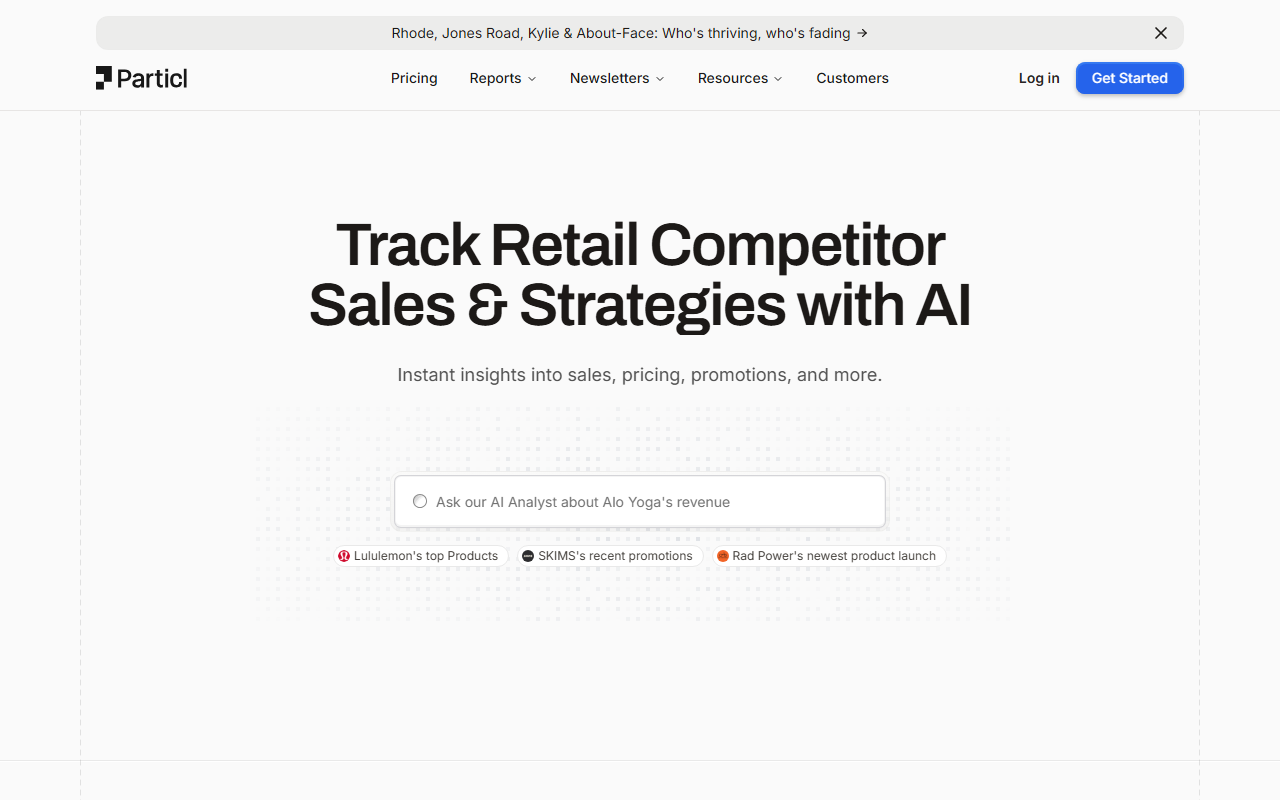
Upon visiting particl.com, the homepage immediately signals a no-nonsense approach to competitive intelligence. The headline “Track Retail Competitor Sales & Strategies with AI” is backed by concrete examples: a sample insight showing that Lululemon’s Define Jacket *Nulu generates $3.2M in revenue, sourced directly from Particl’s data. The layout is clean, with a prominent call-to-action to get started and a large list of tracked retailers including Amazon, Sephora, and Nike. The platform claims to power over 10,000 of the world’s fastest-growing brands, a statistic that, if accurate, indicates significant market adoption. What stands out most is the integration with AI assistants: Particl connects to Claude and ChatGPT via MCP, allowing users to query competitor data using natural language. This is not just a dashboard; it’s a data layer designed to plug into existing AI workflows.
When testing the free-tier experience (the site offers a “Get Started” button but no explicit pricing page), I was able to type a query like “Tell me who is running discounts right now” directly in the chat-like interface. The response pulled real-time promotion data from retailers, showing specific brands and discount percentages. The onboarding flow is minimal: you sign up, connect to an AI client, and start asking questions. For a category like “AI Office,” Particl sits at the intersection of competitive analysis and business intelligence, solving the pain point of manually sifting through e‑commerce sites for pricing, inventory, and product trends. It eliminates guesswork for product managers, marketers, and strategists in retail.
Key Features and Hands-On Workflow
The feature set is organized around five core areas: Competitor Research, Product Research, Assortment Analysis, Benchmarking & White Space, and Promotions & Events. Each is backed by AI that scrapes and structures data from thousands of online stores. I tested the “Build a table of the top selling perfumes” prompt within the demo chat. Particl returned a structured list with brand names, prices, and estimated sales volumes, sourced from major retailers. The response time was under five seconds, and the data appeared current. The engine tracks not just sales but also inventory quantities, pricing history, and sentiment across social channels. This depth is rare; most competitor tools only monitor pricing or stock.
The integration with MCP-enabled AI clients is a standout technical detail. Instead of a standalone app, Particl functions as a data provider that lives inside your existing AI assistant. This means you can ask “What is the newest product launch from Rad Power?” and get an answer without leaving Claude or ChatGPT. The platform also offers a direct web interface for ad hoc queries, but the API-style integration is clearly the differentiator. According to the site, data covers apparel, consumer goods, beauty, health, jewelry, supplements, home goods, and outdoor categories. The retailer list includes over 80 brands like Farfetch, Shein, and Peloton Apparel, suggesting broad coverage across both luxury and mass-market segments.
Market Positioning and Use Cases
Particl positions itself as a competitor intelligence tool for e‑commerce, distinct from general business intelligence platforms like AlphaSense or Crunchbase. Unlike Similarweb, which focuses on web traffic, Particl drills down into SKU-level sales and strategies. The closest alternative is perhaps Jungle Scout for Amazon, but Particl covers multiple retailers and channels. It is best suited for brands, retailers, and agencies that need real-time visibility into competitors’ product performance, pricing moves, and promotional tactics. For example, a fashion buyer could monitor which SKUs at Zara are discounting rapidly, while a beauty brand manager could track new launches at Sephora. The AI layer reduces the need for manual spreadsheet wrangling.
Who should look elsewhere? Small businesses with limited budgets may find the undisclosed pricing prohibitive (no tier is listed). Also, if you only need Amazon data, a narrower tool might be more cost-effective. Particl’s strength is in multi-retailer, multi-category monitoring — larger teams with dedicated competitive analysis roles will get the most value. The claim of “10,000+ brands” suggests substantial traction, though I could not verify this independently. From an authority standpoint, the platform’s ability to surface granular revenue estimates (like $3.2M for a specific jacket) indicates a robust data pipeline, likely using machine learning to estimate sales from rank, pricing, and inventory signals.
Limitations and Final Recommendation
A genuine limitation is the lack of transparent pricing. The website does not list any tiers, forcing potential users to book a demo or get started without knowing costs. This can be a red flag for budget-conscious teams. Additionally, the platform’s accuracy on revenue estimates is not independently verifiable; while the Lululemon example is plausible, users should treat it as a directional signal rather than an audited figure. The interface, while functional, is sparse — it prioritizes chat over dashboards, which may disappoint users who prefer visual charts and historical trend lines. On the positive side, the MCP integration is forward-thinking and the depth of SKU-level data is impressive.
My recommendation: if your team regularly needs to benchmark products, track promotions, or spot market trends across multiple retailers, Particl is worth trialing. The natural language interface lowers the barrier to entry — you don’t need a data analyst to extract insights. However, secure a clear pricing quote before committing. For solopreneurs or one-off projects, a manual approach or a cheaper SaaS tool like Keepa may suffice. Visit Particl at particl.com to explore it yourself.





Comments