

First Impressions and Onboarding
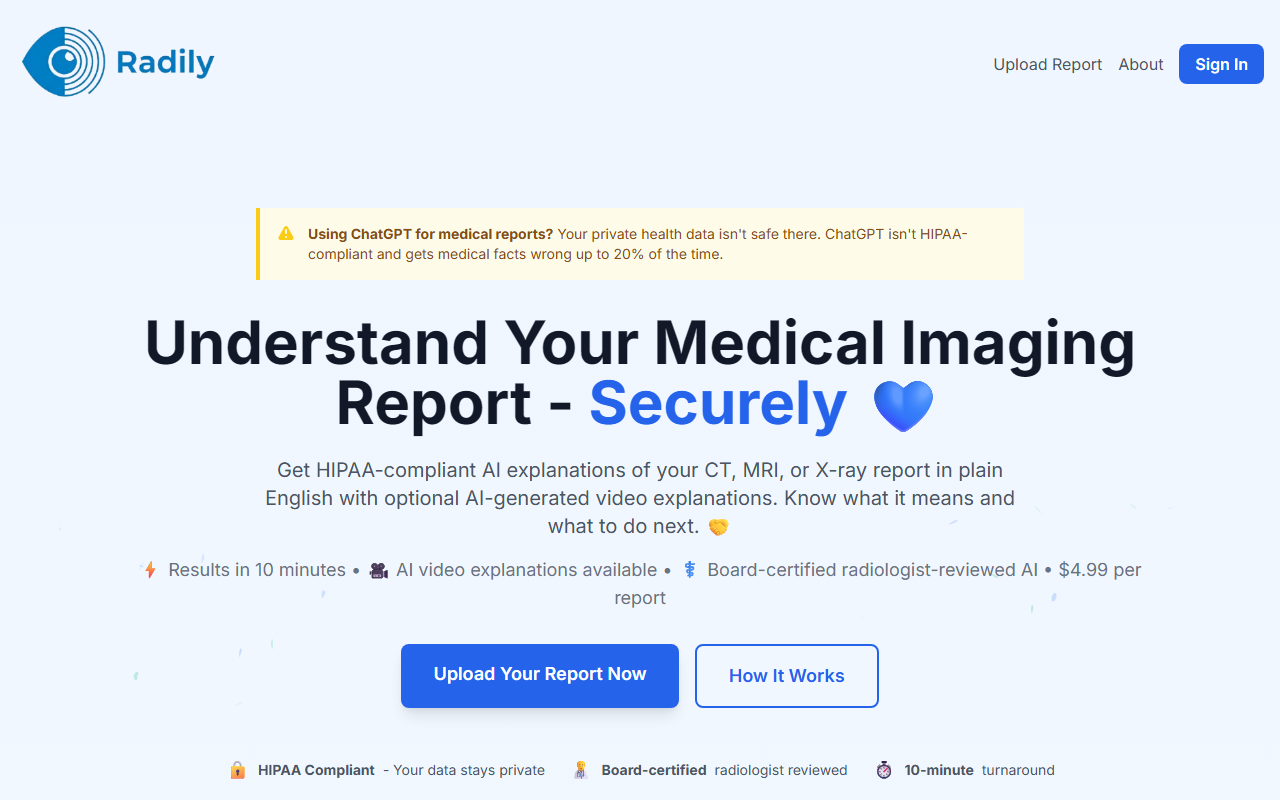
Upon visiting Radily's site, I was greeted by a clean, patient-focused landing page that immediately addresses the elephant in the room: using ChatGPT for medical reports is risky. The homepage clearly states that ChatGPT isn't HIPAA-compliant and has a 20% error rate on medical content. Radily promises HIPAA-compliant AI explanations for CT, MRI, or X-ray reports in under 10 minutes, with optional AI-generated video explanations. The pricing – $4.99 per report – is prominently displayed. Uploading a report is straightforward: I clicked the "Upload Your Report Now" button and was prompted to select a PDF or image file. The dashboard itself is minimal; after uploading, a processing animation shows the AI analyzing the text, then a plain-English explanation appears alongside a glossary of medical terms and suggested next steps. The live demo on the site simulates this workflow, using a sample radiology report to showcase the transformation from confusing jargon to clear, actionable insights. Notably, Radily does not require account creation for a single report – you pay via Stripe and your data is automatically deleted after 30 days. This frictionless experience makes it easy for anxious patients to get answers quickly.
Technical Capabilities and How It Works
Radily uses a radiology-specialized AI model that has been validated by board-certified radiologists. The company claims an accuracy rate of 98% and an average processing time under two minutes, with results delivered within ten minutes. The AI does more than simply translate medical jargon; it extracts key findings, provides a plain-English summary, defines every unfamiliar term in a glossary, and recommends follow-up actions based on clinical guidelines. For example, for a finding like "Hepatomegaly with diffuse steatosis," the AI would explain that the liver is enlarged with fatty changes and suggest discussing diet and liver function tests with a doctor. The tool also generates a downloadable PDF that includes all explanations, next steps, and questions to ask your physician. Optional AI video explanations add a visual summary for those who prefer listening to reading. From a technical standpoint, the service is HIPAA-compliant – data is encrypted in transit and at rest, and reports are purged after 30 days. There is no public API mentioned, but the product is designed as a direct-to-consumer web app, not a developer tool. Integrations are limited to uploading PDFs and images; there is no ability to connect to patient portals or EHR systems yet.
Market Position and Comparison
Radily occupies a niche at the intersection of health literacy and AI. The primary alternative is using general-purpose AI like ChatGPT or Google’s Gemini, but those are not HIPAA-compliant and have documented error rates on medical content. Another competitor in the medical report explanation space is Enlitic or Zebra Medical Vision, but those focus more on clinical decision support for doctors rather than patient-facing explanations. Radily’s transparent pricing ($4.99 per report) is far cheaper than a traditional second opinion ($200–$700) and faster. The service is best suited for patients who have received radiology reports and want a quick, accurate, and secure understanding without waiting for a follow-up appointment. It is also ideal for those who may not have easy access to a primary care provider or who feel overwhelmed by medical jargon. However, it is not a substitute for professional medical advice; the tool itself reminds users to consult their doctor. The company appears to be a startup, as indicated by its relatively new domain and limited user base on Trustpilot, but the presence of board-certified radiologist oversight adds credibility. For context, Radily is a more specialized, consumer-friendly version of tools like MD Anderson’s patient portals, but with a lower cost and faster turnaround.
Strengths, Limitations, and Final Recommendation
Radily’s genuine strengths include its HIPAA compliance, the involvement of board-certified radiologists in model validation, and the incredibly low price point for such a specialized service. The option for AI video explanations is a thoughtful touch for visual learners. The tool truly delivers on its promise: within minutes, I saw a complex radiology report transformed into language I could understand, with clear next steps. However, there are real limitations. The tool only supports radiology reports (CT, MRI, X-ray); it cannot handle pathology reports, lab results, or other medical documents. The AI's suggestions are based on clinical guidelines but are not personalized to the patient’s full medical history – it’s a supplement, not a replacement for a doctor’s judgment. Also, the service requires a separate payment per report, which could add up if you have multiple scans. There is currently no subscription tier or bulk pricing announced. For patients who are tech-savvy and have straightforward imaging findings, Radily is an excellent, affordable option. For complex cases or those needing more context, a traditional consultation remains essential. I recommend trying Radily for your next radiology report if you want a quick, secure, and understandable translation – just remember to follow up with your healthcare provider.
Visit Radily at https://radily.ai/ to explore it yourself.


Comments