

First Impressions and Onboarding Flow
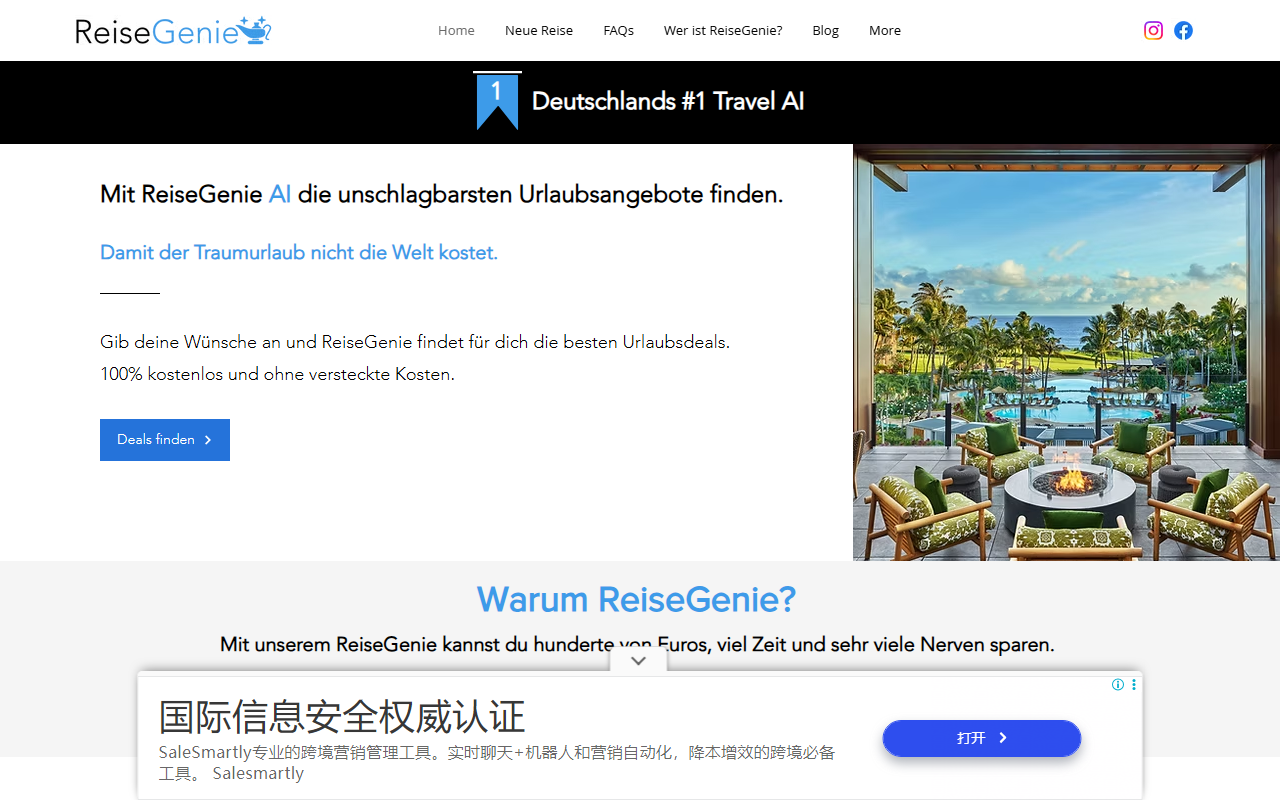
Upon visiting ReiseGenie, I was greeted by a clean, modern landing page entirely in German. The tagline "Deutschlands #1 Travel AI" is prominent. The onboarding is intentionally simple: you tell the tool where you want to go, when, and from which airport. I tested the free tier by submitting a request for a two-week all-inclusive to Mallorca in July. The process took under three minutes. After submitting, the dashboard showed a clear status screen confirming that my request was queued. ReiseGenie states it takes 3 to 7 days on average to surface a deal. I observed no option for instant results, which sets expectations for patience.
How It Works and the Technology Behind It
ReiseGenie is positioned as a cross-border text AI that scrapes or analyzes travel inventory to find discounted packages. The exact model or backend technology is not disclosed on the website, but from the workflow it appears to use a combination of web scraping and deal-matching algorithms rather than generative text models. Unlike a chatbot like ChatGPT, ReiseGenie does not produce conversational output — it surfaces specific travel deals via email or in-platform notifications. The core value proposition is saving time and money. The site claims German travelers spend an average of 14 days searching for hotels, while ReiseGenie users spend 3 minutes inputting preferences. On cost, they report average savings of roughly 398 EUR per person on two-week all-inclusive trips. No API or direct integrations are mentioned on the site, and the service appears to be entirely web-based with no mobile app.
Pricing, Strengths, and Limitations
ReiseGenie is completely free to use, with the site explicitly stating "100% kostenlos und ohne versteckte Kosten." There are no premium tiers listed, and I found no mention of any paid plans. This is a genuine strength: users can submit requests at zero cost. Another strength is the validation from being featured on AIxploria, Dang.ai, and AIToolBoard, which adds a layer of credibility. However, there are real limitations. The 3-to-7-day turnaround time means this tool is unsuitable for last-minute planners. Additionally, the service seems limited to German-speaking users — the entire interface is in German, and the deals focus on European departure airports. For English speakers or travelers outside Germany, this tool is not useful. Another limitation is the lack of transparency around how deals are sourced and which airlines or hotels are included. The site does not display sample deals or success stories beyond the savings claim.
Market Positioning and Who Should Use It
ReiseGenie competes broadly with deal aggregators like HolidayPirates, Secret Escapes, or even Kayak's price alerts. Unlike those platforms, ReiseGenie outsources the searching completely to AI — you do not browse offers yourself. This is best for travelers who want to set a wishlist and forget it, then receive curated deals. It is poorly suited for spontaneous trips or for anyone who prefers comparing options manually. Backing indicators: the site claims #1 status in Germany and features on three third-party AI directories, but I found no investor data or user count. My final recommendation: if you are a German-speaking traveler who plans ahead and wants to save money without spending hours searching, ReiseGenie is worth a try. If you need instant results or live outside German-speaking Europe, look elsewhere.
Visit ReiseGenie at https://reisegenie.com/ to explore it yourself.





Comments