

Overview and First Impressions
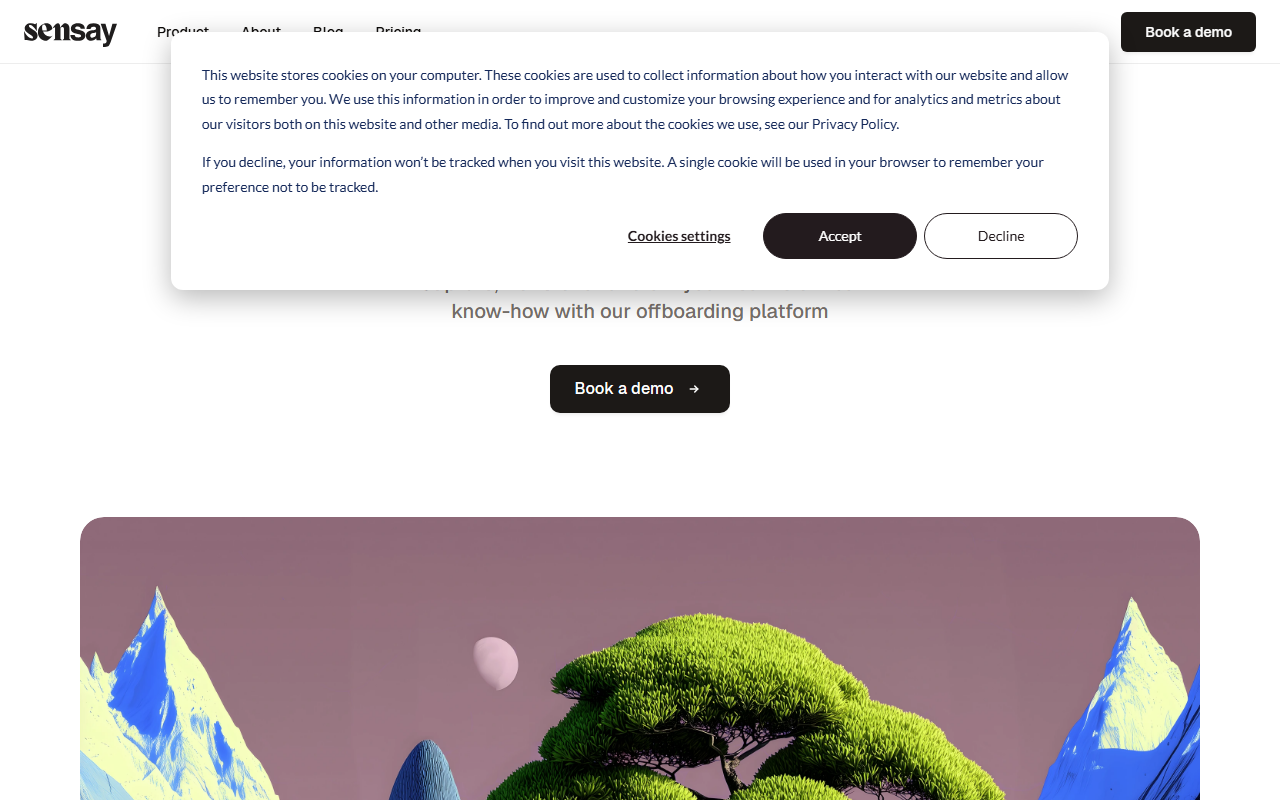
Upon visiting the Sensay website, the first thing I noticed is the emphasis on a single, focused problem: the knowledge that walks out the door when an employee leaves. The tagline, “Capture, transfer and retain your team’s critical know-how with our offboarding platform,” sets a clear expectation. This isn’t another generic knowledge base or collaboration tool; it’s specifically designed for the offboarding moment. The site prominently features a video of “Sophia,” an AI interviewer, explaining how the system works. Sensay claims that over 200 companies already use the platform. The design is clean, with bold statistics (e.g., $31 billion annual cost of knowledge loss) to drive home the pain point.
Exploring further, I found no public pricing page—only a “Book a demo” button. This immediately suggests an enterprise‑focused product with custom pricing. The homepage does, however, list key metrics: 95% knowledge retention rate, 40% faster onboarding for replacements, and 3x ROI in reduced training and knowledge‑search time. While impressive, these numbers lack independent verification, and I’d want to see case studies to back them up.
How Sensay Works – From Setup to Knowledge Retrieval
The workflow described on the site is straightforward. First, you “set up your organisation” in minutes—presumably defining roles, teams, and categories. Next, you invite employees who are leaving, and the system schedules an interview with Sophia, the AI interviewer. Sophia then conducts a voice‑based interview designed to capture “role nuances and tacit knowledge.” This is the core differentiator: instead of having a departing employee fill out a static exit form or write documentation, Sensay uses an AI that can ask follow‑up questions, probe for details, and structure the output.
After the interview, the captured knowledge becomes accessible via Slack and Microsoft Teams integrations. Your team can query it any time, or generate custom documents on demand. During my review, I watched the embedded demo: Sophia’s voice sounds natural, and the interview flow seems to adapt based on the interviewee’s responses. One user testimonial states, “It feels like you’re really talking to a human.” This conversational approach is a smart way to lower the barrier for employees to share their expertise willingly.
From a technical standpoint, the platform uses AES‑256 encryption at rest and TLS in transit, with role‑based access controls. That’s reassuring for handling sensitive institutional knowledge. However, I didn’t see mention of any underlying AI model (e.g., GPT‑4, custom LLM) or whether the system offers an API for custom integrations beyond Slack and Teams. This lack of transparency around the core technology is a minor drawback for technically inclined buyers.
Strengths, Limitations, and Market Position
Sensay’s primary strength is its laser focus on the offboarding problem. Unlike general knowledge management tools such as Confluence or Notion, which rely on manual documentation, Sensay automates the capture process through an intelligent interview. Competitors like Tettra or Guru focus on internal knowledge sharing but don’t offer a dedicated offboarding workflow. For HR teams in organizations with high turnover or critical roles, Sensay could be a game‑changer for preserving tacit knowledge.
However, there are real limitations. First, the lack of public pricing makes it difficult to evaluate ROI without a sales conversation. Small businesses or startups may find the cost prohibitive. Second, the system depends heavily on employees’ willingness to participate in an AI‑led interview. While the testimonials are positive, some people may feel uncomfortable speaking candidly to an AI—though the voice interface likely helps. Third, the knowledge captured is only as good as the interview’s depth. If Sophia misses contextual questions, critical insights might remain hidden. The site claims a “95% knowledge retention rate,” but without independent benchmarks, that number should be taken with a grain of salt.
In terms of user base, “Over 200 companies” is a modest but credible signal for a relatively new tool. The founder, Dan Thomson, is quoted emphasizing the mission to stop knowledge from disappearing. The product feels well‑suited for mid‑market and enterprise organizations where the cost of losing a single employee’s expertise is high.
Who Should Try Sensay?
Sensay is best for HR leaders in companies of 50+ employees who deal with frequent turnover or specialized roles. If you’ve ever lost a key engineer or manager and spent months trying to reconstruct their workflows, this tool is worth a demo. It’s also ideal for organizations transitioning to remote work, where informal knowledge transfer is even harder. On the other hand, if you’re a solopreneur or a small team, the lack of clear pricing and the enterprise‑oriented features may make it overkill. Similarly, if your company already has a rigorous documentation culture, you might not need an AI interviewer—though Sensay could still save time.
Overall, Sensay offers a focused, user‑friendly solution to a painful problem. The AI interviewer concept is innovative, and the Slack/Teams integrations ensure the captured knowledge is immediately accessible. I recommend booking a demo to see if the system fits your organization’s size and budget. Visit Sensay at https://sensay.io/ to explore it yourself.


Comments