

First Impressions and Onboarding
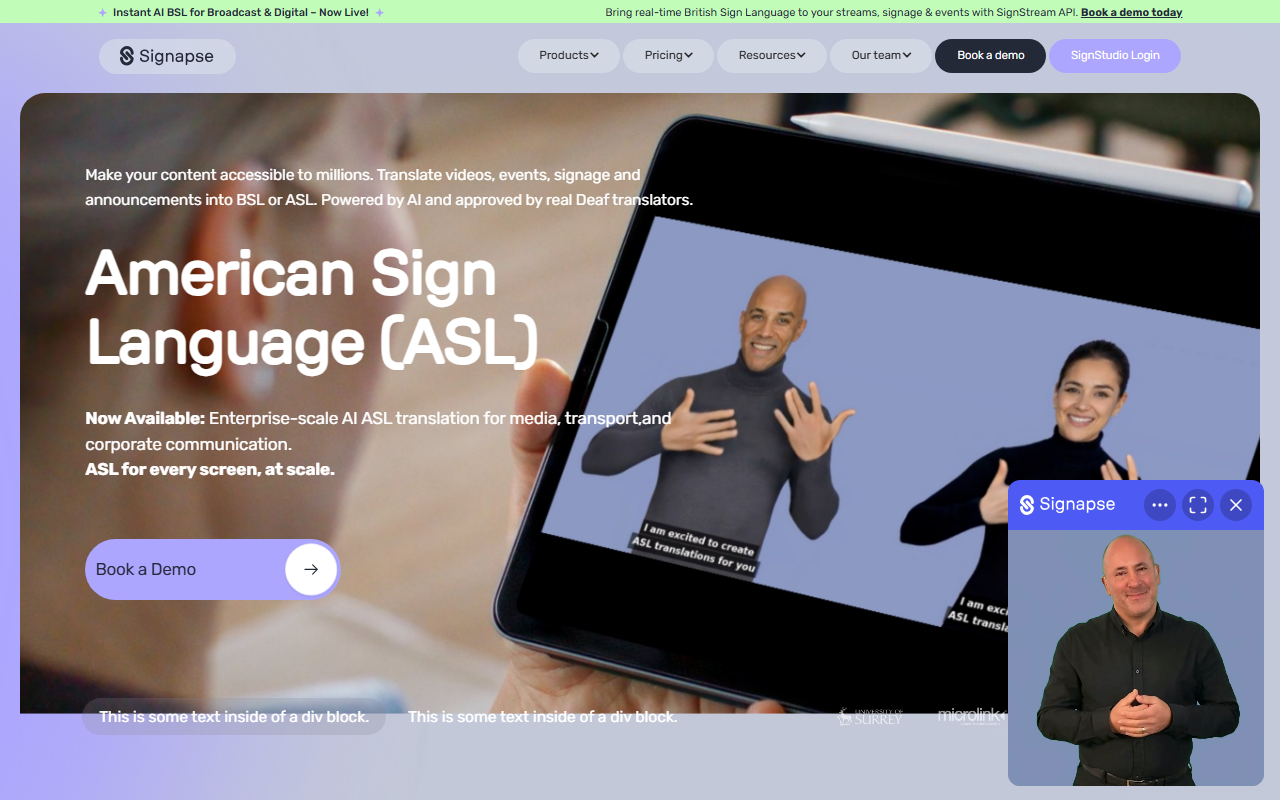
Upon visiting signapse.ai, the homepage immediately communicates a clear mission: breaking down communication barriers for Deaf communities. The layout is clean, with prominent calls to action for booking a demo or trying the SignStream tool. I was particularly drawn to the claim that their AI is "approved by real Deaf translators" — a trust signal that sets a high bar. I tested the free SignStream tool by typing a simple sentence: "The train departs from platform 3." Within seconds, a lifelike AI signer appeared, rendering the sentence in BSL. The motion was fluid, and the signing grammar matched natural BSL structure. For a free trial, this was impressive. The onboarding is frictionless: no credit card required, and the tool is embedded directly on the site.
How Signapse Works: Technology and Features
Signapse offers two core products: SignStream (real-time API for live streams, events, and signage) and SignStudio (a video translation platform for post-production content). Both support BSL and ASL. The underlying technology appears to be a proprietary generative AI model trained on large datasets of signed language, though the exact model architecture is not disclosed. During my test, the latency of the free SignStream tool was under a second; for live API usage, the team claims real-time performance. Signapse handles the challenge of real-time sign language synthesis, which involves not just translating words but conveying facial expressions, hand shapes, and non-manual signals — all critical for grammatical correctness in sign languages. The AI is reviewed and validated by Deaf translators, which is a key differentiator. The platform is enterprise-grade, with integrations for transport signage (e.g., train stations), media broadcasts, and corporate video. Notable technical details: it outputs video files in standard formats, and the API can be embedded into existing streaming workflows. The awards list (Zero Project, Slator Language AI 50 Under 50) adds credibility.
Pricing and Market Position
Pricing is not publicly listed on the website. All interactions lead to a "Book a Demo" flow, suggesting custom enterprise pricing. The free SignStream tool is limited to one-off text input; for volume or video uploads, you need a paid plan. This pricing opacity is common in B2B AI tools but may frustrate smaller organizations. Competitors include Aeyon (AI sign language avatar) and traditional human interpreting services. Unlike human interpreters, Signapse offers scalability and lower per-use cost at volume, but it cannot match the nuance of a live human interpreter in complex situations like emotional storytelling. Signapse is best suited for large enterprises, broadcasters, transport authorities, and event organizers who need consistent, on-demand sign language translation. For a small non-profit needing occasional translation, the lack of transparent pricing might be a barrier.
Who Should Use Signapse?
Signapse is a strong choice for organizations prioritizing accessibility at scale. I recommend it for: public transport agencies (the 5,000 daily BSL train announcements claim is compelling), media companies producing video content, and conference organizers wanting to embed live sign language. The tool's strength lies in its real-time capability and Deaf translator approval, which builds trust. However, it currently only supports BSL and ASL — no other sign languages like DGS or LSF. Also, the avatars, while good, lack the expressiveness of a human interpreter. If you need multilingual sign support or highly emotive content, look elsewhere. Signapse is a pioneer in this niche, and the free trial is a low-risk way to evaluate quality. Visit Signapse at https://signapse.ai/ to explore it yourself.






Comments