

First Impressions and Onboarding
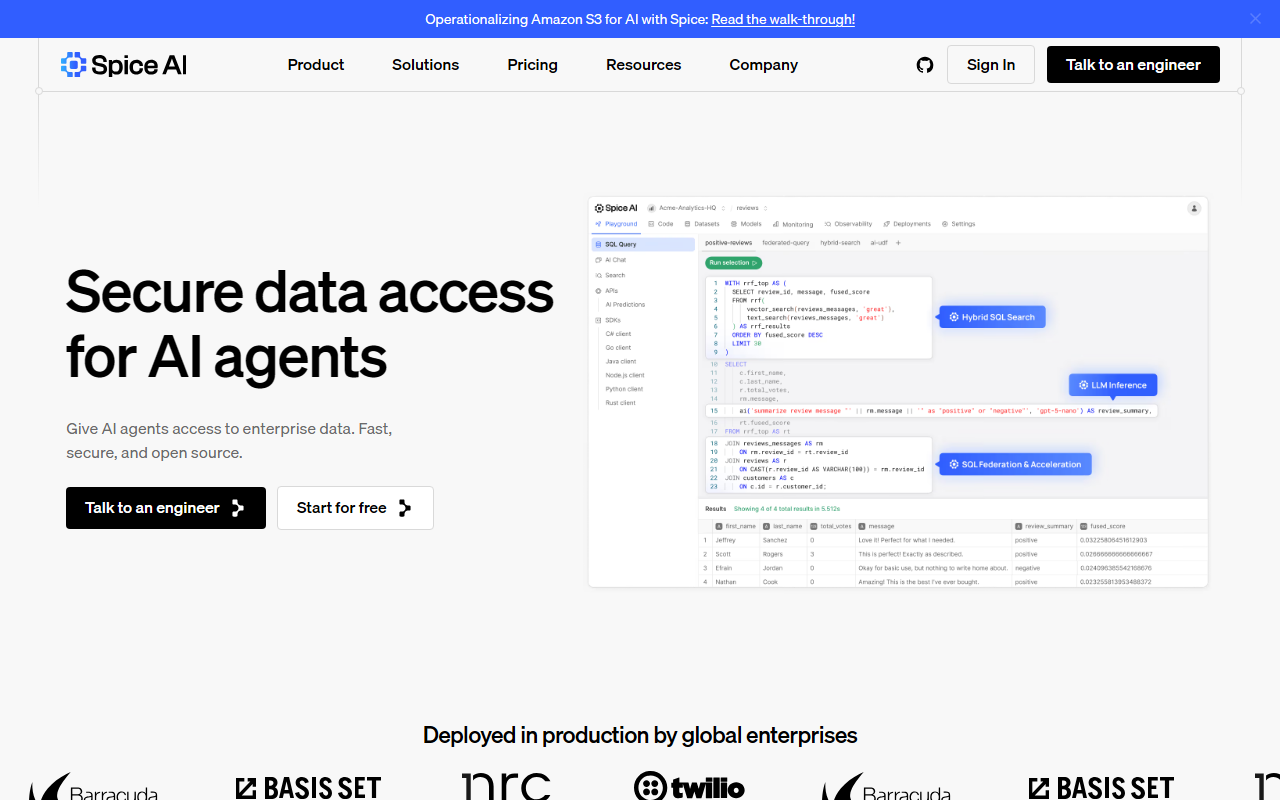
Upon visiting the Spice AI website, I immediately noticed a clean, developer-centric design. The hero section promises "sub-second query performance" and "up to 80% lower lakehouse spend," which sets a high bar. Below that, an interactive 30-second walkthrough (no signup required) lets you test core functionality – a smart touch that reduces friction. The dashboard is not shown directly, but the product appears to be both an open-source runtime and a managed cloud platform. I was able to quickly find the "Start for free" button, which leads to a sign-up flow for the cloud tier, while the OSS version can be deployed locally or at the edge. The site includes a cookbook with over 80 guides, so finding a starting point seems straightforward. For a platform targeting developers, the documentation and demo links are prominently placed, which I appreciate.
Core Features and Technical Depth
Spice AI is not just another data pipeline tool; it is a data platform purpose-built for AI context. Its standout capability is SQL Federation & Acceleration: you can connect to operational databases, data lakes, and warehouses, then materialize working sets in-memory or on disk for millisecond access. The site claims up to 100x faster queries – an ambitious but plausible figure given the in-memory acceleration. Another key feature is Hybrid Search, which combines keyword, vector, and full-text search using standard SQL. This lets you rank structured filters, semantic similarity, and keyword matches in a single query, which is critical for RAG pipelines and AI agents that need grounded, context-aware results.
The third pillar is Embedded AI Inference: you can call hosted or local LLMs directly from the query layer using SQL UDFs or natural language. This means you can generate summaries, classify entities, or translate text without leaving the Spice runtime. Under the hood, Spice leverages distributed observability with end-to-end tracing across SQL, embeddings, search, and LLM calls – useful for debugging and measuring latency. The platform also offers AI sandboxing and security with least-privilege datasets, which addresses a common pain point for enterprises that need to keep governance intact while enabling RAG workflows.
From a technology standpoint, Spice appears to use its own lightweight runtime written in Rust (inferred from its open-source repos), which explains the low resource footprint and portability. The platform is deployable anywhere: locally, at the edge, or on the managed cloud. Pricing is not publicly listed on the website beyond a "Start for free" option, which likely implies a freemium model with paid tiers for scale and support. This lack of transparency might frustrate some evaluators, but enterprise users can request a demo or talk to an engineer.
Market Positioning and Alternatives
Spice AI sits in a space where traditional data platforms (like Databricks, Snowflake, or ClickHouse) are being repurposed for AI workflows, but often with heavy ETL and latency overhead. Unlike Databricks, which focuses on lakehouse analytics and ML training, Spice is narrower: it optimizes for real-time AI inference and serving rather than batch processing. Another competitor is MindsDB, which also allows SQL-based machine learning and model serving, but Spice differentiates itself with deep federation, hybrid search, and a strong open-source ethos. The platform is already in production at well-known companies like Twilio, Barracuda, and NRC Health, which lends credibility. Twilio’s software architect noted that Spice opened the door to take critical control-plane datasets and move them next to services in the runtime path – a clear testimonial for latency-sensitive use cases.
The product is best suited for teams building AI agents, search-driven apps, or real-time personalization features that need to query diverse data sources without moving data. Developers who want an open-source, self-hosted alternative to vendor lock-in will find Spice appealing. However, organizations that require a full-fledged data warehouse with complex ETL pipelines or heavy ML training might need supplementary tools. The platform’s reliance on SQL federation means it works best when your data sources are SQL-accessible; for unstructured blobs or streaming event sources, you may need additional middleware.
Verdict and Recommendation
Spice AI is a genuinely innovative platform that addresses a real pain: grounding AI in enterprise data with minimal latency and maximum flexibility. Its strengths include sub-second query speed, unified SQL across sources, hybrid search, and embedded LLM calls – all wrapped in an open-source, portable runtime. The interactive walkthrough and comprehensive cookbook make it easy to explore. The limitations are the lack of transparent pricing for the cloud tier and the narrow focus on serving rather than batch processing. If you are building AI applications that need fast access to federated data, Spice is worth a serious look. I recommend starting with the free tier to test its federation and acceleration capabilities. For enterprises already in the Databricks or Snowflake ecosystem, Spice can complement those stacks rather than replace them. Visit Spice AI at https://spice.ai/ to explore it yourself.






Comments