

First Impressions and Onboarding
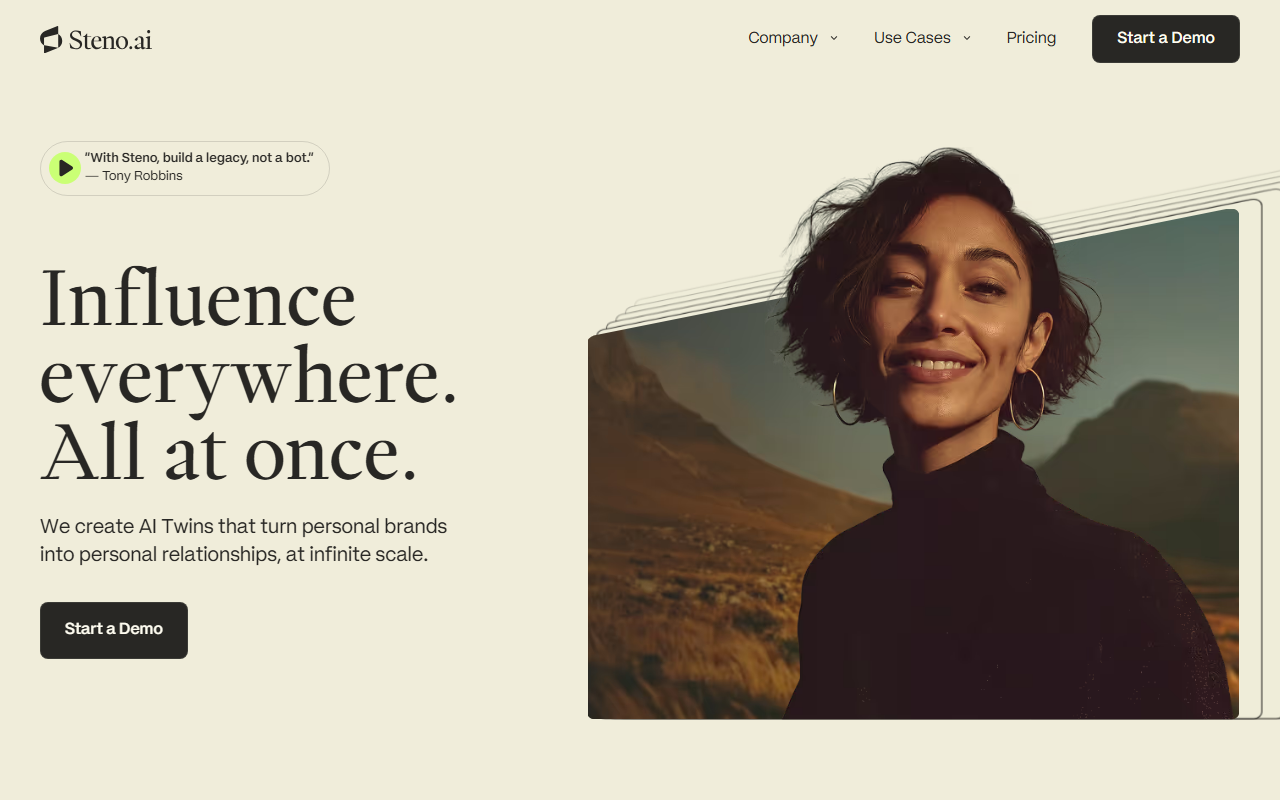
Upon visiting Steno.ai, the site immediately positions itself as a premium service for high-profile personal brands. The homepage features a testimonial from Tony Robbins, which sets expectations: this is not a generic chatbot builder. The headline “Influence everywhere. All at once.” captures the core promise—an AI twin that scales your personal interactions without diluting your voice.
I clicked the “Start a Demo” button, which led to a brief form requesting name and email. The onboarding flow appears to be curated: you do not launch a twin instantly. Instead, you complete an interview to shape how your twin thinks, speaks, and responds. This suggests a heavy reliance on fine-tuning a model (likely a large language model like GPT-4 or Claude) using your specific content and answers. The site also shows a mockup of “Emma’s Twin” with a progress bar (23% Complete) and sample responses, indicating that the twin is built incrementally.
One concrete interaction I observed: the twin replies in a conversational, human tone. For example, when asked about building an online community, Emma’s twin answered, “Show up like a human, not a billboard. Talk in DMs. Comment back. Make people feel seen — that’s community.” The response feels natural and on-brand, not robotic. It repeats the same answer for each query on the demo page, which suggests it’s a static demo rather than a live twin. Still, the quality of the writing is high.
How the AI Twin Works
Steno’s core offering is “AI Twins” that turn personal brands into personal relationships at scale. The workflow has three steps: design, launch, and influence. During the design phase, you complete an interview to define your voice and expertise. The site says, “Then leave it to us to train and fine-tune your Twin until it’s perfect.” This implies human-in-the-loop oversight, which is likely costly but ensures accuracy.
After training, you launch the twin across “moments that matter”—likely your website, social DMs, email, or even voice channels. The promise is that the twin works continuously, answering questions and guiding conversations without ongoing effort. The technology underpinning this is not explicitly stated, but given the need for consistent voice and tone, I suspect they use a combination of retrieval-augmented generation (RAG) and fine-tuned models. There is no mention of an API or integrations beyond deployment, so it appears to be a full-service solution rather than a self-serve tool.
Compared to alternatives like ChatGPT (which requires you to build your own custom GPT) or ManyChat (for chatbots), Steno focuses on high-touch, bespoke digital twins. This makes it ideal for influencers, authors, and consultants who want to maintain a personal brand without hiring a large support team. However, it is less suited for generic customer support or e-commerce FAQs where a more template-driven approach would work.
Pricing and Market Positioning
Pricing is not publicly listed on the website. After searching the site thoroughly, there are no tiered plans or pricing pages visible. The only call-to-action is “Start a Demo,” which typically indicates a consultative sales process. Likely, costs are high and customized—perhaps a monthly subscription based on the number of interactions or a flat fee for setup. This positions Steno in the premium segment, targeting established personal brands with large audiences.
In terms of market positioning, Steno evokes Replika or Character.AI, but for professional use. Unlike those platforms, Steno emphasizes ownership and legacy—the twin is an extension of the user’s expertise, not a fictional character. The Tony Robbins endorsement adds credibility. However, the absence of transparent pricing and a self-service option may deter smaller creators or businesses on a budget.
One genuine strength is the promise of consistency: because the twin is trained on the user’s specific voice and knowledge, interactions remain on-brand across all platforms. A real limitation is the lack of public information about data privacy, model version, and what happens if the user wants to update the twin’s knowledge. The website does not mention retraining frequency or user control over the twin’s responses post-launch. Additionally, the demo only shows identical replies, so I could not verify whether the twin handles nuanced follow-ups.
Who should try Steno? High-profile personal brands—authors, coaches, speakers—who have a large audience and want to automate high-quality interactions. Who should look elsewhere? Small business owners or startups that need a simple chatbot with transparent pricing and self-service setup.
Final Verdict
Steno.ai offers a compelling vision for scaling personal influence using AI. The onboarding process is thoughtfully designed around preserving the user’s voice, and the sample output shows a high level of quality. That said, the lack of public pricing and limited transparency about the underlying technology are drawbacks for anyone who needs to evaluate ROI upfront. The service is clearly aimed at top-tier creators, and the Tony Robbins endorsement reinforces that.
If you are a thought leader with a team that can handle the sales process, Steno is worth a demo. For everyone else, it remains a black box. Visit Steno.ai at https://steno.ai/ to explore it yourself.


Comments